Can You Really Spot AI Art? Visible Clues, False Positives, and Better Verification
Spotting AI art is not a magic-eye puzzle with one secret answer. Visual oddities can tell you where to look, but reliable judgment comes from combining the image, its context, and the evidence behind it.
Start with a clue, not a conviction
You notice six glossy fingers, an earring that melts into a jaw, or lettering that appears to have lost an argument with the alphabet. The image may be AI-generated. It may also be compressed, stylized, edited, poorly drawn, or simply made by a human having a difficult Tuesday. The first useful rule is therefore modest: an odd detail is a reason to inspect, not a verdict.
That distinction matters because the familiar tells are becoming less dependable. Hands, teeth, text, reflections, and repeated textures were once generous sources of obvious errors. Newer systems often handle them better, while deliberately simple, painterly, or low-resolution images may contain too little detail for any visual shortcut to work. Research on human recognition of synthetic images also finds that performance varies with the image and the generation method rather than behaving like a universal visual superpower.
The practical goal is not to win a guessing game. It is to decide what level of confidence the available evidence can honestly support. A suspicious finger can start an inspection, but it should not be promoted to chief detective before lunch.
A suspicious finger can start an inspection, but it should not be promoted to chief detective before lunch.
What a visible clue can tell you, and what it cannot
The useful question is not merely whether a feature looks strange. It is whether several features fail in ways that share the same underlying logic.
| Screening clue | Why it may matter | Common false positive |
|---|---|---|
| Hands, teeth, ears, jewellery | Small structures require consistent count, attachment, depth, and symmetry | Stylization, motion blur, foreshortening, disability, or ordinary drawing mistakes |
| Text and symbols | Letter shapes may imitate writing without preserving language or repeated spelling | Decorative type, damaged signage, foreign scripts, low resolution, or deliberate abstraction |
| Reflections, shadows, lighting | Objects should share a plausible light direction and reflected geometry | Composite photography, studio lighting, retouching, or a physically unusual scene |
| Repeating patterns and textures | Tiles, fabric, windows, foliage, and crowds may mutate instead of repeating coherently | Compression, shallow depth of field, painterly brushwork, or handmade irregularity |
| Edges and object boundaries | Straps, glasses, hair, fingers, and furniture may merge or terminate without structure | Motion, transparency, reflections, masking, collage, or low-quality reproduction |
A 90-second visual inspection that does not overclaim
Use three passes. Each pass asks a different question, which is more reliable than staring harder at the same suspicious thumb.
- Read the whole compositionBefore zooming in, ask whether the scene has a coherent subject, spatial hierarchy, and point of view. AI imagery can be locally convincing while the overall scene feels assembled from several plausible ideas that never quite agreed to meet. Do not confuse an unusual composition with an impossible one; merely mark the areas that deserve a second look.
- Trace structures through spaceFollow one object at a time. Does a chair leg reach the floor? Does a necklace pass behind the neck correctly? Do window frames, picture frames, shelves, and reflected objects preserve their geometry? Structural continuity is often more informative than beauty, because attractive colour can distract from an object quietly giving up halfway across the image.
- Compare independent systemsCheck anatomy, light, text, material behaviour, and repetition separately. One failure may be noise. Three unrelated systems failing around the same region create a stronger screening signal. Record the observations in neutral language: 'the reflected handle does not match the visible handle' is better than 'obviously fake.'
False positives are not a footnote; they are part of the method
Community discussions about how to identify AI art repeatedly return to the same problem: artists also draw unusual hands, simplify anatomy, reuse textures, paint impossible light, and make errors. A visual language that is rough, naive, surreal, heavily filtered, or intentionally flat may resemble the shortcuts people associate with generators. Accusing a person on one clue can therefore punish precisely the experimentation that art is allowed to contain.
Compression creates its own little theatre of suspicion. Social platforms resize images, sharpen edges, smooth skin, and destroy fine text. Screenshots add another generation of damage. If a clue appears only after aggressive zooming into a reposted JPEG, ask whether you are inspecting the artwork or the journey it survived to reach you.
A better habit is to name alternative explanations before increasing confidence. Could the anomaly come from perspective, an edit, a scan, a lens, a material, a disability, a stylistic decision, or missing pixels? This does not mean every image becomes unknowable. It means confidence should rise only when alternatives become less plausible across several independent checks.
Move from appearance to evidence
Visual inspection is the first rung. When the decision matters, climb higher.
- The image itselfUse visible anomalies as screening signals. Save the original resolution if possible and distinguish what you observed from what you inferred. This is useful for triage, but weak for attribution on its own.
- The surrounding contextCheck the account history, upload date, caption, corrections, other versions, reverse-image results, and whether reputable reporting has traced the image. During fast-moving news, context can be more revealing than pixels because false captions often travel with real images and convincing images can travel without any source at all.
- The creator's processAsk for sketches, iterations, layer history, contact sheets, working files, material tests, printing decisions, or an explanation of how the work changed. None is impossible to imitate, so process evidence should be judged as a coherent sequence rather than one screenshot of a software window.
- Provenance and accountable identityFor a physical work or a purchase, connect the named maker or studio, the specific object, the transaction, and the continuing record. A certificate of authenticity for art can help identify a claim, but it works best alongside consistent object details, invoices, archives, and reachable people.
Treat an AI detector score as one measurement, not a confession
Automated detectors can be useful for screening large sets or adding one more signal, but their results depend on the model, image type, compression, transformations, and decision threshold. Academic evaluations continue to test how detectors generalize to unfamiliar generators and ordinary image modifications. A tool that performs well on one benchmark can become less dependable when the image has been cropped, recompressed, edited, or produced by a newer system.
If you use a detector, record its name, date, input file, result, and limitations. Compare more than one kind of evidence rather than shopping for the score that agrees with your suspicion. A percentage in a neat box can look very official; so can a weather forecast five days from now.
A percentage in a neat box can look very official; so can a weather forecast five days from now.
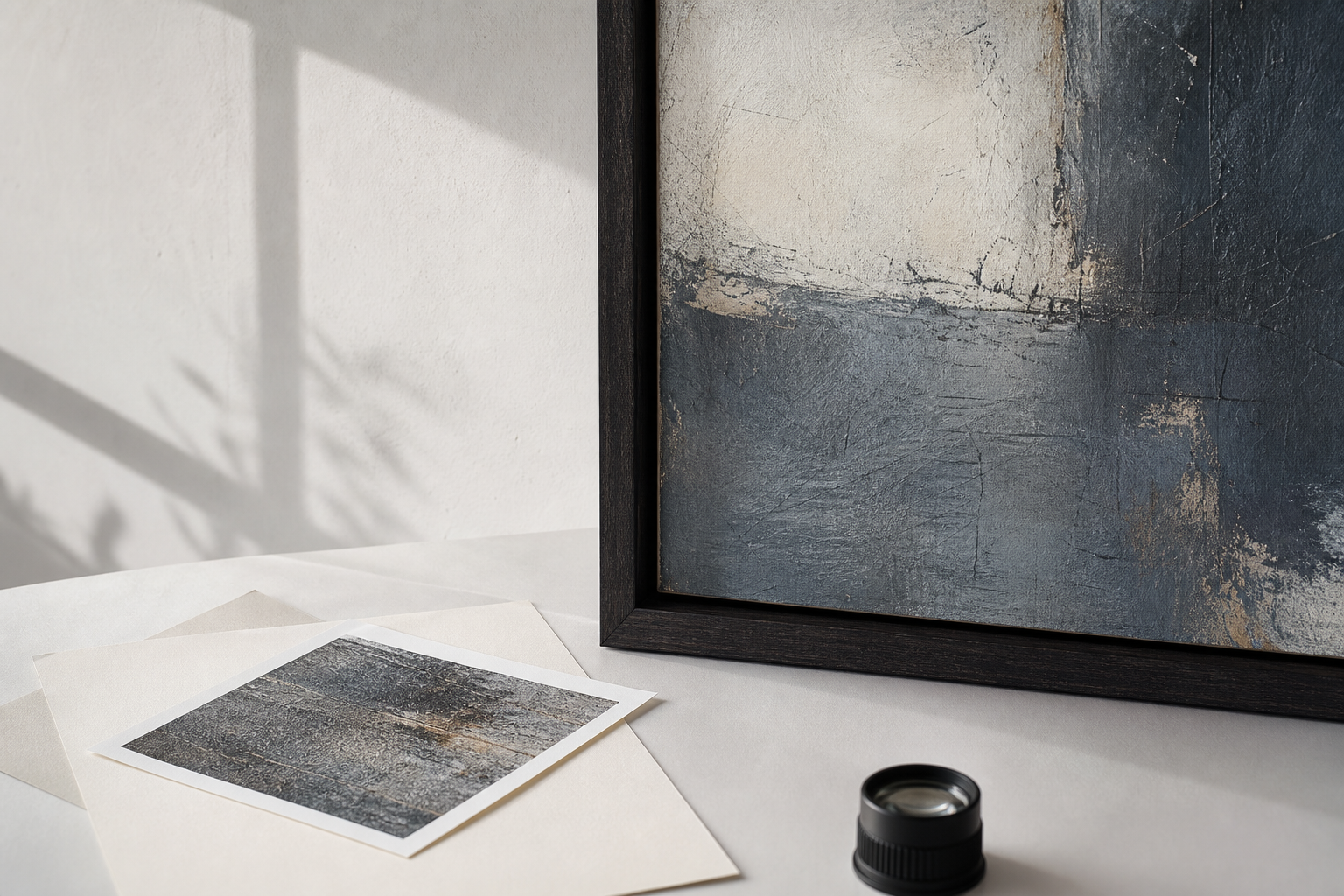
The frame may be handsome, but it keeps declining invitations to testify.
For a buyer, the better question is what the seller can make inspectable
When money, authorship, or a physical object is involved, 'does this look generated?' is only part of the decision. Ask what exactly is being sold, who stands behind it, how the final object was selected and produced, whether the description is transparent about tools, and which records will remain with the work. The frame may be handsome, but it has declined every invitation to testify.
Whispart's own studio position treats machine generation as one stage inside selection, refinement, physical production, naming, and individual object identity. That is a first-party practice, not a universal rule for AI art. Readers should inspect the particular work and the particular seller. The useful standard is accountability: can the claims be traced to an identifiable process and object rather than resting on the glow of a category label?
The same logic applies to documentation. A certificate of authenticity for art does not settle every question, but it can make a claim, issuer, and object easier to identify when used with the rest of the record.
A clue tells you where to look. Evidence tells you how confident you are allowed to be.
A practical rule for judging synthetic imagery
Questions people ask about spotting AI art
What is the easiest way to spot AI art?
There is no single reliable shortcut. Begin with structural continuity: anatomy, object boundaries, geometry, lighting, text, and repeating patterns. Confidence should increase only when several independent clues agree and contextual evidence supports the same conclusion.
Are strange hands proof that an image is AI-generated?
No. Strange hands are a screening clue, not proof. Human artists, perspective, motion blur, stylization, image damage, and ordinary mistakes can produce similar results. Check other structures and the image's context before drawing a conclusion.
Can AI image detectors be trusted?
They can contribute one signal, especially in controlled workflows, but results vary with the detector, generator, file quality, compression, edits, and threshold. Keep the original file and combine detector output with visual, contextual, and provenance evidence.
Can layers or a time-lapse prove a person made the image?
They can strengthen a coherent process record, but one screenshot or clip is not impossible to fabricate. Look for a plausible sequence of decisions, iterations, source material, revisions, and a consistent relationship between the creator and the final work.
What should I ask before buying AI-assisted art?
Ask what the physical or digital object is, how it was selected and refined, how tools are described, who is accountable for the claims, what documentation accompanies it, and whether the seller can connect the listing to a specific identifiable work.