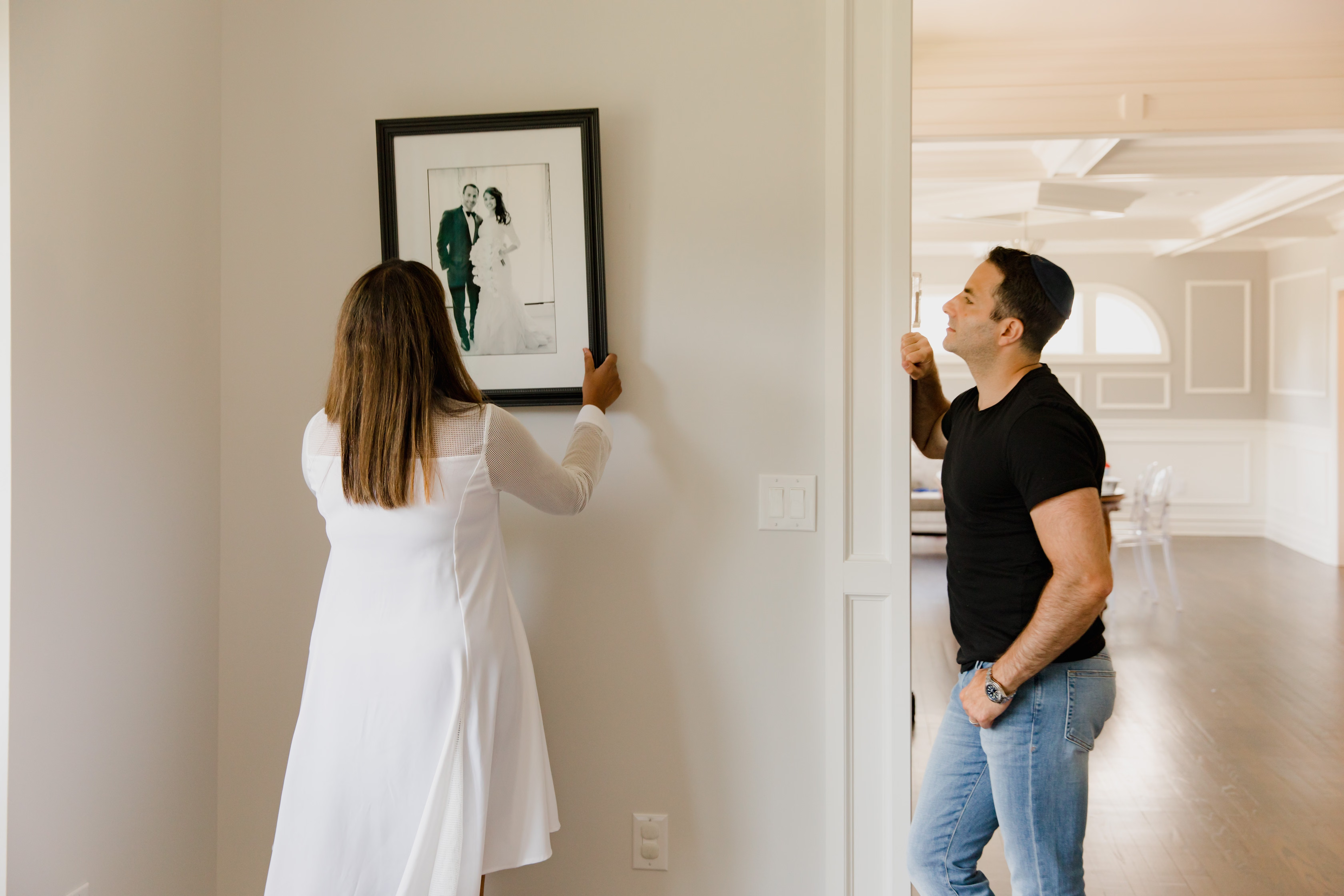
How High Should You Hang Wall Art? A Practical Measurement Guide for Every Room
The best wall-art height is usually not a magic number. Start with the centre of the artwork, then let the furniture, sightlines, and the way you use the room make the final adjustment.
How high should wall art hang from the floor?
Wall art usually looks more settled when you measure to the centre of the artwork rather than to its top edge. Several placement guides use a 57-60 inch centre-height starting point for a typical standing-view room. That shared range is useful because it gives you a place to begin without pretending every ceiling, sofa, and viewer has signed the same contract.
Think of it as a mark on the wall, not the final answer. A work that is particularly tall, a room you mostly experience while seated, or a long hallway can all make a small adjustment sensible. The goal is not to defend a number. It is to make the artwork feel intentionally placed when you enter the room and when you use it.
This also takes some pressure off the drill. You do not need to solve every exception before you start. Find a reasonable centre mark, test it with the actual frame or a paper outline, and only then decide whether the room is asking for a modest change.
Find the mark before you think about the hook
Separate the visual measurement from the hardware measurement. That one distinction prevents a very common last-minute surprise.
| Check | What to do | Why it matters |
|---|---|---|
| Artwork centre | Measure the full framed height and locate its halfway point. | This is the visual reference point the room responds to. |
| Starting mark | Put a small removable mark at your proposed centre height. | It gives you something simple to test before calculating hardware. |
| Hanging point | Measure from the top of the frame down to the installed hook or wire position. | The hook is usually not at the visual centre, so it needs its own calculation. |
| Final check | Hold or tape the outline in place and view it from normal positions. | It catches a placement that is mathematically tidy but visually awkward. |
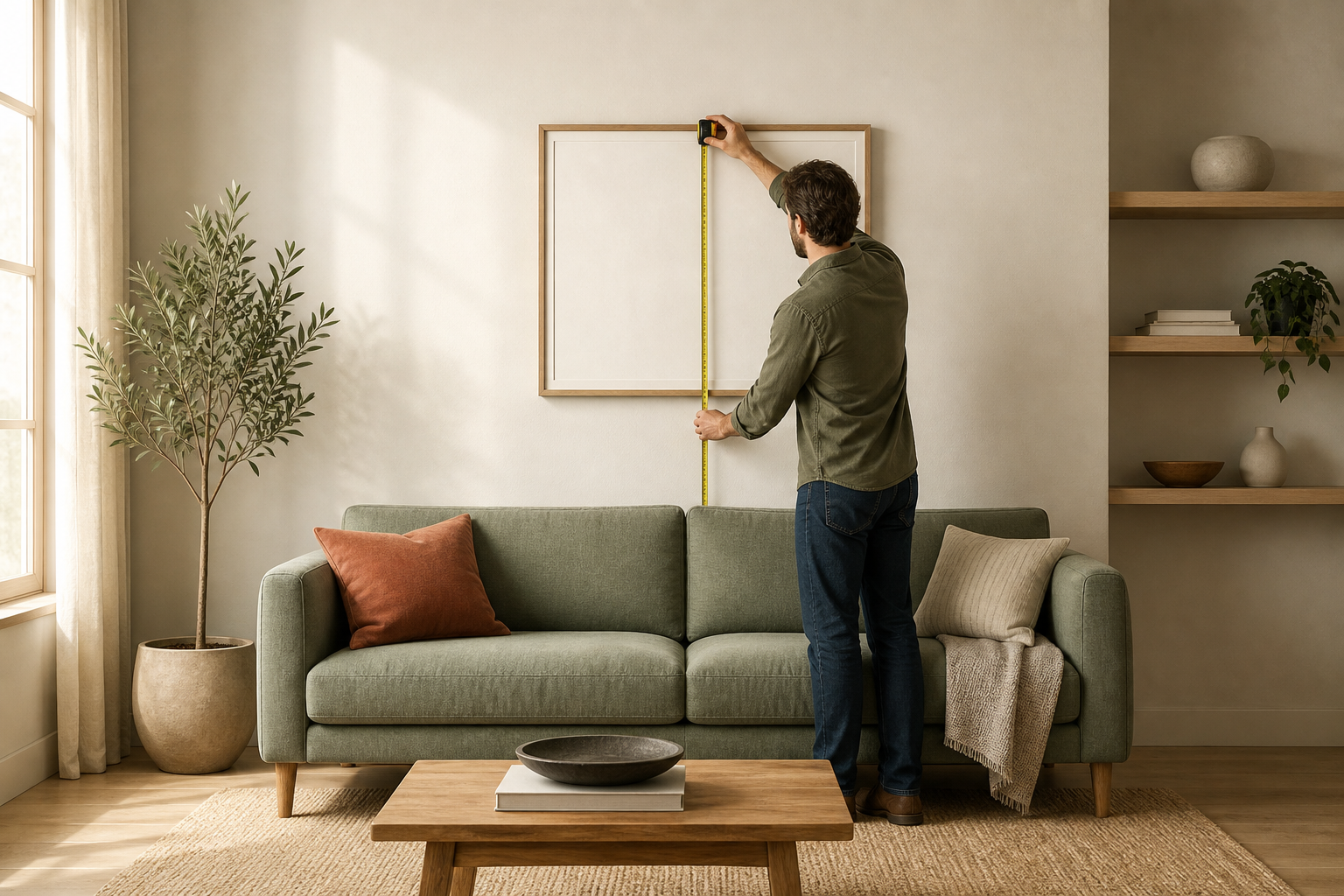
How high should wall art hang above a sofa, console, or desk?
Here is where a centre mark and a furniture check become different jobs. A height that feels comfortable on an empty wall can still make art look as though it has floated away from a sofa or console. Placement guides therefore treat the relationship between artwork and furniture as a second visual check: look at the bottom edge of the frame and ask whether the two elements still read as one conversation.
Do not turn that into a competing rulebook. If lowering the frame makes it feel crowded, return to the centre mark and change only one thing at a time: height, artwork size, or the relationship to the furniture. A wide piece can be the right height yet still feel undersized; a well-proportioned piece can feel wrong simply because it is too high. Naming the actual problem is much more useful than buying extra decor in a panic.
For a desk, work from the view you have while using the desk as well as the doorway view. For a console in a passage, protect clear sightlines and avoid letting a low frame compete with lamps or a tall vase. In a room with tall ceilings, resist the urge to make a small work climb the wall just to occupy more blank space.
Use the room to refine the starting mark
| Situation | What to inspect | A small, useful adjustment |
|---|---|---|
| Open wall | Whether the work feels comfortable at standing eye level. | Begin with the centre mark and avoid overthinking it. |
| Above a sofa or console | The visual gap between the frame bottom and the furniture. | Move the whole work a little only if it feels detached or crowded. |
| Desk or reading chair | The seated view and any lamp, monitor, or shelf below. | Check the normal-use viewpoint before deciding the standing view wins. |
| Hallway | Sightlines from both approaches and nearby door frames. | Keep the work readable in motion rather than forcing a living-room arrangement. |
| Tall ceiling | The scale of the artwork itself, not empty height alone. | Consider a larger or taller piece before moving a small one too far upward. |
Do this tape test before you make holes
A five-minute reversible test is much cheaper than a confident-looking patch of filler. The aim is to see the placement from the room, not from six inches away.
- Mark the proposed centre.Use painter's tape or a light removable mark at the first centre-height position.
- Map the outside edges.Tape the frame outline, or hold the actual framed work at the mark if you have a second pair of hands.
- Add the furniture check.If the work hangs over furniture, tape the lower edge and look at the gap before you calculate the hardware.
- Walk to the places that matter.Look from the doorway, across the room, and from the seat or desk you use most. Each view catches a different kind of awkwardness.
- Adjust one variable once.If it floats, try a modest lower position. If it feels crowded, try a modest higher one. If it still looks weak, the issue may be width rather than height.
If it still feels wrong, fix the right variable
A frame that feels too high usually needs a height adjustment, not more accessories beneath it. A frame that feels timid above a long sofa may be at a perfectly sensible height but too narrow for the furniture. In that case, use our wall-art size guide for a living room to decide whether one larger piece, a pair, or a compact group solves the real problem.
That order matters. Height is about where the composition sits. Size is about whether the composition has enough visual presence. Keep those decisions separate for a moment, and the room becomes much easier to read.
Choose the work after the wall has given you a brief
Once your tape outline looks calm from the views you actually use, you have a practical brief: approximate height, orientation, and the amount of wall presence you need. That is a better starting point for browsing than hoping a product photo has quietly solved your room for you.
If you are ready to look for a piece, you can browse physical framed artwork with that brief in hand. The collection is an optional next step; your wall measurement remains the decision-maker.
Questions people ask before they hang the frame
Should I measure to the top of the frame?
Start with the artwork centre instead. The top edge changes dramatically with frame height, while the centre gives you a more stable visual starting point. Then calculate the hook location separately from the hardware on your actual frame.
Should art be centred on the wall or on the sofa?
When the sofa is the visual anchor, begin by centring the composition on the sofa. Shift only when an architectural feature or a deliberately asymmetrical arrangement gives you a clearer reason.
Does every room need the same centre height?
No. The centre mark is a starting point for a typical standing-view room. Use a tape test to check a seated room, passage, low furniture, tall ceiling, or unusually large work before you drill.
What if the frame is already the right height but still looks small?
That is probably a scale question rather than a height question. Check the horizontal span of the artwork or group against the furniture below it before moving the frame farther up the wall.