How Is AI Art Made? A Plain-English Guide to Prompts, Models, and Human Choices
AI art is made through a chain of input, learned visual patterns, generated options, and human decisions. Here is the process in ordinary English—no lab coat required, and the toaster may keep its spectacles.
Start with the chain, not the button
When people ask how AI art is made, they often want a tidy little answer: somebody types a prompt, a computer makes a picture, curtain down. That is a fair beginning, but it is too small for the whole play. A prompt can set a direction—subject, mood, palette, composition, or a stubborn request for 'less gloomy, please'—yet the image appears through a model that has learned visual patterns from training data. A person then decides whether any result is worth developing. The process is closer to briefing, exploring, editing, and presenting than to pressing a vending-machine button.
That distinction matters whether you are a curious maker or a buyer looking at a finished piece. It helps you ask better questions. What idea guided the work? Which results were selected? What was refined? How was the image ultimately presented? Those are more useful questions than trying to squeeze an entire creative history into the word 'prompt.'
How AI art moves from an idea to an image
At the technical center is a generative system: machine learning models are trained on data and can produce new content, including images. In a text-to-image workflow, a written description gives the system a direction for the kind of image it should attempt. That does not mean the system rummages through a filing cabinet for one hidden picture. It uses learned relationships among visual features and language to construct a new result. If 'neural network' makes you picture a toaster wearing spectacles, you are in decent company; the useful point is simply that the model has learned patterns rather than a set of literal paint strokes.
The input can be text, but it can also be shaped by tool settings, references, iterations, or later editing. The practical takeaway is modest and important: text-to-image models respond to descriptions by producing image possibilities, not a certified record of one person's imagination. Results can differ when the wording, settings, model, or sequence of choices changes.
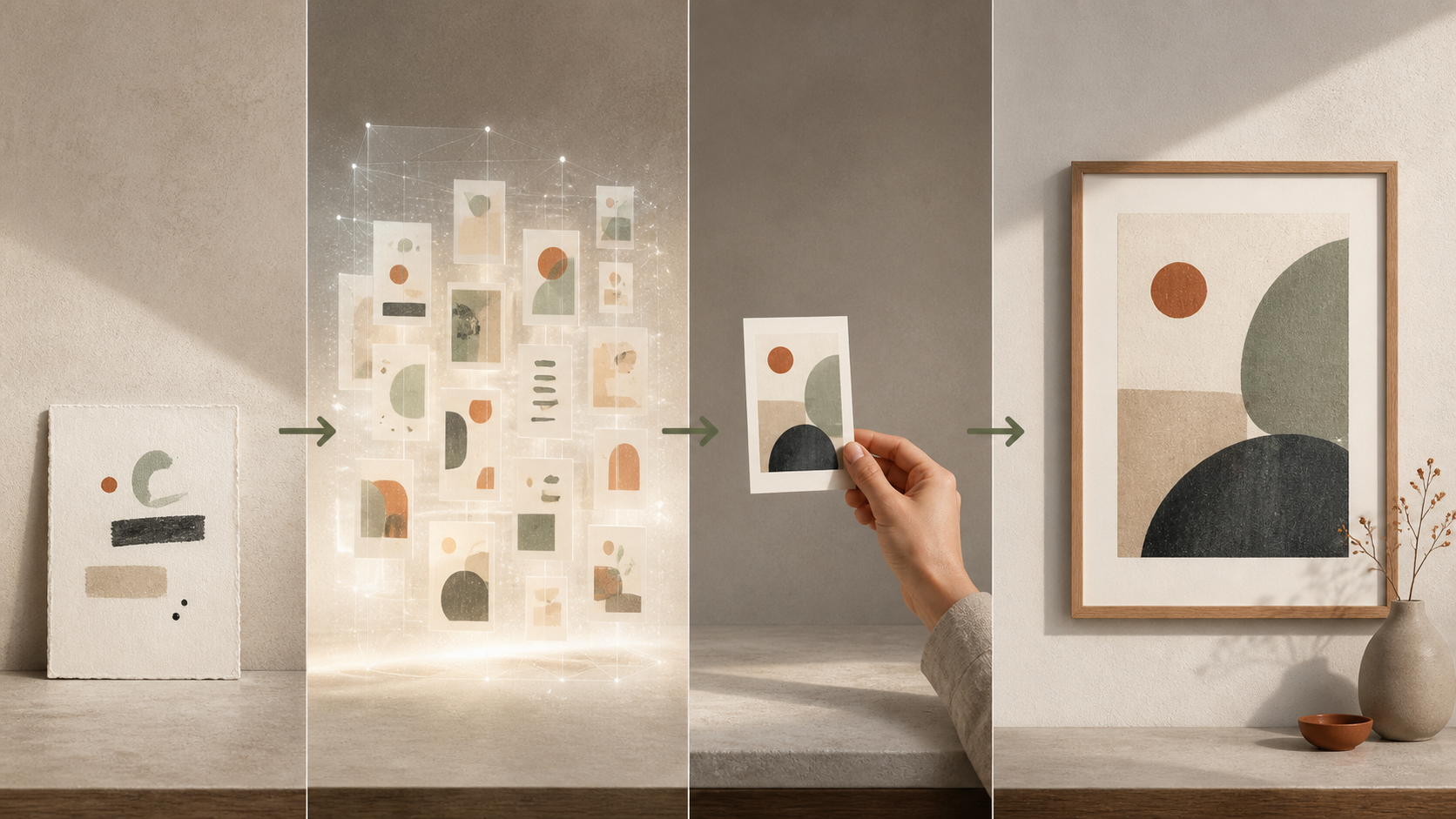
The sequence is deliberately simple. It does not rank the stages or claim that every artist uses the same route; it makes the handoffs visible. That is useful because the most interesting questions usually sit at those handoffs: how a direction becomes an input, how a field of outputs is narrowed, and how one selected image becomes a work someone can encounter.
Where human choices enter
Human input can happen before generation, during exploration, and after a result appears. Someone can set an intention, write or revise instructions, compare variations, reject near-misses, combine directions, choose a final image, and decide whether it belongs in a series. None of those choices makes the model disappear; nor does the model make the choices evaporate. It is usually more honest to describe the chain than to award the whole trophy to one link. If you are judging an image by appearance, our guide on how to spot AI art explains why visual clues also need careful context.
For a physical work, the chain can grow longer. Whispart describes its own studio process as model training and image generation followed by human selection, refinement, naming, production, framing, quality control, and packaging. That is a first-party description of one studio practice, not a rule for every AI-assisted work. A buyer can still ask which of those steps applied to a particular piece—and that is a much livelier question than treating an image as if it wandered into the room unattended.
A prompt is important, but it is not the whole job
Think of the prompt as a brief inside a larger workflow. Handy, influential, and occasionally dramatic—but not the only person in the family photo.
| Part of the process | What it does | What it does not settle by itself |
|---|---|---|
| Idea or prompt | Provides direction about subject, mood, style, or constraints. | Whether the final result is the best option or how it should be presented. |
| Image model | Generates possibilities from inputs using learned patterns. | A single universal definition of authorship, ownership, or artistic value. |
| Human selection and refinement | Narrows options and shapes the final direction. | Every legal outcome in every jurisdiction. |
| Physical presentation | Turns a selected image into a particular printed, framed, or otherwise finished object. | The technical history of every prior generation step. |
Process is not a legal conclusion
It is tempting to use a simple process description as a shortcut to a copyright answer: 'a person typed it, so it is protected,' or 'a model helped, so nothing counts.' Real questions are more fact-specific. The U.S. Copyright Office has published materials on AI and copyright, and its approach places human authorship at the center of the analysis. That makes this a good place for careful language, not victory-lap language.
Federal registration guidance likewise addresses works containing AI-generated material and explains why the human-authored portion and the relevant facts matter. For a fuller reader guide, see our discussion of can you copyright AI art; for a decision about a real work, contract, or jurisdiction, consult qualified legal advice. Paperwork is useful, but it cannot be bullied into becoming a crystal ball.
How to evaluate AI art without oversimplifying the process
If you are considering an AI-assisted artwork, try these questions. They are less flashy than a hot take, but they tend to survive the trip home.
- Ask about direction.What idea, brief, or series concept guided the work? This reveals intent without demanding a novelist's diary of every keystroke.
- Ask about selection.How were image possibilities reviewed and narrowed? Selection is often where a broad output field becomes a specific artistic decision.
- Ask about refinement.Was the selected result edited, developed into a series, or prepared for a particular visual outcome? The question is about process, not a purity test.
- Ask about the physical object.If you are buying a print or framed work, what are the production and presentation details for that object? A digital image and a physical artwork are related, but not identical.
- Keep legal questions in their lane.If your question is copyright, licensing, ownership, or registration, seek current, qualified guidance for the relevant facts and jurisdiction.
Frequently asked questions about how AI art is made
Does AI art begin and end with a prompt?
No. A prompt can be a useful starting direction, but the process can also include settings, iterations, selection, editing, sequencing, and a decision about whether any output deserves to become a finished work.
Is every AI art workflow the same?
No. Tools, inputs, models, and human workflows vary. The four-stage map is a way to ask clear questions, not a claim that every system or artist follows one identical recipe.
Can an AI-generated image become a physical artwork?
Yes, an image can be selected and then produced as a physical object, such as a print or framed work. The physical work adds its own production and presentation decisions to the earlier generation process.
Does knowing the process settle copyright?
No. A process description helps clarify what happened, but legal questions about copyright or ownership are fact-specific and can depend on jurisdiction. Treat this guide as context, not legal advice.