Art Deco Art: Three Real Works and One Speakeasy Wall Choice
A gold fan print can suggest the era, but it cannot explain it. Look at three dated decorative works, then use what you actually see to make one honest, contemporary wall-art decision.
The short answer
Art Deco describes a broad modern design language that flowered in the 1920s and 1930s across objects, images, interiors and buildings. Strong geometry and repeated rhythm matter, but so do stylized flowers, figures, curves and new ways of working with material. A fan or a coat of gold alone cannot date or authenticate a work. If you are choosing art now, describe a new piece as Art Deco-inspired unless it is a documented period work; judge it by its particular composition, authorship and fit, not by a label on a product listing.
The Art Deco Society of Los Angeles places the style’s full expression around 1925–1940 and explains the movement’s geometry alongside stylized organic forms. Christie’s movement guide also traces its reach beyond painting into furniture, jewellery and architecture. We use three actual collection objects below because those visual differences say more than a generic mood board. The objects are study references, not artworks WhispArt sells or proposes to hang in a bar.
Look closely at three real Art Deco works
1. Paul Fehér: a figure inside disciplined metal rhythm
Designed by Paul Fehér and made by Rose Iron Works in 1930, Muse with Violin Screen is a large ironwork screen, not a framed print. Begin with the stepping and curving metal lines around the central figure. The flowers and leaves are recognizable, yet reduced to crisp, deliberate shapes. Dark gaps make the silver lines readable; the composition feels ordered without becoming a grid of identical fans. The Cleveland Museum of Art’s record identifies its geometric patterning, stylized natural forms and central figure as classic Art Deco features.
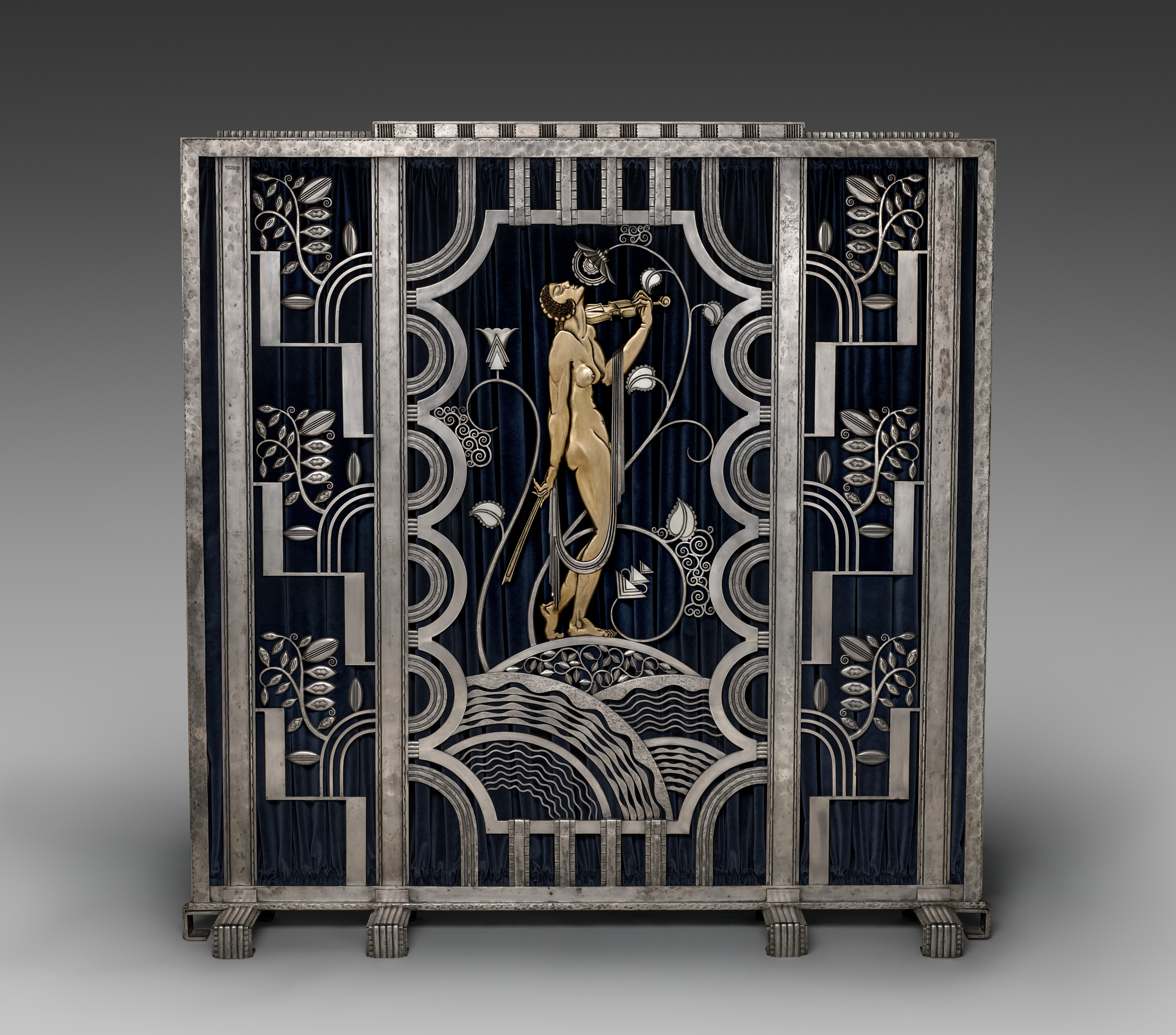
For a new picture, the useful lesson is not “copy this screen.” It is that a focal figure and a decorative border can coexist when the background gives each line space to register.
2. R. Guy Cowan: a figurative work can still be Art Deco
R. Guy Cowan’s 1928 ceramic Adam and Eve is the counterexample to the idea that Art Deco means only straight edges. The figures stretch into long, flowing poses; the orange glaze and repeated curves carry the rhythm. Its subject is narrative rather than abstract. The museum calls it a masterpiece of the American Art Deco aesthetic. You need not want its subject in your own room to learn from its shape: a style can be recognizable without reducing every image to a motif.
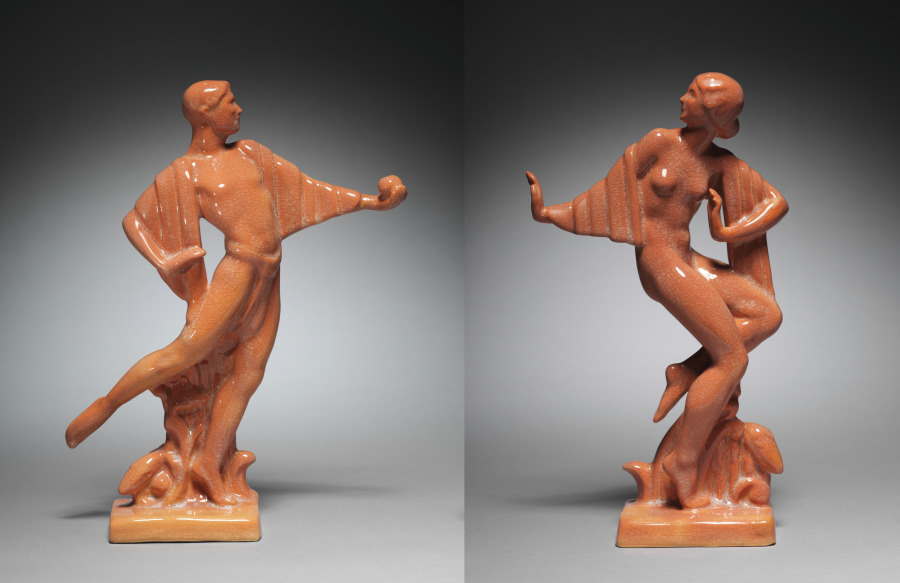
This is why we would ask what an image does with form and material before deciding whether its title or subject “matches” a themed room.
3. An anonymous textile: repetition with structure
An anonymous Dutch maker’s printed tablecloth, dated 1920–1930 in the Rijksmuseum collection, shows another route. Follow one beige angular shape across the black field and notice how its return changes direction inside the border. It has a limited palette, but it is not visually empty. The museum identifies it as an Art Deco pattern and marks the object public domain. Again, this is a textile, not a ready-to-buy wall print.
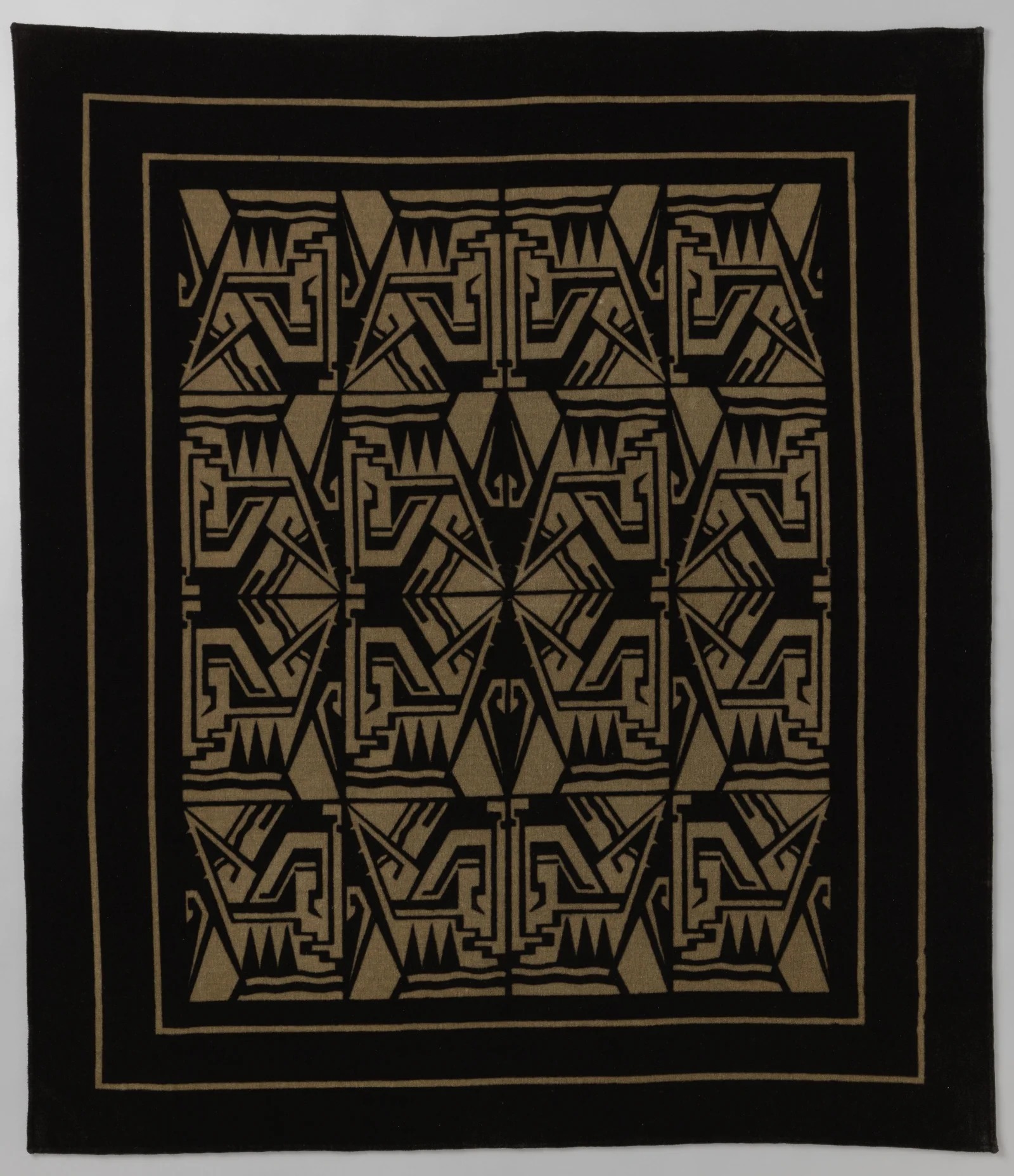
The textile is useful because it makes the difference between rhythm and mere repetition visible. A repeated shape can still have changes in scale, direction and boundary.
Historical work, reproduction or inspired new art?
These are three different things. A dated object with a museum record can be described as a historical Art Deco work. A reproduction is a new image of that object; its making, credit and reuse rights need their own check. An artist working today can make original art informed by Deco geometry or stylized nature, but its date remains today. We would rather label that honestly than imply a new picture was made in the 1930s.
“Geometric” is not a sufficient test. One Art Deco discussion disagreed over whether a contemporary geometric drawing was genuinely Deco or merely Deco-inspired. A separate speakeasy detail discussion compared period fit, metal color and whether an element would show against a dark room. Those are individual judgments, not a style tribunal. They prompted a better editorial question: which particular visual relationship survives in the actual room?
The comparison with Art Nouveau also needs care. Christie’s describes Art Nouveau’s more fluid natural lines and Art Deco’s stronger geometry; Fehér’s screen shows that Art Deco did not abandon nature. It disciplined and stylized it. The period, maker and object record do more to establish a historical identity than one shape does.
A speakeasy wall: our choice
Now imagine a fictional small speakeasy with one dark booth wall, two warm sconces and a normal seated view from across the table. Nothing here is a measured WhispArt project. We keep that wall and furniture fixed and compare two proposed art directions. A repeats three small, nearly identical gold-fan prints. B uses one newly commissioned, contemporary picture with a stepped geometric top, a spare stylized plant form and a quiet dark field. The illustration shows the intended relationship, not a finished or purchasable artwork.
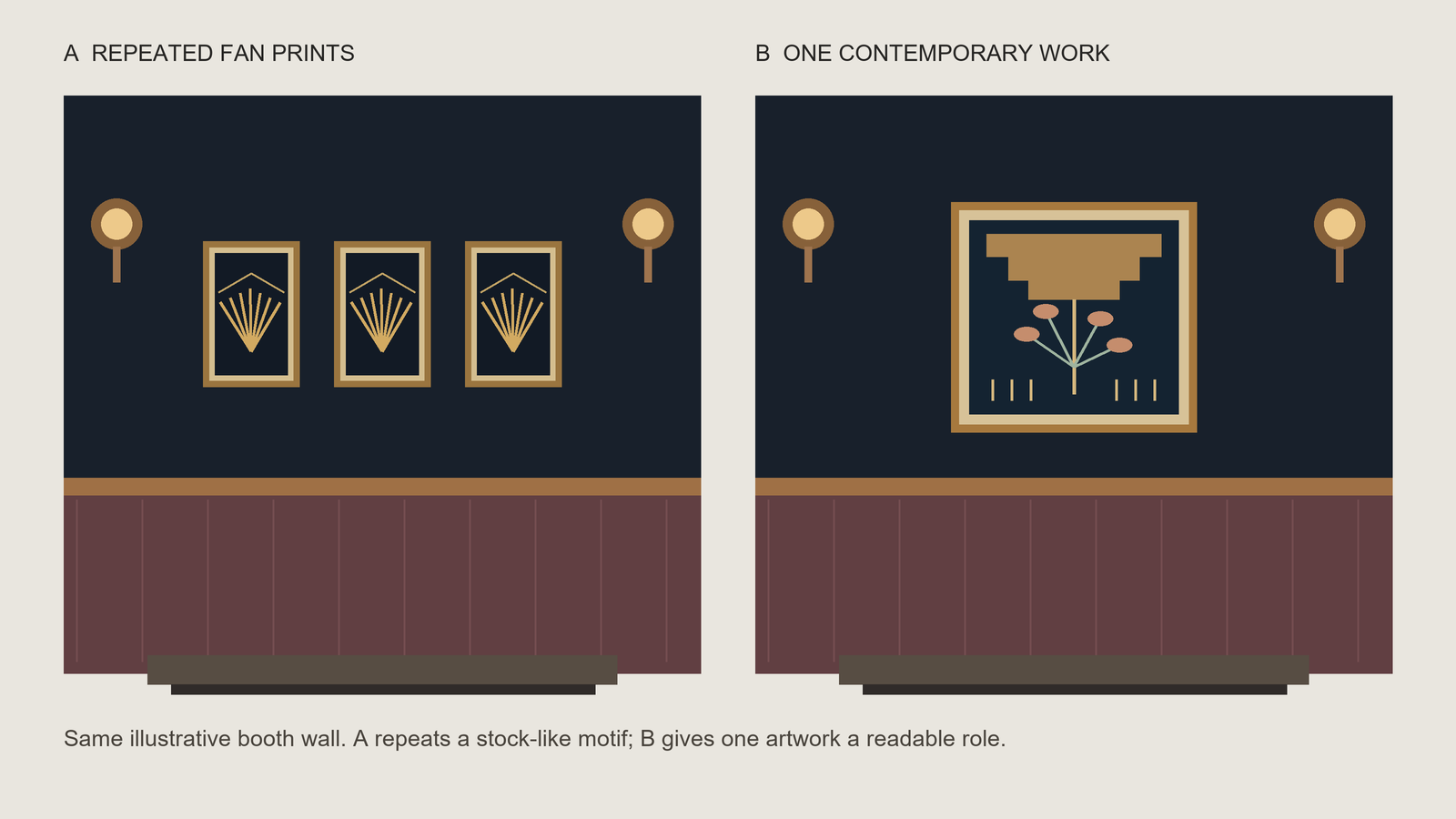
We would choose B for this brief. The source objects make the choice more specific than “add something gold”: Fehér’s screen suggests B’s relationship between geometry and a stylized plant. Cowan’s ceramic shows the breadth of the style beyond flat pattern, and the textile shows how repetition can be structured; neither is a motif reproduced in B. The imagined picture borrows these questions—what repeats, what changes, where does the eye rest—without copying any one object. One focal artwork also remains easier to recognize from a seated position in this illustration. The cost is less decorative sparkle; if the operator wants a dense, theatrical wall, we would test a different multi-work arrangement rather than assume B is universal.
This is a visual recommendation, not an authenticity certificate or a lighting specification. We would ask the artist for an original concept and rights terms, check the wall and mounting with the appropriate installer, then view a full-size sample under the room’s actual evening lighting from both the booth and the approach. If the shapes disappear in the dark, change contrast, scale or placement. If the operator instead wants to reproduce a historical image, confirm the particular image’s rights and credit before use; do not infer permission from the age of the object alone.
FAQ
Is every gold geometric print Art Deco art?
No. Geometry or metallic color can suggest the style, but neither verifies a period, maker or historical object. Look for a documented record when calling a work historical; label a newly made picture Art Deco-inspired when that is what it is.
Did Art Deco artists use figures and flowers?
Yes. Fehér’s 1930 screen uses a central musician and stylized leaves within a geometric metal structure. Cowan’s 1928 ceramic is figurative and rhythmic. Art Deco is broader than a fan or a zigzag.
May I print a museum image for a commercial room?
Check the specific object image’s rights, permitted use and credit requirements at the holding institution, as well as any artist or photographer rights that apply. The three images in this article have verified public-domain or CC0 collection status for this publication; that status does not automatically extend to every Art Deco image or to a product made from it.
How do I choose art for a dim speakeasy booth wall?
Test the actual framed size and contrast under evening light from the seat and entry route. For the illustrated wall we prefer one distinct contemporary work over three repeated small motifs. A brighter or larger work, different placement, or a deliberate multi-work wall could win in another room.
Is a contemporary Deco-inspired commission less legitimate?
No. It is a different category from a period original. We value honest authorship and a work composed for its room over a vague claim that new decor is “authentic 1920s.”
Sources and image notes
Historical context: Art Deco Society of Los Angeles and Christie’s Art Deco guide. Object identity and image status: Cleveland Museum of Art screen, Cleveland Museum of Art ceramic, and Rijksmuseum textile; the Rijksmuseum’s reuse policy explains its open images. The museum works are educational examples, not WhispArt inventory or proposed reproductions. The speakeasy and both pictures in its comparison are original editorial illustrations, not a customer venue. Linked Reddit conversations express individual questions and differing preferences; they are not representative survey findings.