Op Art: What Is Moving When the Picture Stays Still?
Op Art makes a still picture feel less settled than it is. A grid can seem to bend inward; neighboring shapes can suggest a pulse or a change of depth. The useful question is what belongs to the painted construction, what belongs to our experience of looking, and what is actually changing in the artwork.
We would begin with that distinction before choosing an optical work for a room. An image with visual energy and an artwork that changes over time offer different kinds of attention.
What is Op Art?
Op Art, short for optical art, uses arrangements of shapes, lines and colors to produce optical effects. Tate’s definition places its emergence in the 1960s and names Bridget Riley, Victor Vasarely and Jesús Rafael Soto among its leading artists. Geometric structure matters because the relationship between marks can make a surface appear unstable, deeper or more active than its physical state.
That history is broader than a black-and-white checkerboard. Color can participate, and optical concerns can meet sculpture and kinetic art. Here we look at three later works to make those relationships visible. They are contemporary examples, rather than a substitute for the movement’s historical works.
A painted route into depth
Start with the black and cream checkerboard in Henrique Matos’s Optical Motion VII – Journey into Space. Follow a broad ribbon of cells toward the tight turn near the upper left. Then compare it with the angular compartment at the lower right.
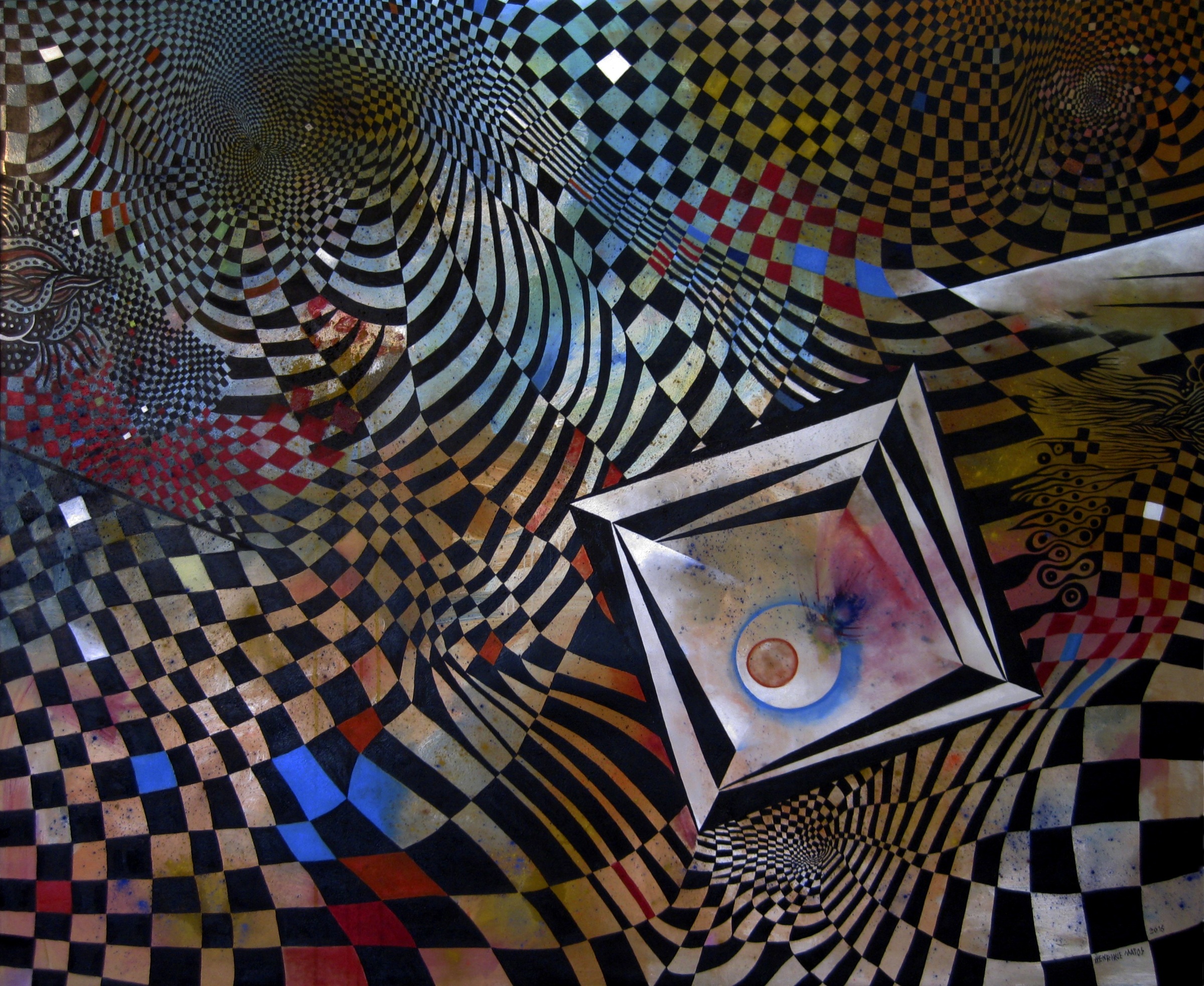
The changing widths and directions make the surface read as a route into space. The lower-right compartment offers another spatial cue: light and dark triangles surround a rounded form. Those are painted relationships in this reproduction. The picture file is not rotating, and the apparent compartment is not evidence of a box projecting from the canvas.
Our first description would be “a fixed checkerboard bending into a painted depth.” That is more useful than simply calling it moving. It names something another person can find in the image, even if they do not experience the same sensation of motion.
Optical structure can share a picture with loose paint
In Matos’s Optical motion II, follow the checkerboard around the outside, then look at the irregular field it surrounds. The rough red, gray and green passages do a different job from the ordered cells.
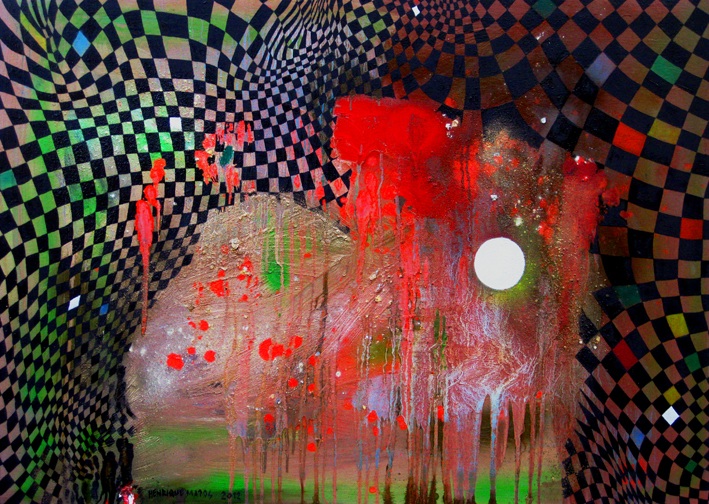
The bending grid suggests recession; the central paint feels less governed by a repeated unit. The small white circle supplies a comparatively simple shape among those interruptions. We find the meeting of those two treatments more interesting than treating the whole image as one uniform optical trick.
It also changes how we would browse. Someone who likes the distorted grid but wants visible irregularity could look for optical painting with gestural passages. Someone who wants the repeated structure to dominate would keep looking. Neither preference establishes how the artist made every edge: neat geometry alone does not prove a computer, tape or a particular studio process.
Some of the depth is physically there
Now compare the painted rings in Youri Messen-Jaschin’s Spiral with the edges and shadows of its wooden cells, especially along the bottom rows.
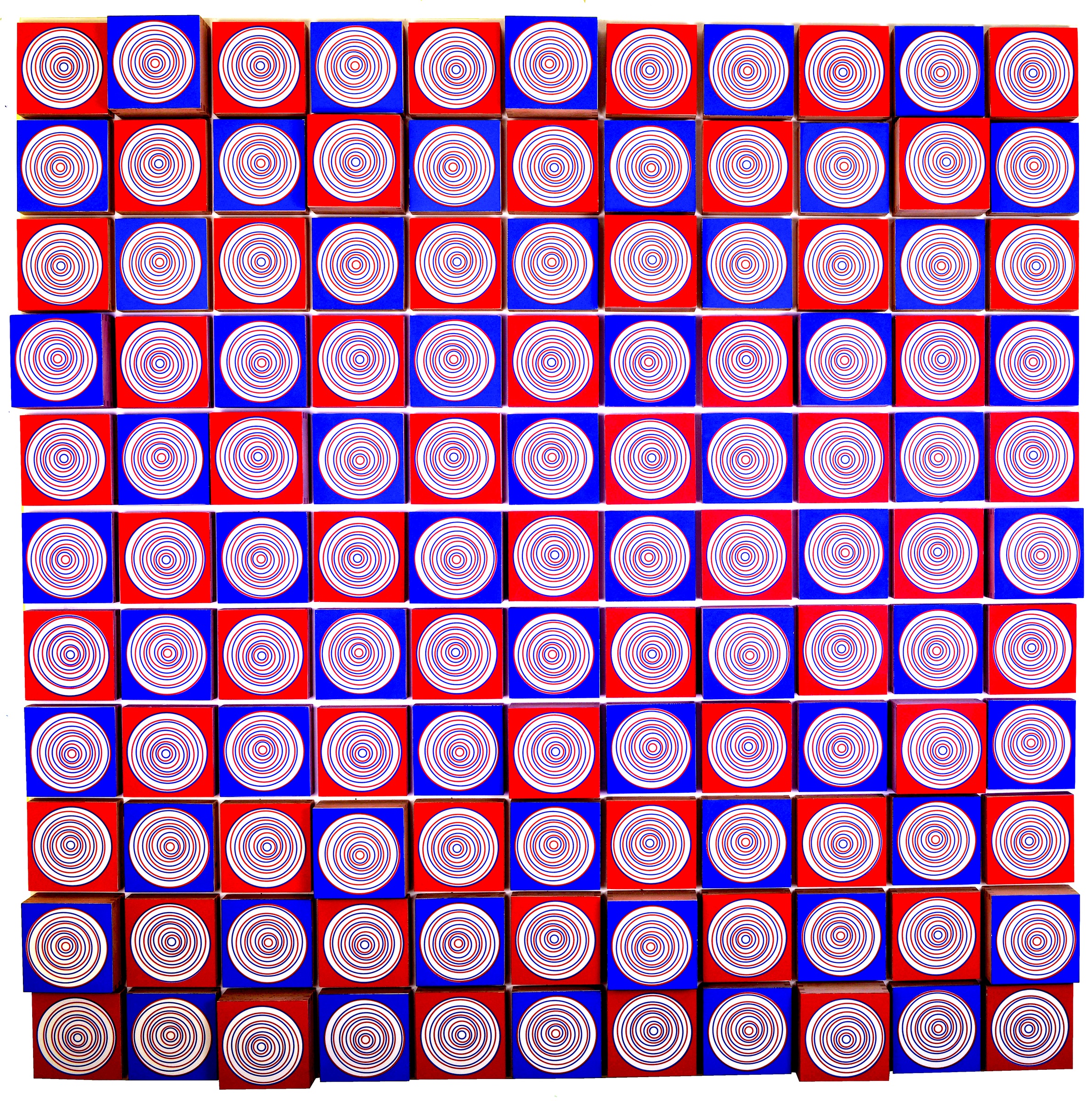
The rings repeat, but the photograph also shows real relief. Projecting cells have edges and cast shadows. We would describe the pattern and the wood structure separately; calling all of this depth an illusion would miss part of the object.
A different viewing position can change how a three-dimensional object appears without making the object itself move. This single photograph, however, does not demonstrate a sequence of viewpoints or a moving mechanism. It supports a close look at the relief we can see.
Op Art and kinetic art can overlap. The practical distinction is the source of the change: a fixed painted arrangement, a fixed object seen from another position, a physically moving component, or a changing image on a screen. These are observations about a work’s behavior, not four exclusive art movements.
An animated optical image is a different object
A loop made from an optical pattern changes its displayed frames over time. That is actual change in the image sequence, even if the source painting stays still. A moving online adaptation therefore cannot show, by itself, exactly how the original painting behaves.
We would check the original work’s record and the adaptation’s credit before describing either. The artist who made a painting and the person who animated a reproduction may be different people. A familiar visual effect is not enough to identify its author.
What we would choose for a dance-club rest area
Imagine a small rest area where the brief is a fixed artwork with visual energy: guests can return to the same image while taking a break. This is a hypothetical art-direction choice, not a report from a venue we have fitted out.
For that brief, we would choose a static optical painting direction before a changing screen program. The checkerboard passages in the Matos works show why: a fixed arrangement can offer several routes for looking without requiring a sequence of new frames. If we also wanted a less uniform surface, Optical motion II would be the more useful reference of the two.
The tradeoff is real. A static work does not supply new scenes or a timed progression. If the actual brief were changing visual sequences that unfold with the program of the evening, we would reverse the choice and consider properly credited digital or moving-image art. That would be a different medium decision, not an upgrade that every optical painting needs.
Our reference note would read: a fixed optical painting, with distorted repeated forms and some irregular painted passages; compare a more systematic alternative before deciding. It describes the desired artwork. It does not promise a particular response from every guest.
FAQ
Does an Op Art painting actually move?
A fixed painting can suggest movement or changing depth through the arrangement of its marks. Its painted surface remains fixed. A work with physically moving parts or changing screen frames introduces another source of change; optical and kinetic interests can overlap.
Does Op Art have to be black and white?
No. Color can participate in an optical arrangement. The red and blue cells in Spiral and the colored passages in the Matos paintings make that visible here.
What if I do not see the picture moving?
You can still look at the structure: where cells tighten, lines turn, colors meet or painted forms suggest recession. We would judge whether those relationships hold our attention, rather than use a particular sensation as a pass-or-fail test.
Do precise edges mean an artwork is computer generated?
No. Precision does not establish a tool or a process. Use the artist’s or museum’s documentation when process matters; do not infer it from straight lines alone.
Is an animated version the same artwork as the painting?
It may be an adaptation with different authorship and behavior. Check the original’s record, the animation credit and the medium. A looping file cannot stand in for evidence of what changes in the original object.
Sources and image credits
Tate provides the historical definition linked above. Artwork identities and image licenses are linked under each reproduction. Our looking descriptions and the hypothetical medium choice are editorial judgments. The photographs remain still, and the examples are independent works rather than WhispArt products or venue projects.
Cover: Henrique Matos, Optical Motion VII – Journey into Space. CC BY-SA 4.0. The responsive cover may show a detail; the complete reproduction appears in the article. Image proportionally resized and JPEG re-encoded.