Why Does AI Art Look Weird? A Visual Guide to the Tells Your Eye Notices
A strange hand, a too-perfect surface, or a scene that will not quite add up can make an image feel uncanny. That first impression is useful as a question—not as a verdict. This guide turns the feeling into a careful way to look.
Your eye often notices a mismatch before it can name it
The uneasy feeling is often a coherence problem. A picture may offer a plausible face, fabric, or sky in isolation, then lose the thread when you follow the relation between parts: fingers and a cup, reflections and a window, text and the object meant to carry it, or a foreground that does not share the scene's perspective. That does not make every odd detail an AI artifact. It makes it a useful place to slow down. Research on how people identify AI-generated photos and practical verification guidance both point toward caution: visual signals can assist scrutiny, but they are not a complete authorship test.
The useful distinction is between a clue and a conclusion. A clue says, “This relationship deserves another look.” A conclusion says, “I now know the image's origin.” The first can be reached by looking. The second usually needs context that the pixels do not contain: where the image was posted, what process information accompanies it, and whether a reliable source can account for it.
Look at one historical example, not a universal tell
Start at the wrist and follow the hand outward. In the image below, the skin shading and tattoo can read as convincing local details. Now trace each visible fingertip back toward the palm: the spread does not match the ordinary five-digit hand the scene suggests.
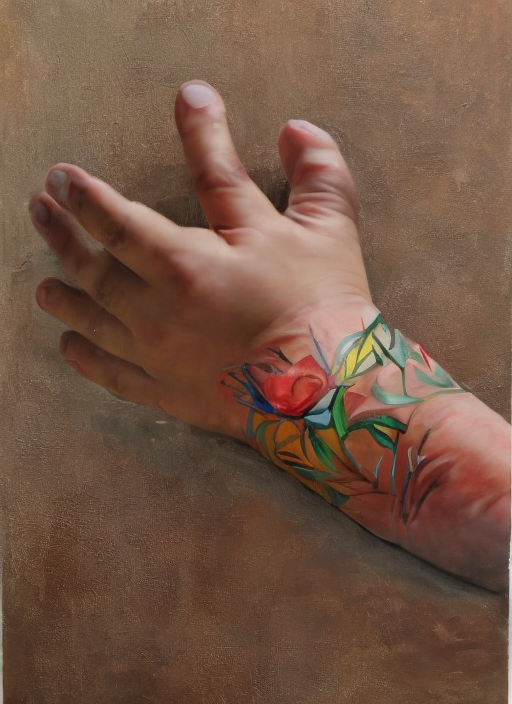
The completed observation is specific: texture and shading can feel plausible while the arrangement of parts does not fit the familiar object. That tension explains one kind of weirdness; it does not diagnose the exact training, prompting or editing cause. This single 2023 example is not a measure of current models' error rates.
The alternative explanation matters too. Human artists can deliberately add or rearrange digits, and real hands can have more than five. The source record, rather than the finger count, is what supports calling this particular upload generated. A smooth surface alone is an aesthetic impression; an arrangement that conflicts with the depicted object is a structural question. Keep those two judgments separate.
Turn the feeling into a better question
Use this as a reading aid, not a checklist that can identify an image on its own.
| What can feel off | A more precise question | What it does not establish |
|---|---|---|
| A hand, object, or texture changes logic from one area to the next | Do adjacent details agree about shape, contact, and material? | That the image must be AI-generated. |
| Lighting, reflections, or shadows pull in different directions | Can one scene explain the direction and strength of the light? | Who made the work or which tool was used. |
| A polished style repeats across otherwise unrelated images | Is this an aesthetic default, a deliberate series choice, or a platform trend? | That sameness proves a particular model or workflow. |
| Tiny text or symbols dissolve into decorative marks | Is the text functioning as language, or only as a visual texture? | That every unreadable sign is a generated artifact. |
Why familiar-looking defaults can keep showing up
It is tempting to look at a glossy, dramatic, hyper-detailed image and imagine one simple explanation for its look. In practice, recurring defaults can come from several layers acting together: the visual material a system learned from, the way a model represents patterns, the wording of a prompt, and the preferences that influence which outputs are kept, shared, or rewarded. An examination of why AI art can converge on a familiar aesthetic is useful here because it resists the idea that one visual tendency has one universal cause.
That is also why an image can look oddly generic without being visibly broken. A work may have technically tidy anatomy and still feel over-smoothed, theatrically lit, or disconnected from a particular material practice. Those reactions can describe an aesthetic response. They should not be converted into a forensic claim without additional evidence. The 2024 visual-literacy guide by Kamali and colleagues separates anatomical, stylistic, functional, physical and sociocultural cues. It presents examples rather than a universal origin test; its studied image set should not be treated as a description of every current image model.
Why a weird-looking image is not proof
Human-made work can be stylised, unfinished, compressed by a platform, photographed badly, intentionally distorted, or simply unfamiliar to the viewer. The cost of forgetting that is real. In one r/AskArtists post, a painter described sharing process material after other people labelled their watercolour portraits as AI. It is a single account, not evidence of a broad trend. It is still a sharp reminder that style alone can misfire when it becomes an accusation.
The ethical and practical response is to keep the claim proportionate to what you can show. “This detail seems inconsistent” is a description. “Can you share more context about the process?” is a question. “This was made by AI” is a conclusion that needs support beyond an impression. That difference protects both the person looking and the person whose work is being discussed.
Name the kind of weirdness before choosing a response
| Your concern | Useful response | Stopping point |
|---|---|---|
| A depicted relationship does not add up | Trace the exact attachment, count, reflection or text relationship. Name a plausible alternative such as stylization, collage or obscured detail. | Describe that mismatch without claiming to know its production cause. |
| The style feels glossy, generic or unfamiliar | Separate your taste response from a structural failure. Ask whether the treatment serves the work's intended mood. | You may dislike the look without calling it defective or generated. |
| You need to know how the image was made | Move to source and process evidence using the worked verification guide. | Leave origin undetermined when that evidence is unavailable. |
Let a first impression lead to a better question
A good visual reading does not end with a label. It starts a more specific inquiry: Is the concern about authenticity, disclosure, authorship, taste, or the cultural value of the work? Those questions overlap, but they do not have the same answer. If the larger question is about value rather than detection, read a framework for the question of whether AI art is really art. It separates the kind of question being asked before trying to settle it.
For a deeper practical checklist, use this guide to spotting AI art without treating clues as proof. It is designed to keep visual signals, context, and confidence in the right order.
Questions about why AI art can look weird
Why does AI art sometimes look overly smooth or glossy?
A smooth or glossy look can be an aesthetic tendency rather than a technical failure. It may reflect the imagery, prompt language, model behaviour, or output-selection preferences involved. By itself, it cannot identify an image's origin.
Can I tell whether an image is AI-generated just by looking at it?
No single visual cue can establish that reliably. Looking can help you form a question; source context, process information, and provenance are what make a conclusion more defensible.
Does an unusual-looking image mean it is poor art?
No. Deliberate distortion, unconventional materials, stylised anatomy, and a personal visual language can all create an unfamiliar result. The question is whether the work's relationships feel intentional in the context provided.
What should I ask before I share a claim about an image?
Ask what you actually know, what you inferred from appearance, and what evidence would resolve the uncertainty. That usually produces a more useful conversation than a binary label.