Apartment Wall Decor: Make Your First Place Feel Like You
Keep something you love, find a position that suits it, and finish one spot. A worked example shows how to choose without buying a whole new aesthetic.
By WhispArt · Updated
Your first apartment can look more intentional while still holding the posters, photographs and odd little images you brought with you. The useful change is giving them a reason and a position, rather than spreading them across every empty wall.
Jump to the location example, paper-template test, rental checks or finished-cost comparison.
Keep the old poster if you still like it
Sort what you already own into three groups: still meaningful, right image but wrong presentation, and only filling a gap. A concert poster may belong in the first group; a photograph with curled edges may need a suitable frame; a coordinated print you barely notice can go away for a while.
This is not a test of sophisticated taste. You do not need to replace your interests with beige abstract prints to look grown-up. If you like quiet abstract work, keep it for that reason. If you like strange, colorful images, give them a deliberate place.
To find a direction, choose three things you already enjoy—a book cover, a photograph, a piece of clothing—and name one connection. “I like blue, botanical shapes and gentle oddness” gives you something to recognize. “I need unique apartment decor” gives you another open-ended search.
Choose the wall's job before the object
Look from the entrance and your usual seat. Pick the spot that matters most in daily use, then match the treatment to the problem.
| What is missing? | Try first | Hold off when… |
|---|---|---|
| A personal connection | One picture, photograph or poster you can explain wanting to keep. | You like the color match but not the image. |
| A clearer focal point | A single work or deliberate group in one chosen area. | It competes with a window view or furniture you already love. |
| Less visual clutter | Remove filler; try consistent alignment or spacing with existing pieces. | You are buying a set before testing the layout. |
| A useful function | A mirror or display shelf only if you need reflection or storage. | The fixing requirements or load are unresolved. |
| A different background | Consider paint or a wall treatment if changing the surface is the actual task. | Permission, compatibility or removal requirements are unclear. |
An empty wall is not automatically an unfinished wall. Art, mirrors, shelves and wall treatments solve different problems and have different installation requirements.
A worked choice: move the picture before buying a bigger one
Illustrative inputs: you want to keep an existing picture with a 50 × 50 cm outer frame. Your sofa is 180 cm wide; a nearby narrow wall is 90 cm wide. Your immediate goal is to give this picture a place, not to fill the entire sofa wall. These are hypothetical dimensions, not a product specification or a universal decorating rule.
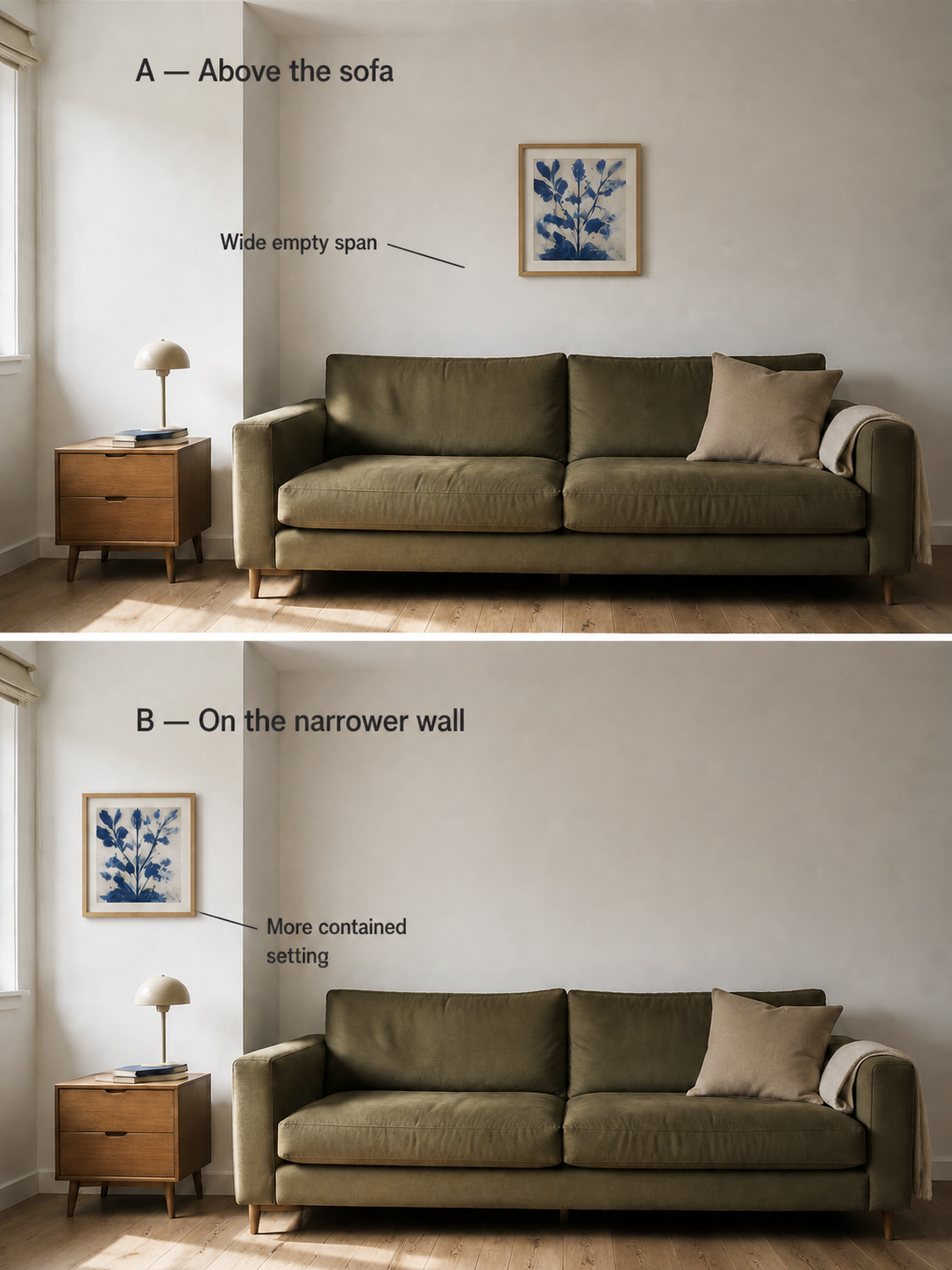
Compare the same picture in two positions. The room illustration shows the placement idea; measure your own room rather than measuring the image.
| Option | What changes? | Decision for this example |
|---|---|---|
| A: above the sofa | The frame width is 50 ÷ 180 ≈ 28% of the sofa width. There is a large surrounding span. | Keep it only if you enjoy that sparse effect. Try the narrower wall if this position does not give the existing picture the setting you want. |
| B: on the narrower wall | The same frame is 50 ÷ 90 ≈ 56% of this wall's width. The location, not the artwork, changes. | Choose B for the keep-this-picture task, subject to the real position and installation checks. |
Result: keep the picture, choose the narrower wall, and postpone additional art purchases. The percentages describe these inputs; they are not target ratios. If your goal changes to creating a focal point above the sofa, compare a wider work or a group instead. Our sofa wall-art size guide covers that separate task.
This choice still has a tradeoff: the sofa wall stays blank. That is acceptable when the first priority is enjoying the piece you already own.
Test the finished outline in your actual apartment
Use the frame's outer dimensions, including its border, rather than just the printed image size. A paper test checks the outline and position; it cannot establish color, reflections, fixing strength or wall condition.
Cut a paper outline at the actual outer size. For the example above, that is 50 × 50 cm.
Identify switches, doors, furniture movement and the surface behind it. If permission or surface compatibility is unknown, have someone hold the paper; do not attach it yet.
Look from the entrance and your usual seat. Check whether the picture's position is useful from those viewpoints, not only when standing in front of it.
Compare the alternative position from the same viewpoints. Write one sentence about what improves and what you give up.
Retest the selected spot with the actual artwork or an appropriate sample before final fixing, especially if reflections or evening lighting matter.
For the narrow-wall example, a completed note could read: “Choose the side wall because it gives the existing picture a defined setting. Leave the sofa wall empty. Do not install until the frame weight and wall method are confirmed.” If the cabinet door hits the outline or the picture is awkward to view while seated, reject that position and try the next one.
Once the position is settled, use the wall-art hanging-height guide for the measurement step. A residential placement guide is not approval for a particular fixing system.
Renting? Separate permission from product suitability
A first-apartment renter in this public discussion worried about wall damage and the deposit. Other replies report different experiences. That is useful context for the question, not evidence that a particular method is permitted or reliable in your apartment.
Permission: check your own agreement and ask the landlord or manager about unclear restrictions on holes, adhesives or wall treatments.
Surface: identify the actual wall finish and its condition. Wallpaper, texture, loose paint and recently painted surfaces are not interchangeable.
Item and fixing: obtain the complete framed weight, dimensions and back construction. Match these to the exact product's instructions, including application, waiting time and removal.
Command's official FAQs say capacity and suitability vary by product; using extra strips does not automatically increase capacity. Its U.S. picture-hanging-strip instructions exclude wallpaper, placement over beds, and valuable or irreplaceable items. Follow the instructions for the exact product and region you are using.
Worked hold decision: if the proposed wall has wallpaper and the complete frame weight is unknown, do not proceed with those picture-hanging strips. A landlord's permission would not remove the product restriction. Choose a different location or method only after both permission and technical suitability are established.
If the picture is irreplaceable, its personal value is another reason to resolve the fixing method carefully. A suitable tabletop frame may provide a temporary display when used according to its instructions. Heavy objects do not become secure merely because they lean against a wall. This guide makes no promise about deposit deductions or tenant rights.
Compare the complete cost, not the print price
If you still need to buy after testing the position, compare finished alternatives against one spending limit. The following amounts are invented arithmetic examples in U.S. dollars, not current prices or supplier quotes. Assume both options otherwise suit the chosen spot and the cap is $150.
| Cost | A: print plus separate frame | B: framed option |
|---|---|---|
| Artwork / framed artwork | $35 | $110 |
| Separate frame | $95 | Included in the assumed $110 |
| Delivery | $20 | $15 |
| Suitable fixing supplies | $15 | $15 |
| Total | $165: $15 over the cap | $140: $10 remains |
Result: B fits this example's budget; A does not, despite its cheaper image price. Replace every amount with your actual full quote, including taxes or installation service if applicable. If an unlisted charge takes B above the cap, pause or revise the choice. Keeping the suitable picture you already own may avoid the new purchase entirely.
Before ordering, confirm outer dimensions, material, included fittings and return conditions. The online wall-art buying guide explains how to check those details rather than relying on a close-up product photograph.
Finish one spot, then stop and live with it
You have completed this round when you can say: “I know why I want this picture, where it belongs, what the finished display costs, and which installation conditions are confirmed.” If the last part is unresolved, the decorating decision can be complete while installation remains on hold.
If the room still feels like a dorm, review scattered placement or tired presentation before discarding meaningful posters. If it feels like a show apartment, bring back something connected to you. If one wall works but the room feels busy, pause the other walls.
Choose one thing you still like and one place it might belong. The aim is a room you want to live in, not a completed shopping list.
Frequently asked questions
What is the easiest place to start with apartment wall decor?
Start with one picture you already like and compare two possible positions. A smaller wall can give a small picture a useful setting without adding more art. Check the real outline and installation requirements before fixing it.
Does a small picture always look wrong above a sofa?
No. A sparse arrangement may be exactly what you enjoy. In the worked example, the narrower wall is chosen because the goal is to give an existing small picture a contained setting. If the goal is a sofa focal point, a wider work or group is a separate option.
Are no-drill hanging products always renter-friendly?
No. Permission and product suitability are separate. Check the surface, complete item and exact instructions. The Command picture-hanging-strip instructions cited here exclude wallpaper, placement over beds and valuable or irreplaceable items.
Do I need to replace my posters to make the apartment feel grown-up?
No. Keep images that still matter. Suitable framing, a deliberate grouping or a better location may change the presentation without replacing your interests.