How to Buy Wall Art Online Without Regretting It: A Practical Guide to Size, Material, and Proof
The image is only the beginning of an online art purchase. Use four small checks to turn a hopeful scroll into a decision you can explain to yourself after the delivery arrives.
How this guide was prepared
The material-comparison sections draw on public discussions about paper, printed canvas and framing, alongside specialist conservation guidance. We use discussions to identify questions, not as technical proof or a representative US survey. The worked offers and buyer briefs are hypothetical; the dated Crimson Omen walkthrough uses an actual inspected listing and supplied digital original. No physical product test or customer purchase is claimed.
Questions worth settling before checkout
The public examples inspected for this update raise distinct questions: whether “canvas” means a roll or an assembled object; whether image content moves around an edge; and what framing and glazing a paper work needs. A giclée-framing discussion begins by clarifying the support before proposing a frame. The canvas-versus-print discussion contains strong, conflicting presentation and detail preferences; its original post is deleted, so the visible replies cannot establish the original buyer’s complete brief.
Use those questions to clarify your own purchase. Keep wall fit, seller terms, and the limits of photos as separate checks. A material preference cannot supply missing dimensions or tell you what happens if the package arrives damaged.
Start with the wall, then choose the buying route
Online art is easier to browse than to judge. A page can show a painting, print, canvas, or framed work in a beautifully styled room and still leave the buyer with the awkward part: deciding whether that object belongs on their wall. Seller roundups are useful for seeing the range of routes available, from artists and galleries to marketplaces and home retailers. But a route is not a decision. Before comparing shops, write down the wall's usable width and height, the furniture beneath it, the viewing distance, and the amount you are comfortable spending on the object plus any framing, delivery, or taxes.
Consider a buyer choosing a large focal piece above a sofa. This is a hypothetical decision exercise, not a customer story: if the buyer cannot relate the listed finished dimensions to the wall, they should pause before comparing colour or price. Tape the proposed outline on the wall, or make a simple paper rectangle. A screen makes everything look politely proportioned; your hallway does not.
The four checks every listing should pass
This is Whispart's editorial decision framework, not a record of product testing or customer outcomes. Think of the checks as separate questions: a listing can be strong on one and weak on another.
On a narrow screen, scroll sideways to read all four checks.
| Check | What the photos can show | What to verify in writing | Reason to pause |
|---|---|---|---|
| 1. Wall fit | Colour, broad composition, whether the work has visual weight | Exact width and height, orientation, framed or unframed dimensions | You cannot place its footprint on your wall. |
| 2. Physical format | A general sense of texture or finish | Medium, substrate, print method, frame, glazing, edition or originality where relevant | The object is called simply a 'print' or 'canvas' without specifications. |
| 3. Seller proof | The seller's presentation and packaging style | Dispatch location, production timing, shipping method, damage process, return window and exclusions | The policy is missing, contradictory, or only appears after payment. |
| 4. Photo limits | Subject, palette, basic scale cues and sometimes a room mock-up | Whether images show the exact work, close-up detail, edge treatment, finish and condition | Every view is heavily staged or no one can answer a simple factual question. |
Follow one real image into its actual offer
A purchase can begin with a particular visual attraction. In Whispart’s Crimson Omen, a broad red, cloak-like form stands against a pale ground; a separate red oval and dark, irregular interruptions make the figure feel strange. I would keep this image on a shortlist for someone who wants that stark contrast and unsettling figure-like presence. A buyer seeking a quiet naturalistic landscape has a reason to pass.
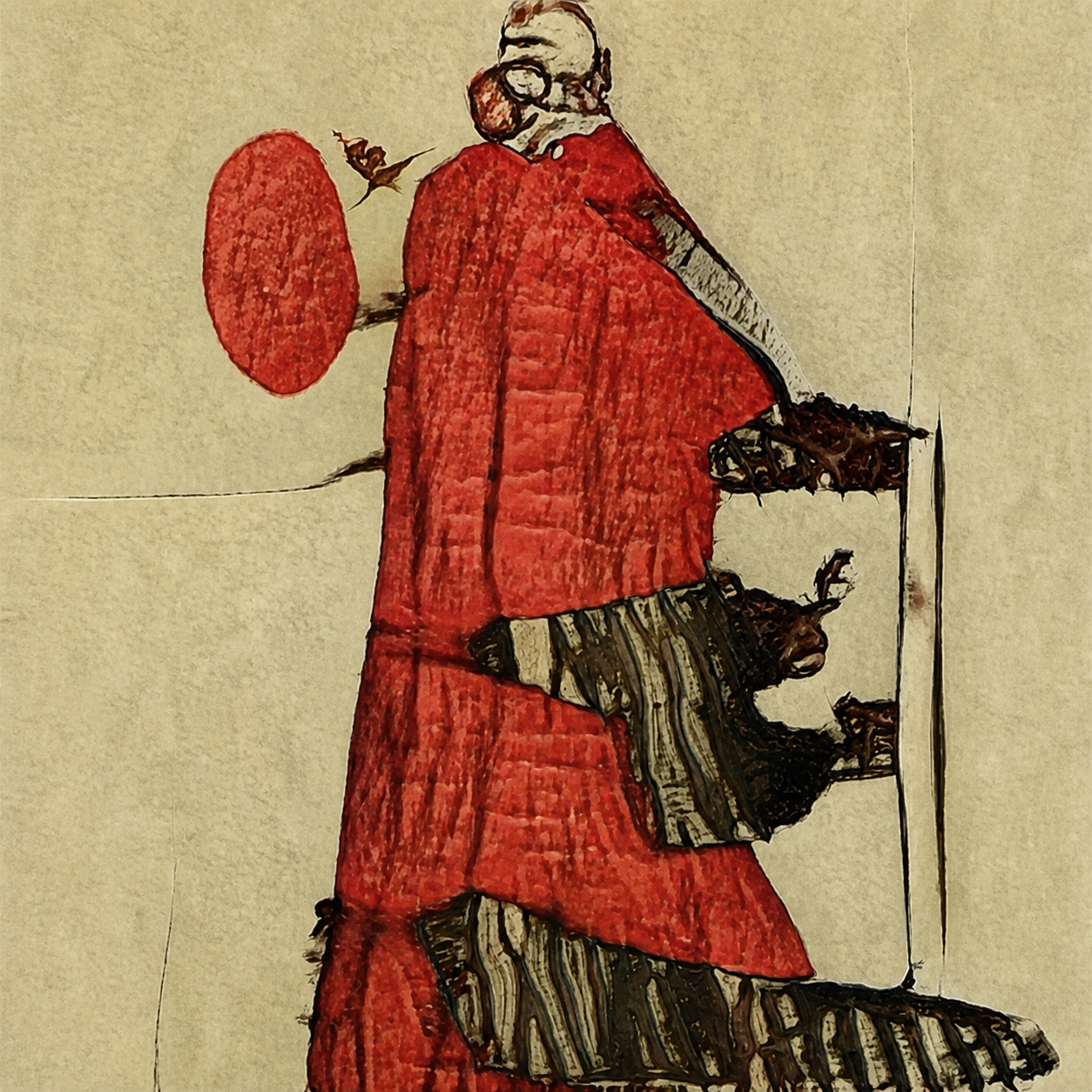
The work’s page develops a literary reading around carnival, authority and menace. That can give you another reason to return to the image. It does not establish the material, size or condition of the object you will receive. This is a printed GAN artwork; a requirement for a hand-painted original would rule it out, regardless of the appeal of its image or archive record.
Now consider the Black Aluminum Frame option inspected on October 20, 2026. The page showed US$238 and described flat-mounted textured fine-art inkjet canvas, a mat and acrylic glazing. Its product-specifications panel distinguished 50 × 50 cm (19.7 × 19.7 inches) outside the frame from 39.8 × 39.8 cm (15.7 × 15.7 inches) of visible artwork. Those are the seller’s stated specifications, not measurements we made.
Imagine a buyer who likes this image, has room for a square up to 20 inches outside, but wants at least 18 inches of visible artwork. I would decline this particular format for that brief. The 19.7-inch frame fits the wall limit; the 15.7-inch visible image fails the image-size requirement. Keep the image on the shortlist and verify another physical offer, or choose another work. Do not assume that a different framing option preserves either measurement without opening its own specifications.
If a 15.7-inch visible image is acceptable, the size objection changes, but the purchase still needs the other checks below. The original image cannot prove printed color, surface detail or reflection. Read the current Shipping & Returns policy as well: at this check, it allowed return requests within 60 calendar days after receipt for eligible, non-personalized artworks, subject to authorization and condition requirements. Delivery eligibility was limited to valid street addresses in the contiguous 48 United States. An appealing image cannot establish those terms or make every address eligible. Prices, availability and policies can change; use the live offer for a later order.
Canvas vs print: compare the finished object
Canvas describes a support; printing describes a process. A reproduction can be printed on paper or canvas. An original painting may also be made on canvas. The label alone does not establish originality, an edition, image quality, or a finished object ready for your wall. If those labels are the confusing part, our art print versus poster guide separates those questions.
If you still like an image you bought earlier in life, a material change need not mean replacing its subject. First decide what you want to change: the loose-paper presentation, the surrounding frame, the visible surface, or the way the image occupies the wall. Paying for canvas will not, by itself, answer any of those questions.
First ask what arrives
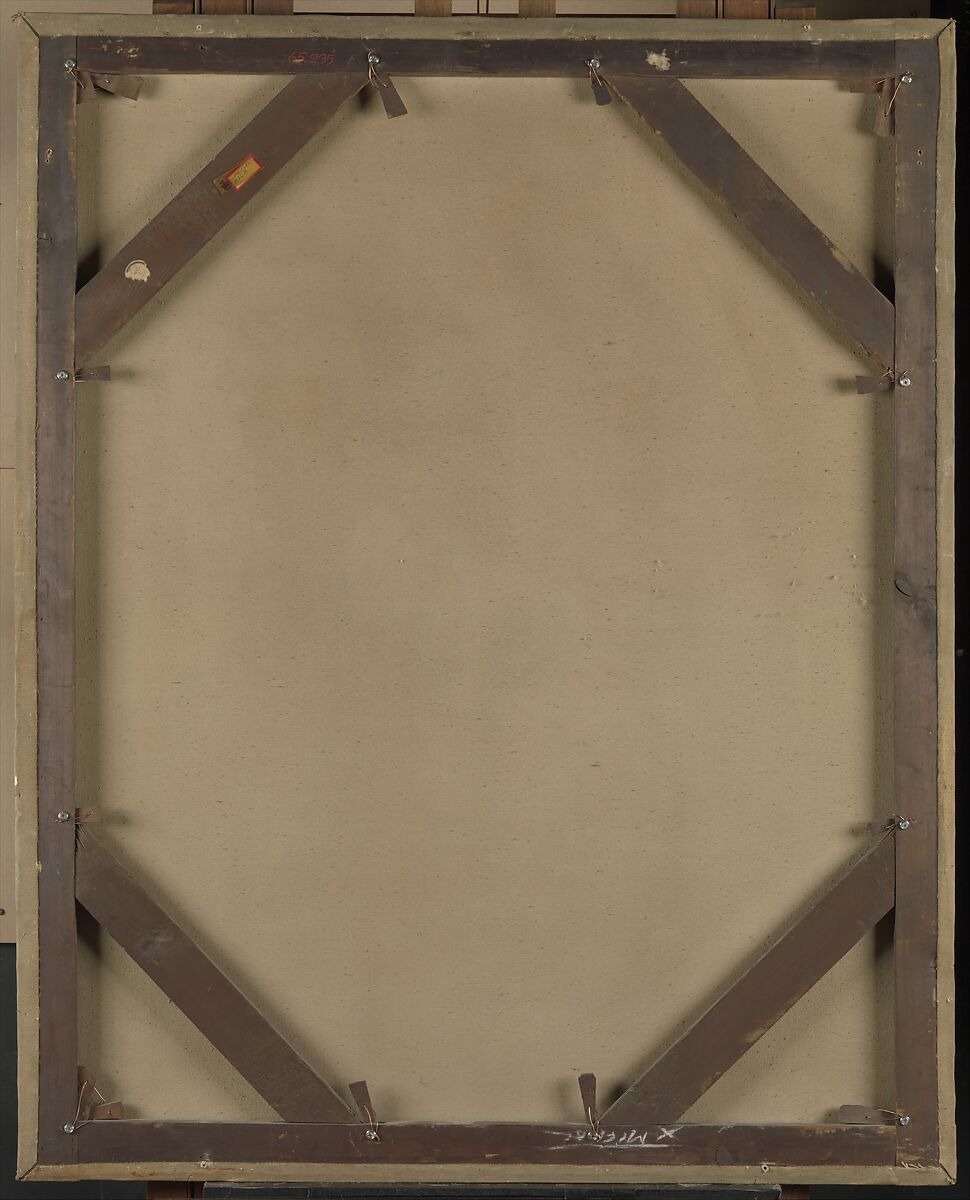
A paper reproduction might arrive as a loose sheet or as an assembled frame package. A canvas reproduction might arrive rolled, mounted to a board, stretched over a support, or with an additional frame. Write down the seller’s actual delivery form and what remains to be done. “Canvas print” is not enough information to assume that stretching, framing, or hanging hardware is included.

The distinction can be expensive to discover after delivery. In a public rolled-canvas discussion, a buyer had expected to handle the purchased roll like a paper image in an ordinary picture frame. That is an example of an unanswered format question, not a technical instruction to mount your own work. Ask a framer about an unfamiliar material before ordering a frame.
Then check what stays on the front
For a paper offer, distinguish image area, any blank border, sheet size, the visible opening, and the finished outside frame dimensions. For a wrapped-canvas offer, ask whether the image continues over the sides, is cropped, is mirrored at the edge, or has a separate border. These are alternatives to verify with the seller, not features to assume from a room mock-up.
Compare a straight-on preview of the exact selected format with the full artwork image. If a face, signature, or shape near an edge matters to you, confirm where it ends up. A print-versus-canvas framing discussion moves from a format preference to precisely this border question. Keeping the image on the front can matter more than which support sounds more substantial.
A worked choice with two fully specified offers
The following offers are fictional, supplied only for this exercise. They reproduce the same image; neither is a Whispart listing. Suppose your usable wall area is 24 by 30 inches, and your priorities are retaining the complete image on the front and receiving an assembled object. Both offers meet your budget; their delivery and return terms are acceptable.
On a narrow screen, scroll sideways to compare both offers.
| Specification | Offer A: framed paper reproduction | Offer B: stretched canvas reproduction |
|---|---|---|
| Image on the front | Complete 18-by-24-inch image; seller confirms the visible opening retains it | 18-by-24-inch front; seller’s preview places part of the image around the sides |
| Finished outside dimensions | 20 by 26 inches, including the frame | 18 by 24 inches, 1.5 inches deep; no outer frame |
| Delivery form | Assembled frame with glazing, spacing from paper, backing, and stated hanging hardware | Printed, stretched canvas with stated hanging hardware; no glazing |
| Evidence supplied | Full-front preview and exact-size detail sample you find acceptable | Front-and-side preview and exact-size detail sample you find acceptable |
I would choose Offer A under those conditions. Its quoted 20-by-26-inch outside footprint fits, and its visible opening retains the complete image. Offer B is also within the available area, but the specified wrap moves image content onto the sides. That conflicts with the priority we set. Paper does not win because it is inherently finer; this particular completed package answers the brief.
Now change the conditions: your available area is only 20 by 26 inches, but the frame you actually choose makes Offer A 22 by 28 inches. A no longer fits. I would switch to B only if the seller supplies a revised full-front layout, with a separate or mirrored border, and confirms the 18-by-24-inch outside size and satisfactory detail. If the full-front image, finished size, or delivery form cannot be confirmed, hold the purchase. A different material label does not resolve missing evidence.
Surface and protection need their own check
Do not infer sharpness, glare, water resistance, or lifespan from “paper” or “canvas.” Compare the actual output at its intended size, the surface finish, and any glazing. In a room with a window opposite the artwork, ask to see the relevant finish under comparable light or check a sample; a styled listing cannot measure reflection in your room.
The Canadian Conservation Institute’s paper-framing guidance explains protective frame packages and keeping the work separated from glazing. Its painting-framing guidance also allows for protective glazing: canvas does not automatically mean “never behind glass.” The appropriate package depends on the actual work. For the next frame-choice step, see our guide to framing canvas art.
Ask for a sample at the size the detail will actually occupy
A small print of the whole image cannot settle every question about a large version. In a photographer’s canvas-versus-framed-print discussion, the buyer asks about retaining detail at a stated viewing distance. That is a more useful question than whether one support always looks sharper.
Here is a hypothetical sample request, not a print test. Suppose the production image is 4,000 × 3,000 pixels and its intended image area is 20 × 15 inches. That places 200 source-image pixels in each printed inch: 4,000 ÷ 20 = 3,000 ÷ 15 = 200. This calculation specifies scale; 200 pixels per inch is not a quality guarantee.
- Select the important passage. Choose an 800 × 600-pixel crop containing the detail you would miss if it became indistinct—a fine line, small face, or subtle transition.
- Keep its final physical scale. At the stated output scale, that crop must occupy 4 × 3 inches: 800 ÷ 200 = 4 and 600 ÷ 200 = 3. Ask the printer to confirm those dimensions, without “fit to page” enlargement or reduction.
- Specify the actual proposed output. If comparing paper and canvas, request the same crop at that same physical size on each named medium, using the production workflow intended for that medium. The appropriate settings may differ. Label each proof so you know what you are seeing.
- Check the produced samples where the detail matters. Inspect them at the intended viewing distance, as well as close up. A 4 × 3-inch miniature of the whole picture is a different test. It makes all the pictured features smaller.
We would send: “For the 20 × 15-inch output from this 4,000 × 3,000-pixel file, please print the attached 800 × 600-pixel crop at exactly 4 × 3 inches on each proposed medium. Please identify the medium and confirm that the crop has not been fitted to another size.” If that proof cannot establish the detail you want, hold the decision or discuss a smaller final size and a new, correctly scaled proof.
In our founder’s written account of early canvas-sample comparisons, we checked printed size, reproduction, and whether the screen image’s color and feeling carried into the object. That is a scoped studio self-account, not a measured comparison proving one support superior. The request above is our worked planning example; we have not produced or judged these hypothetical proofs.
A satisfactory crop still leaves the whole image, color relationships, assembly, and viewing light to check. Our texture guide separates depicted brush marks from an object’s physical surface; our art print versus poster guide covers what the seller’s terminology establishes.
Read the transaction proof before you fall in love
A return policy is not a mood board. It is the actual agreement that applies if the piece arrives damaged, differs from the listing, or simply cannot work in the intended room. Read it before checkout, together with delivery timing, production status, international duties where relevant, and the procedure for reporting a problem. Check the chosen seller’s current return window, condition requirements, and any exclusions for made-to-order work. The useful question is not whether the policy sounds generous in the abstract. It is whether you can restate the terms in one sentence before paying.
Also look for a contact path that can answer a factual question: Is this the finished framed size? Is this a stock room image or the exact work? What happens if the package is damaged? The answer matters less as a sales performance than as evidence that the seller can describe the object and the transaction. Save the listing, policy, and any clarification you receive. It takes two minutes and makes any later conversation much clearer.
Use photos for what they can answer—and ask for the rest
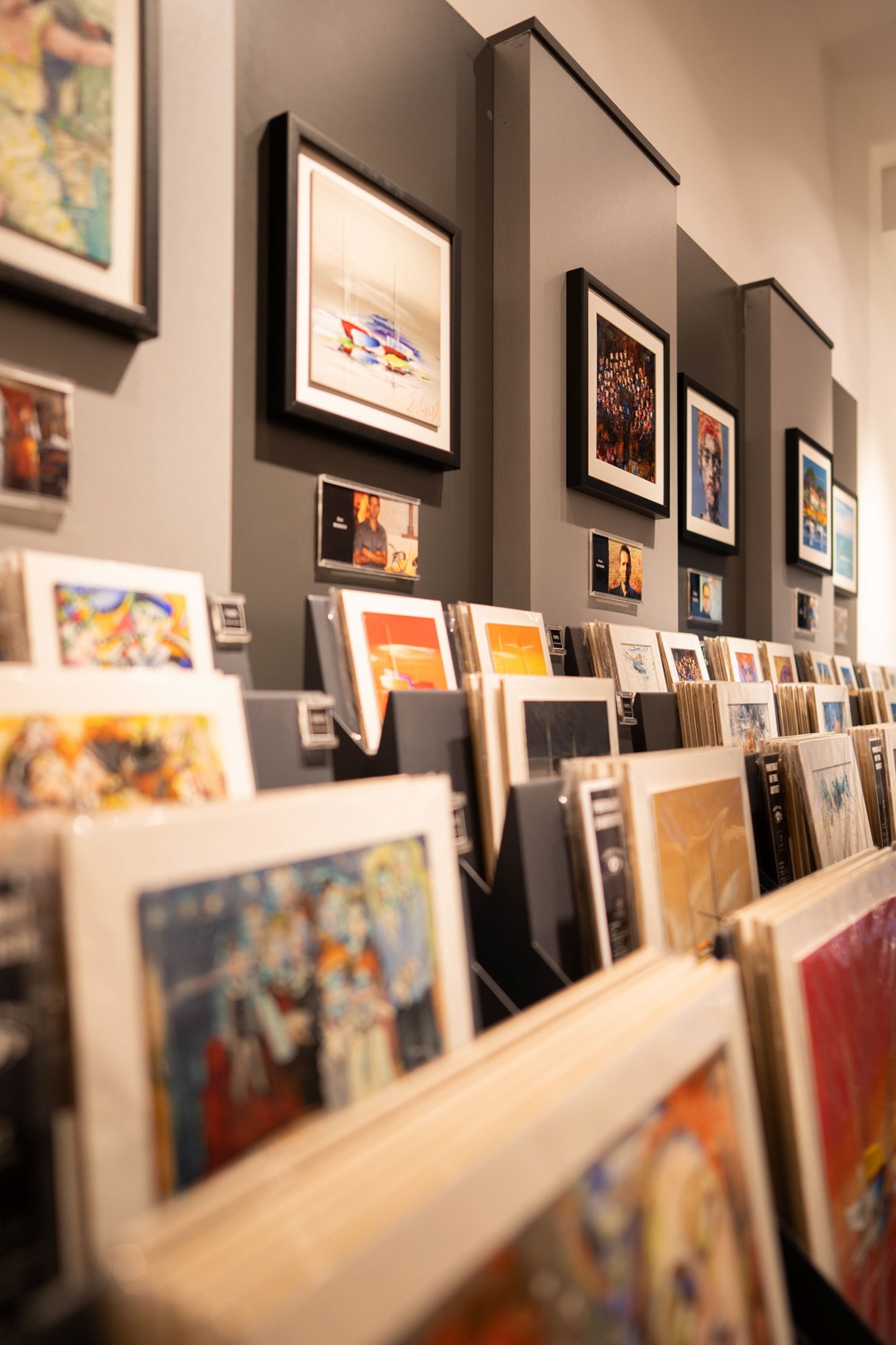
Listing photos are useful for a first filter. They can help you decide whether you respond to the subject, palette, rhythm, and broad scale of a piece. A room image can help you imagine presence. But it is prudent to treat a polished photo as a starting point, not a complete specification: it may not answer a decisive question about finish, depth, framing, condition, or delivery. For those questions, ask for a written specification, a close-up, a video, or a direct answer from the seller.
This is not a reason to distrust every polished listing. It is a way to assign each piece of evidence a proper job. Let the photos help you decide whether to investigate. Let the specifications and terms decide whether to purchase. If you need the listing to answer a question it cannot answer, ask it directly rather than trying to zoom yourself into certainty.
A 15-minute order of operations before checkout
- Measure the wallRecord usable width and height, furniture boundaries, and viewing distance. Mark the proposed footprint at full scale if you can.
- Copy the physical specificationWrite down finished dimensions, material, frame, surface, hanging method, and whether the listing refers to the exact work or a representative image.
- Read delivery and return termsCheck timing, damage reporting, return window, exclusions, and any cross-border costs before the payment screen.
- Ask one decisive questionAsk the question that would genuinely change your purchase: about finish, production, scale, shipping, or condition. Save the answer.
- Sleep on the decisionReturn to the taped outline and your notes the next day. If the evidence still matches the room and the budget, buy with a clearer reason than 'the thumbnail was beautiful.'
Frequently asked questions about buying wall art online
How do I know what size wall art to buy online?
Start with the usable wall area and the furniture below it. Compare the listing's finished dimensions to a taped outline or paper mock-up on your wall before comparing images.
Is canvas better than a paper print?
Neither support is automatically better. Canvas can also be printed. Compare complete offers: delivery form, the image retained on the front, finished outside size, actual-size detail, surface, and protection. Choose the specified package that meets your priorities, or pause if those facts remain unknown.
Should I avoid art with a strict return policy?
A strict policy is not automatically a reason to avoid a seller, but it raises the value of checking dimensions, material, production status, delivery terms, and unanswered questions before you pay.
What should I ask the seller before ordering?
Ask the one factual question that would change your decision: whether the listed size includes the frame, whether photographs show the exact work, how damage is handled, or when the item will dispatch.
Is a small version of the whole image enough to approve a large print?
It can help with the overall image, but it does not preserve the physical scale of each detail. Ask for a critical crop printed at its size in the intended final output. In the worked example, the 800 × 600-pixel crop must occupy 4 × 3 inches; that is a planning calculation, not a guarantee of acceptable quality.