A Curated Gallery Wall for an Art-Hotel Lounge: Which Pictures Belong Together?
A set can share a palette and still say very little as a group. Before choosing frame sizes or adding another picture, decide what connects the images—and what each one contributes.
A curated gallery wall is a deliberately selected group, not necessarily a group bought one piece at a time. For an art-hotel lounge, start with a specific relationship between the pictures: a subject, a visual motif, a place with documented relevance, or a contrast you actually want guests to encounter. Keep the works that make that relationship legible. Remove a work that only matches the furnishings but changes the intended story.
You can make this judgment about a ready-made set as well as an individual shortlist. Society6, for example, offers curated sets while also allowing customers to choose individual pieces. Desenio’s Eclectic Curation page presents a group that can be customized. Buying together does not remove the need to look; buying separately does not automatically create a stronger result.
This guide works through one small lounge grouping. It is about selecting images, not building a hotel-wide art program or specifying installation. The following property, brief and picture candidates are invented teaching examples.
Four pictures, one palette—and a reason to leave one out
Imagine a small hotel with an already-furnished lounge. Its design lead wants a group about quiet passages beside water: places the eye can enter, follow or move through. Blue and ochre already suit the room, but color is a supporting connection, not the entire brief. There is no claim that the pictures depict the hotel’s location.
Here are four candidates. First look at the pictures, then read the selection below.
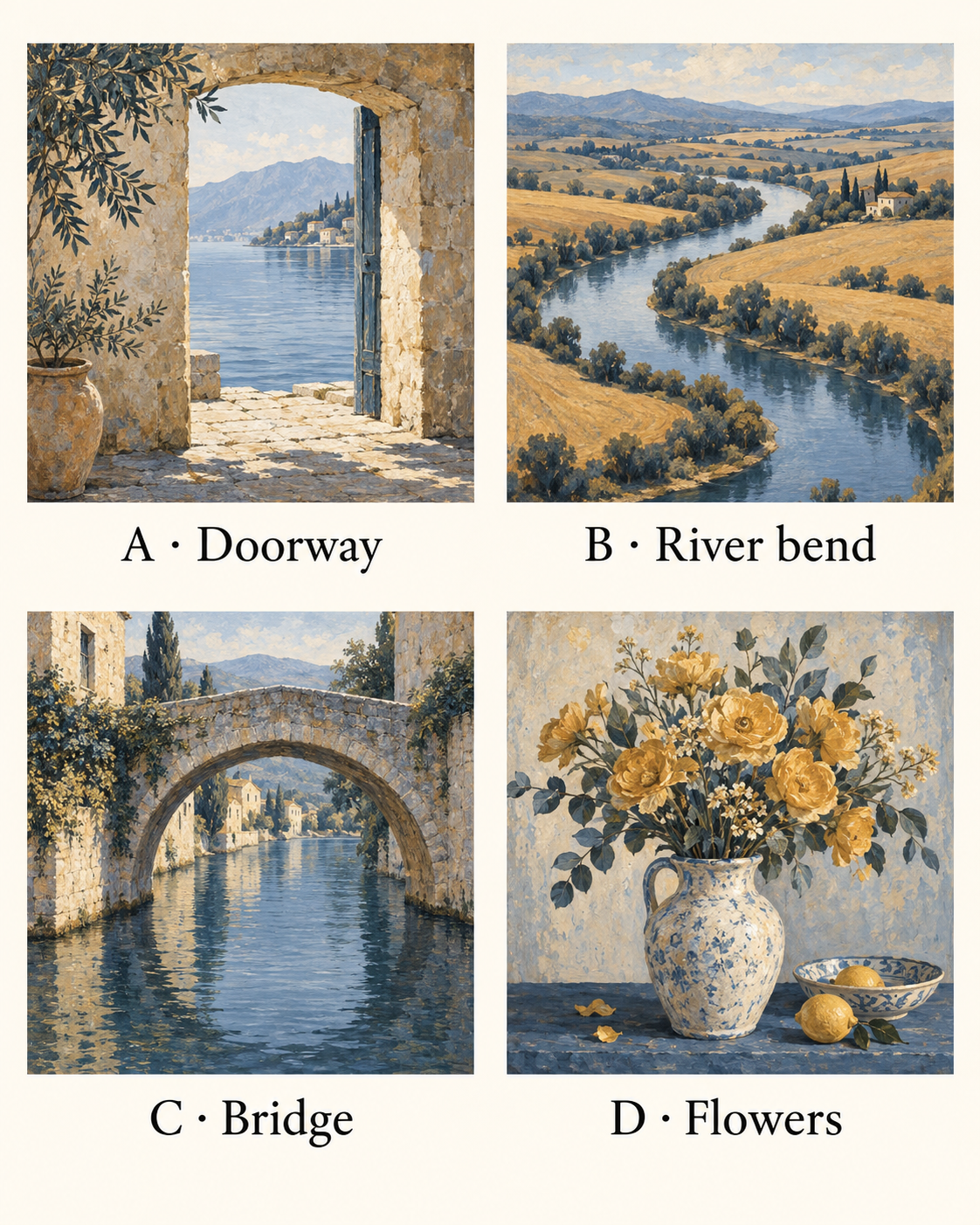
A · Doorway: keep the invitation to enter
The opening gives the group a clear threshold. You look from the enclosed stone foreground toward water and a more distant landscape. It earns its place through that near-to-far movement, not simply because its walls are ochre.
B · River bend: keep the route
The winding water carries the eye through an open landscape. It extends the passage idea without repeating another stone opening. The higher viewpoint also changes the experience: now you are looking over a route instead of standing at its entrance.
C · Bridge: keep the crossing, with a different viewpoint
The arch links the group back to built space and water. Compared with A, you are outside the opening, seeing both a crossing above and a route beneath it. A and C have a useful family resemblance; B prevents the set from becoming three versions of the same architectural view.
D · Flowers: leave this one out of this group
The still life is appealing and shares the colors. Its subject, however, gathers attention around a vase on a table rather than a passage through a place. For this brief, choose A, B and C; leave D out. Changing D’s frame would not change that subject relationship.
This is not a rule against flowers, still lifes or mixing subjects. It is a specific editorial choice for a stated idea. If the lounge brief were about domestic rituals or a garden, the same floral picture could become the starting point.
What the edited group looks like together
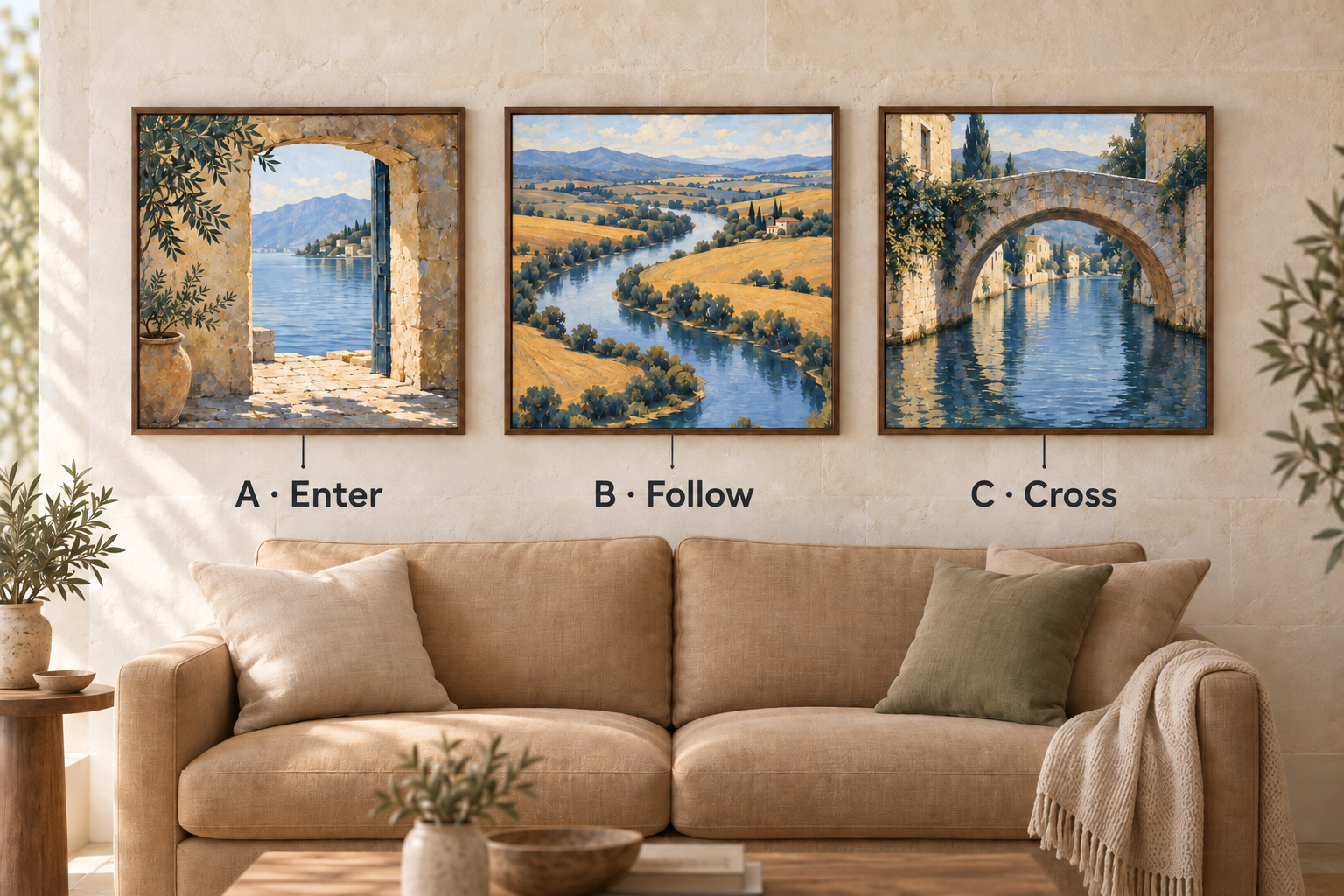
A simple row makes the relationship easy to inspect. Matching frames reduce another changing variable in this teaching example; they are not what makes the images belong together. A more varied arrangement could work, provided the pictures still read as a deliberate group.
The selection note is now concrete enough to hand to a colleague:
Keep the doorway, river bend and bridge. They connect water with three ways of moving through a place. Leave out the floral still life because its tabletop subject does not develop that idea. Review the three selected images at their proposed framed sizes before ordering; do not add a fourth just to occupy spare wall.
That is more useful than “three blue pictures, something sophisticated.” It tells the next person what must survive a substitution. If the bridge becomes unavailable, a replacement needs a reason to belong—not just a similar dominant color.
When the ready-made set is already enough
Now change the brief. Suppose the lounge should have a blue-and-ochre botanical group, and a ready-made set contains a full flowering branch, a close view of a blossom and a loose leaf study. One shows the whole, one the detail, and one the shape. If the actual images satisfy that intention, keep the set rather than replace a picture merely to make the purchase feel more individual.
You still check whether you like every member. If two pictures repeat the same close-up without adding anything you want, replacing one may improve the group. But repetition can also be intentional—for example, a disciplined series of botanical studies. The question is whether it serves this wall, not whether repetition is forbidden.
Palette, subject and medium are established ways of connecting a gallery. Edward Martin’s gallery-wall guide discusses those links alongside layout, framing and lighting. Here, the extra step is to make the inclusion decision with the actual images in front of you, rather than assume that a shared description guarantees a coherent result.
Finish the selection before solving the installation
- Put the actual candidates together without styled-room distractions. Use complete images and retain their maker, title and source. Write one sentence naming the relationship you intend. If local history or a named community matters, verify those connections rather than invent them from the picture.
- Give each member a job within that relationship. In our example, A introduces an opening, B extends a route, and C adds a crossing. Remove or replace a member only for a reason; “we need to fill the last gap” is not enough by itself.
- Check the selected group in the actual room. Use confirmed outer frame dimensions and a surface-approved mock-up method. Inspect the group from the approach and the seats: can people distinguish the pictures, and does glare obscure an important image? A digital scene cannot establish those answers.
- Hand off a finite shortlist. Record the selected works, acceptable substitutions and unresolved item or site questions. Get the project team’s approval of the specified objects and installation conditions before ordering or mounting.
If the group loses its intended relationship at the real viewing distance, revise the sizes, count or candidates. Do not keep adding works in the hope that quantity will restore it. Equally, do not discard an image you love because it fails this one brief; it may belong elsewhere.
At this point the picture-selection decision is finished: three named candidates, a stated connection and one deliberate exclusion. Use the hotel art brief to turn that shortlist into item and site requirements. If the remaining question is whom to buy from, the separate commercial-artwork sourcing guide covers that next decision.
Sources and image note
Research checked September 9, 2026. The linked Society6 and Desenio pages are supplier examples; the Edward Martin article provides general gallery-wall guidance. The selections and hotel scenario above are WhispArt’s editorial teaching example, not a reported customer project, a guest-preference study or a claim of increased bookings.
The cover uses artwork from WhispArt’s product-image library in an AI-generated room. The four comparison artworks and the three-picture lounge are separate AI-generated teaching illustrations. Illustrated rooms and frames do not establish the dimensions, finish, supplied frame or suitability of any sale item.