Different Types of Abstract Art, Explained Through Real Paintings
A Mondrian grid, a Kandinsky improvisation and a dreamlike Klee do very different things. Look closely at real works to learn the language of abstraction—and find the qualities you actually like.
Useful types of abstract art include geometric abstraction, expressive or gestural abstraction, organic or biomorphic abstraction, Color Field painting, hard-edge painting and Op Art. Color rhythm, as in Orphism, offers another way in. These labels describe different things: some are historical approaches, while others identify shapes, edges or the way a picture directs your eye.
There is no fixed number of types, and one work can fit several descriptions. Start with what you can actually see: an ordered grid, a sweeping line, a rounded natural form, a broad area of color or a pattern that seems to move. Then use the artist and museum record to establish historical context.
This guide brings together ten historical works, followed by two WhispArt room examples. First, a distinction that makes the rest much easier: visible brushwork and unusual color do not automatically make a painting non-objective.
Before abstraction: is Van Gogh an Impressionist?
Claude Monet is an Impressionist; Vincent van Gogh is generally described as a Post-Impressionist. Neither label means “a painting with no recognizable subject.” Compare these two works before moving to the abstract examples.
Monet: a recognizable pond, seen through color and light
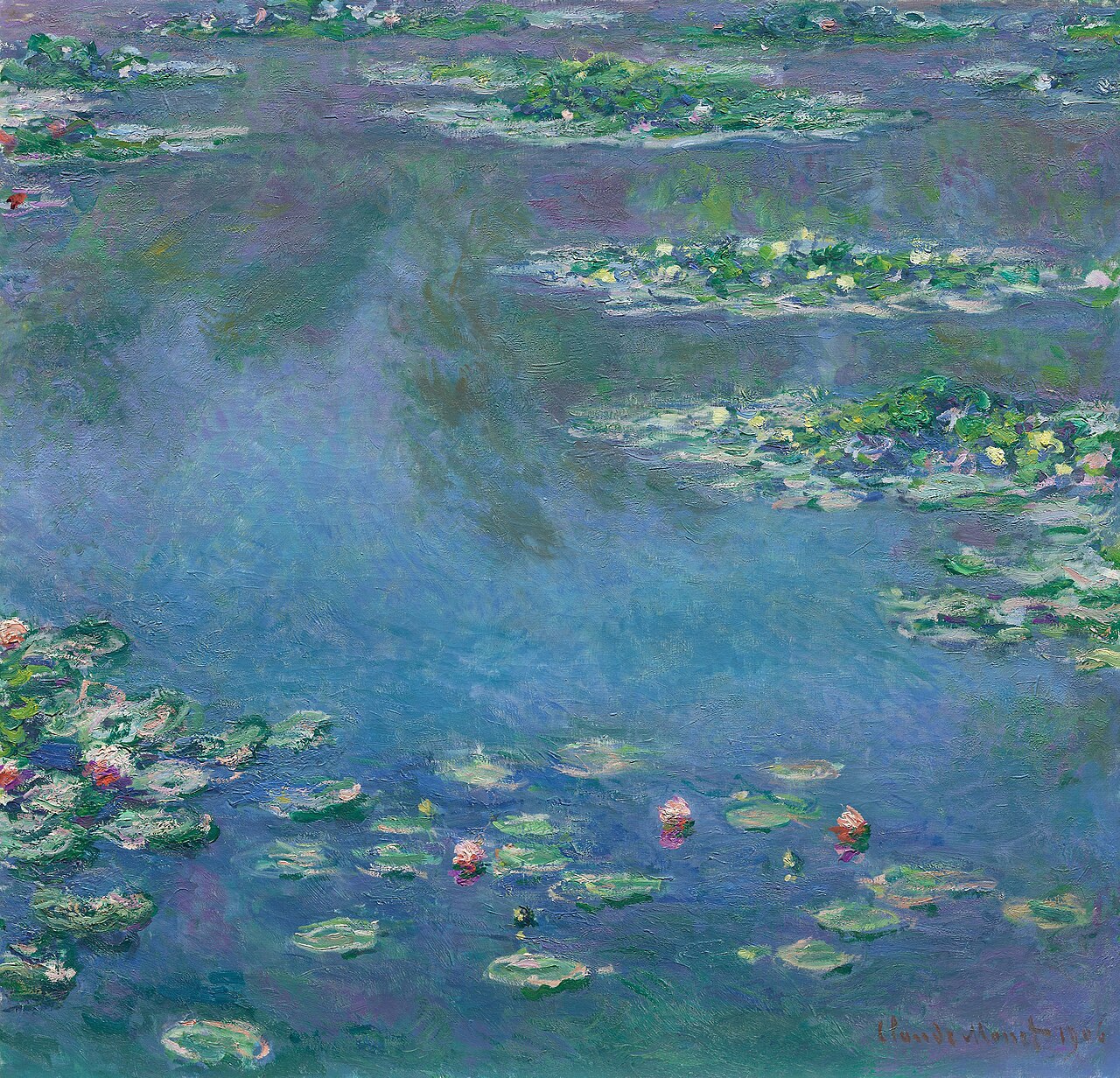
In this 1906 Water Lilies, find the green lily pads across the top and lower left. Between them, blue and violet strokes make the water and its reflections difficult to separate. The scene is loose and immersive, but it still depicts Monet’s pond. The Art Institute’s account explains how he concentrated on the water’s surface, leaving out a conventional division into land and sky.
The useful distinction is between a subject becoming less literal and a subject disappearing altogether. Monet’s handling of paint can feel abstract in places without making this particular work a non-objective composition.
Van Gogh: expressive color within a depicted room
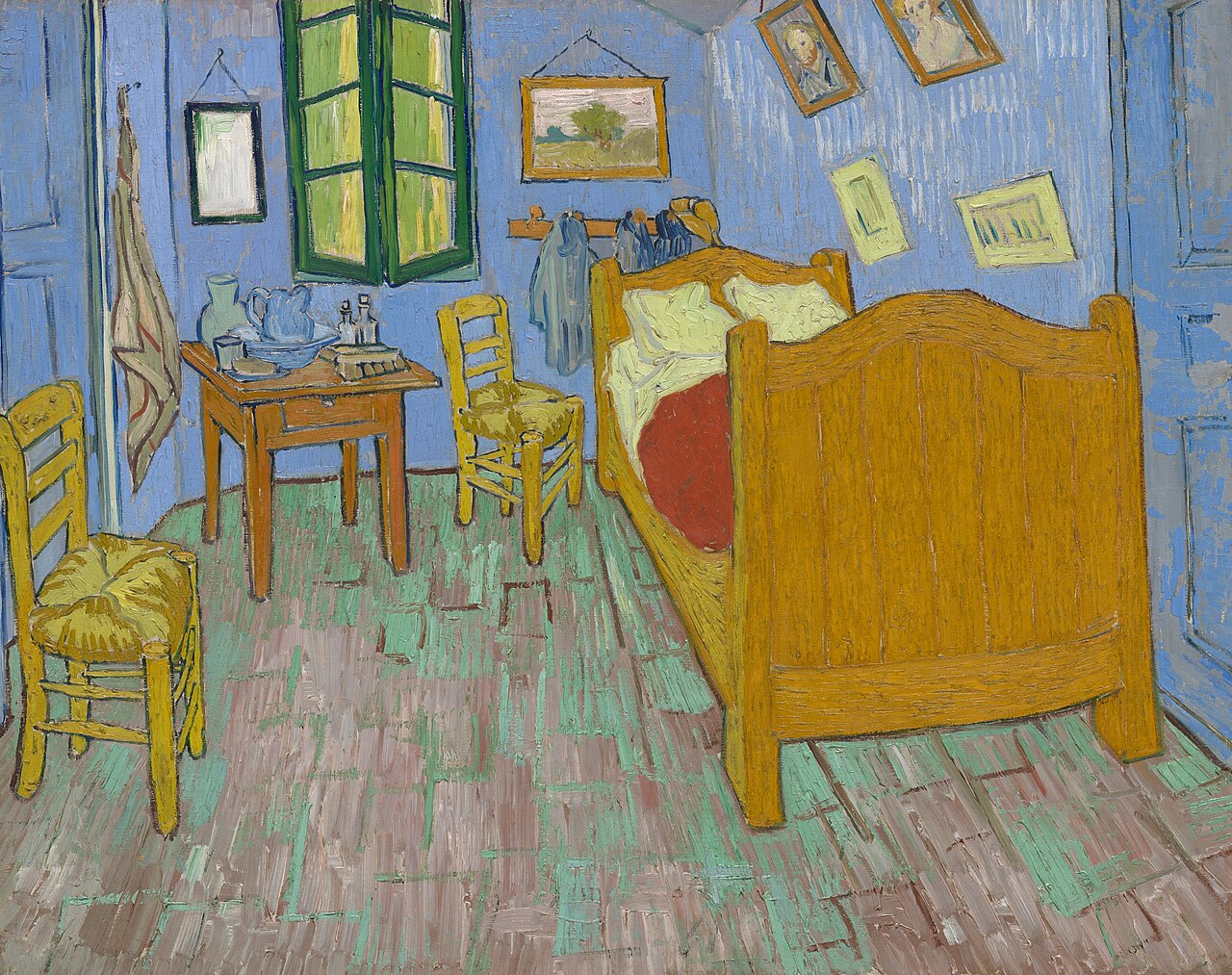
In The Bedroom, the yellow bed, two chairs and green window remain easy to identify. Look at the strongly receding floorboards and the short strokes on the blue walls: the room is transformed by color and mark-making, but it is still a room. The museum identifies the work with Post-Impressionism.
Calling it “expressive” describes something you can see. Calling Van Gogh an Abstract Expressionist would place him in the wrong historical context. The postwar movement associated with artists such as Jackson Pollock came much later.
1. Geometric abstraction: relationships between shapes
Geometric abstraction organizes a picture through forms such as rectangles, circles and straight lines. The MoMA definition emphasizes geometric and linear forms in abstract space. It does not require a particular palette, perfectly smooth paint or one standard grid.
Piet Mondrian: a diamond outside, a grid inside
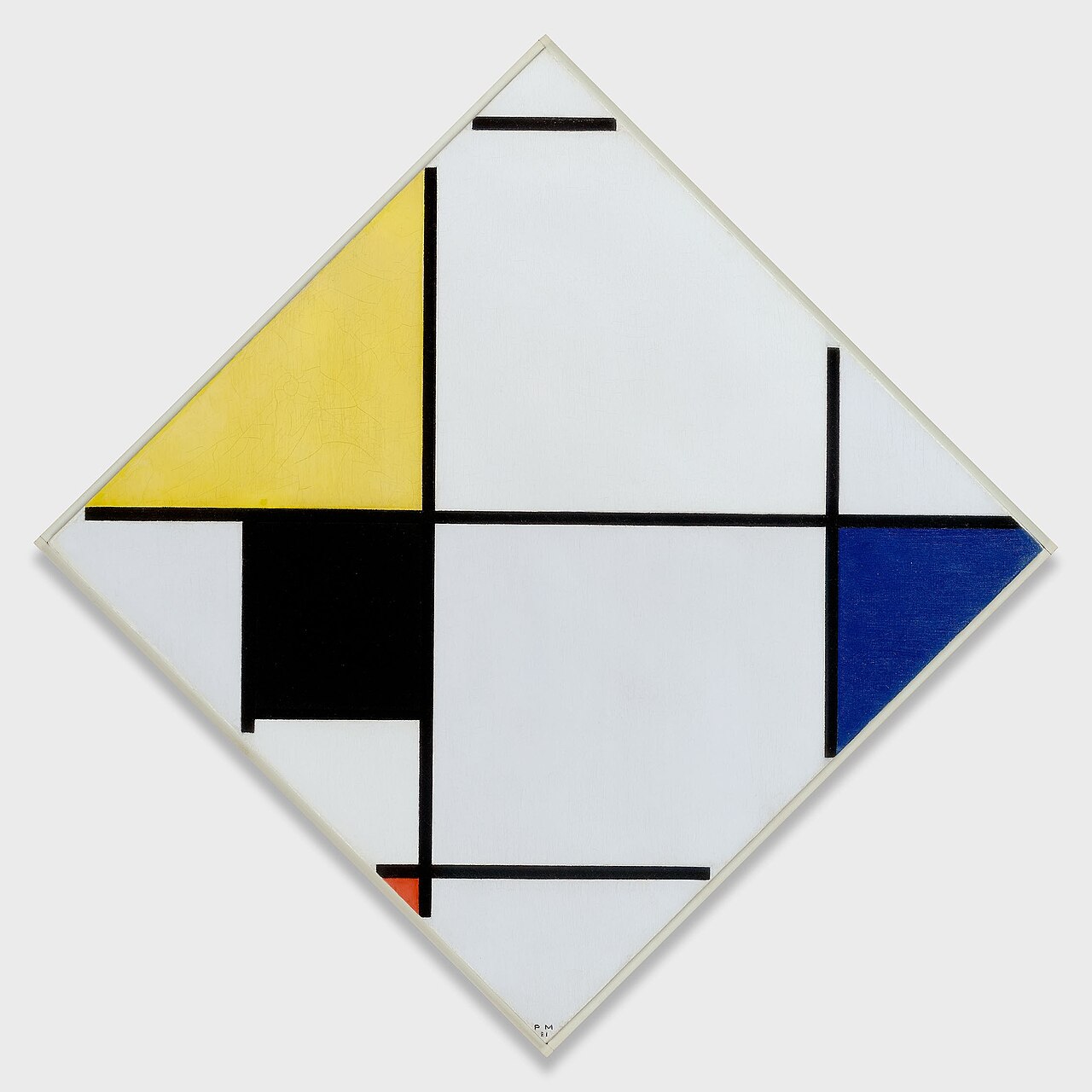
Follow the long black horizontal line through the middle, then the vertical lines crossing it. Although the canvas is a diamond, those internal lines remain horizontal and vertical. Small red and blue passages carry visual weight against much larger pale areas. This is a useful example of geometric abstraction associated with De Stijl: the structure does not depend on recognizing a landscape or a face. The museum record also draws attention to the tension between the diamond boundary and the internal grid.
Kazimir Malevich: a geometric painting can be almost monochrome
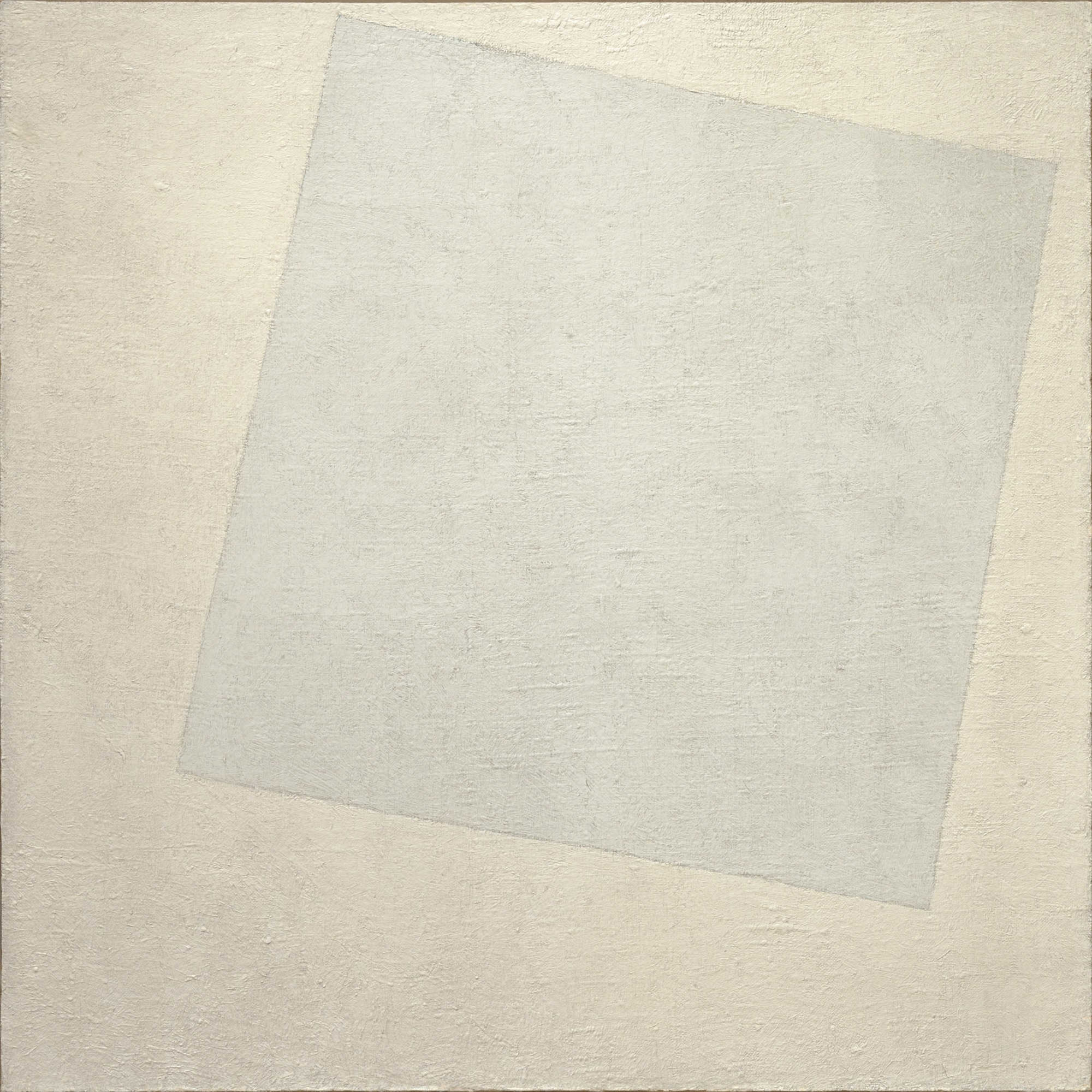
Look for the slightly tilted, cooler white square inside the warmer surrounding field. Its boundaries are irregular enough for the surface to remain visibly painted. White on White belongs to Suprematism, Malevich’s abstract approach. Its spare appearance is not a reason to relabel this 1918 work as a product of the later Minimalist movement.
Compared with Mondrian, the contrast is quieter and the shape appears less anchored. Both works use geometry; geometry alone does not tell you how much color, texture or movement to expect.
Paul Klee: a grid can have a delicate, irregular rhythm
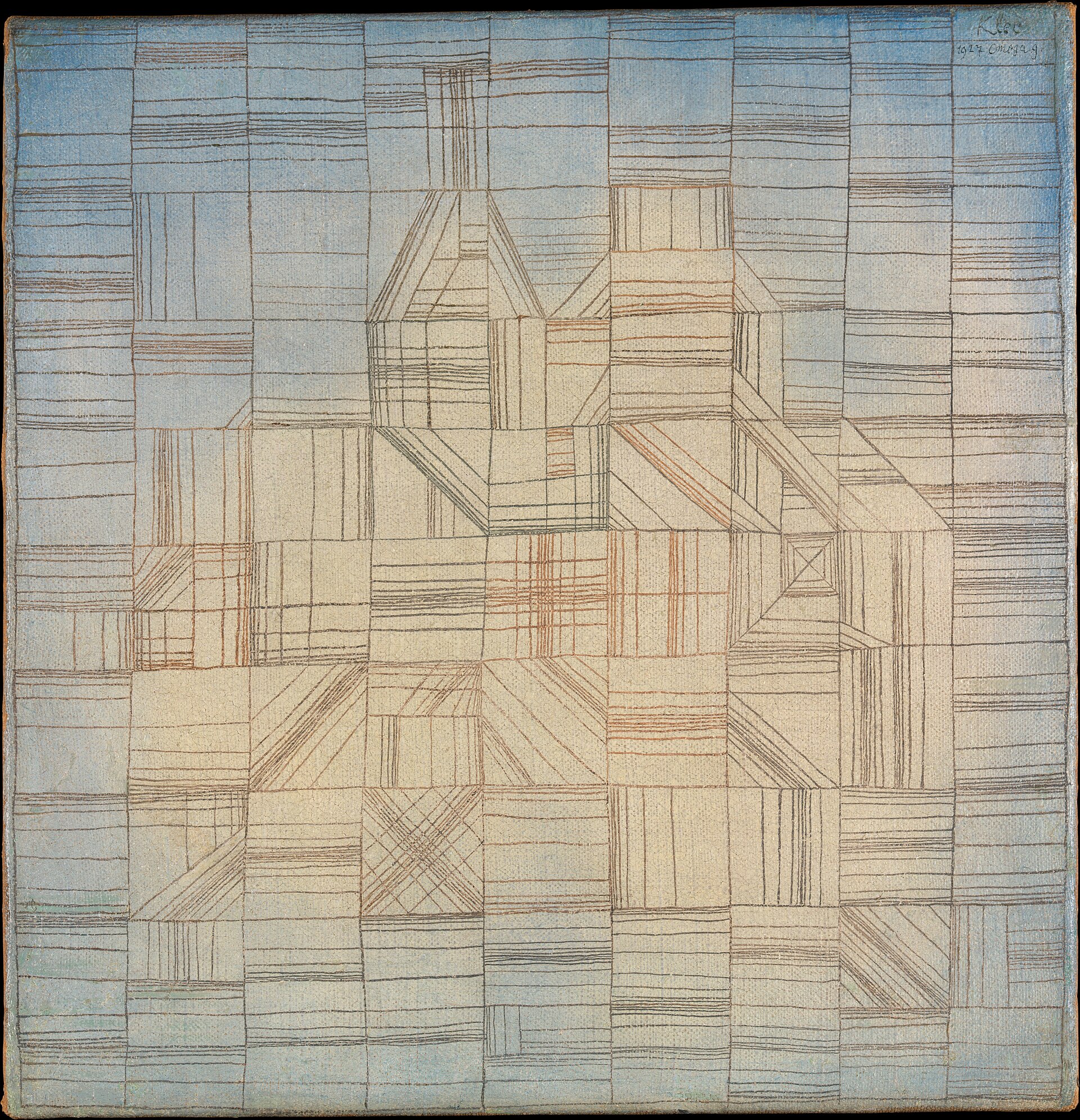
In Variations (Progressive Motif), thin lines gather into horizontal, vertical and diagonal groups. Notice how their direction changes around the center and how the pale blue margins differ from the warmer interior. This is a more intricate geometric structure than Mondrian’s broad divisions. Repetition is visible, but repetition by itself does not make a work Op Art.
2. Expressive abstraction: lines and colors that carry the action
Here, the first thing you follow may be a slashing line, a sweeping curve or a collision of colors. “Expressive” is a useful description of the effect; it does not prove that the painting was unplanned, and it is not a substitute for a historical label.
Vasily Kandinsky: an early route into abstraction
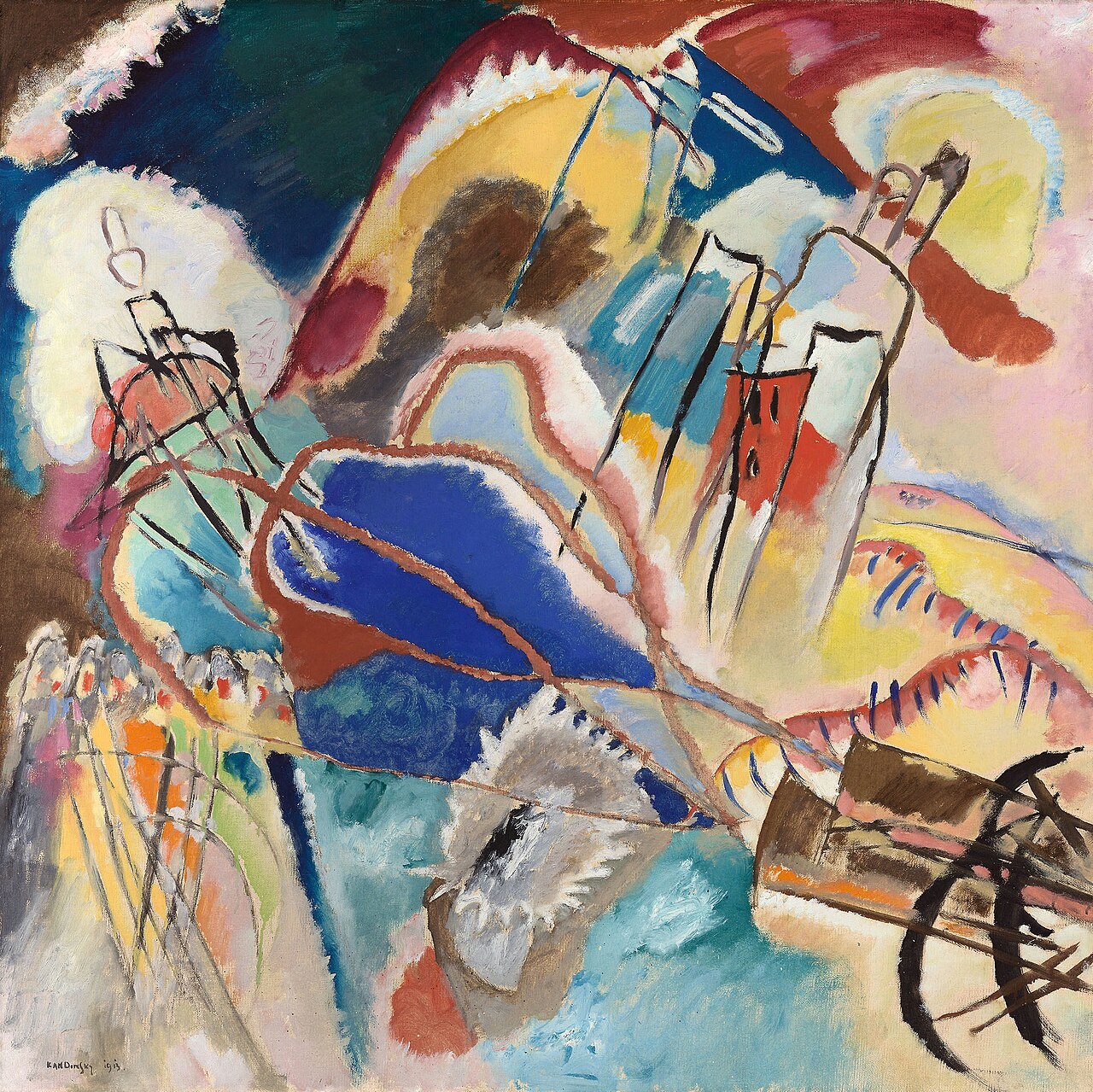
Begin at the black diagonals in the lower right, then move toward the large blue form near the middle. Angular lines and irregular areas of color create several competing directions. The title gives a clue: the Art Institute documents cannon references within the work. Abstraction here does not mean that every trace of the visible world has vanished.
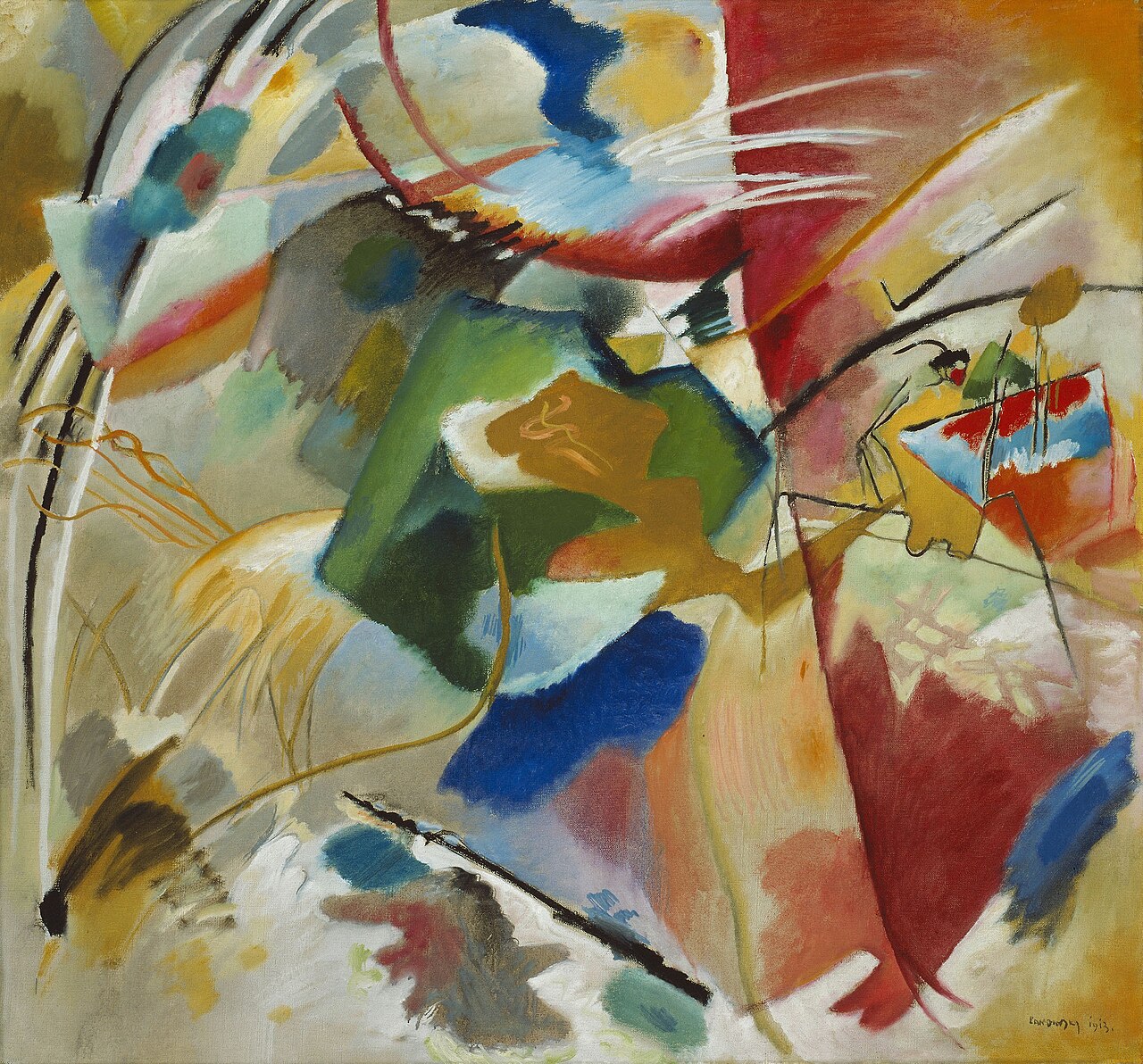
Now compare Painting with Green Center. The dark green mass gives your eye a place to gather, while fine black lines, pale sweeps and red passages pull away from it. Instead of cataloguing objects, try describing the relationship: a dense center surrounded by active lines and color.
Both paintings date to 1913. They demonstrate early abstraction, not the later American movement called Abstract Expressionism. Within that later movement, Pollock’s poured and dripped paintings offer a particularly clear example of gesture becoming the organizing feature; a museum viewing link appears below.
3. Organic and biomorphic abstraction: forms that suggest nature
Organic abstraction draws on natural forms and rhythms. “Biomorphic” is especially useful for shapes that suggest living forms—cells, bodies, leaves or growth—without necessarily depicting an identifiable organism. These are related descriptions, not exact synonyms for every curving picture.
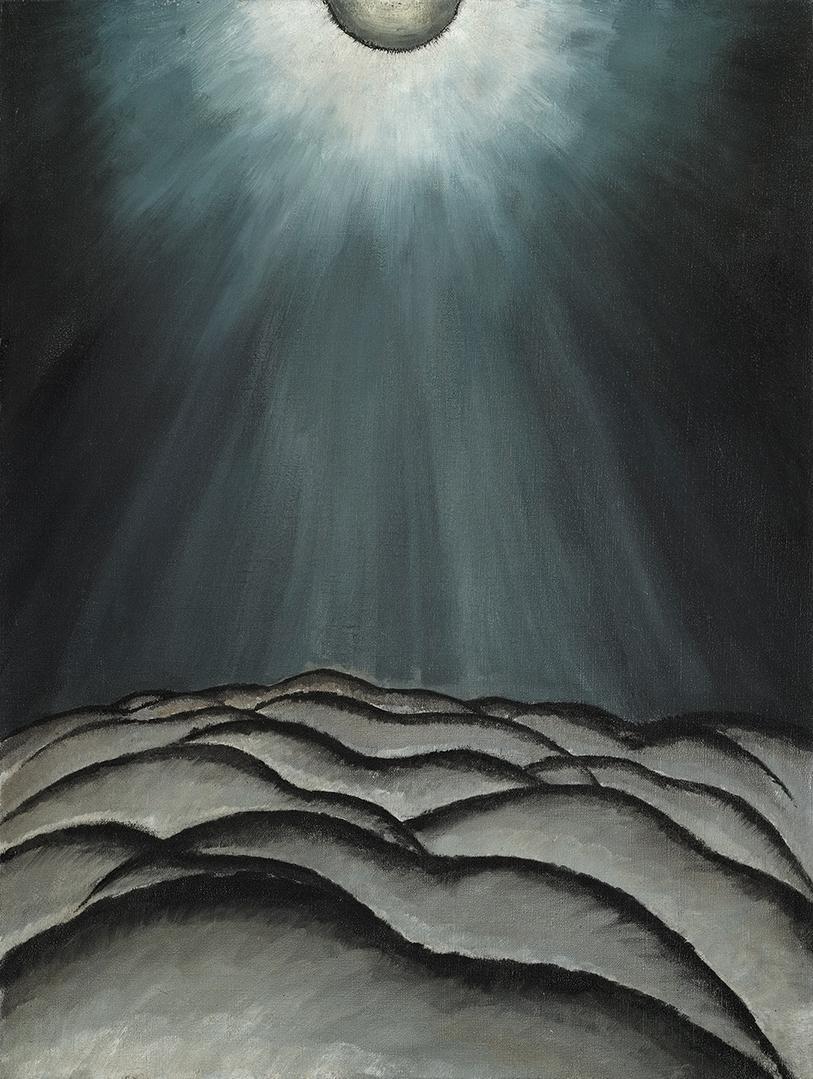
Arthur Dove’s Moon and Sea No. II keeps a recognizable natural starting point. A pale moon touches the top edge; below it, dark and light bands swell across the sea. Follow one band from left to right. The repeated curves carry more of the experience than small descriptive details would.
This is a helpful example of nature-derived abstraction that still retains a subject. It is not completely non-objective, and the image need not be called biomorphic simply because it contains curves. When browsing, “organic abstract seascape” describes it more precisely than either “realistic landscape” or “geometric grid.”
4. Color and rhythm: Delaunay and Orphism
Some abstract works are organized above all by the relationships between colors. In the early twentieth century, Robert Delaunay explored this territory through circular forms and color contrasts, in work associated with Orphism.
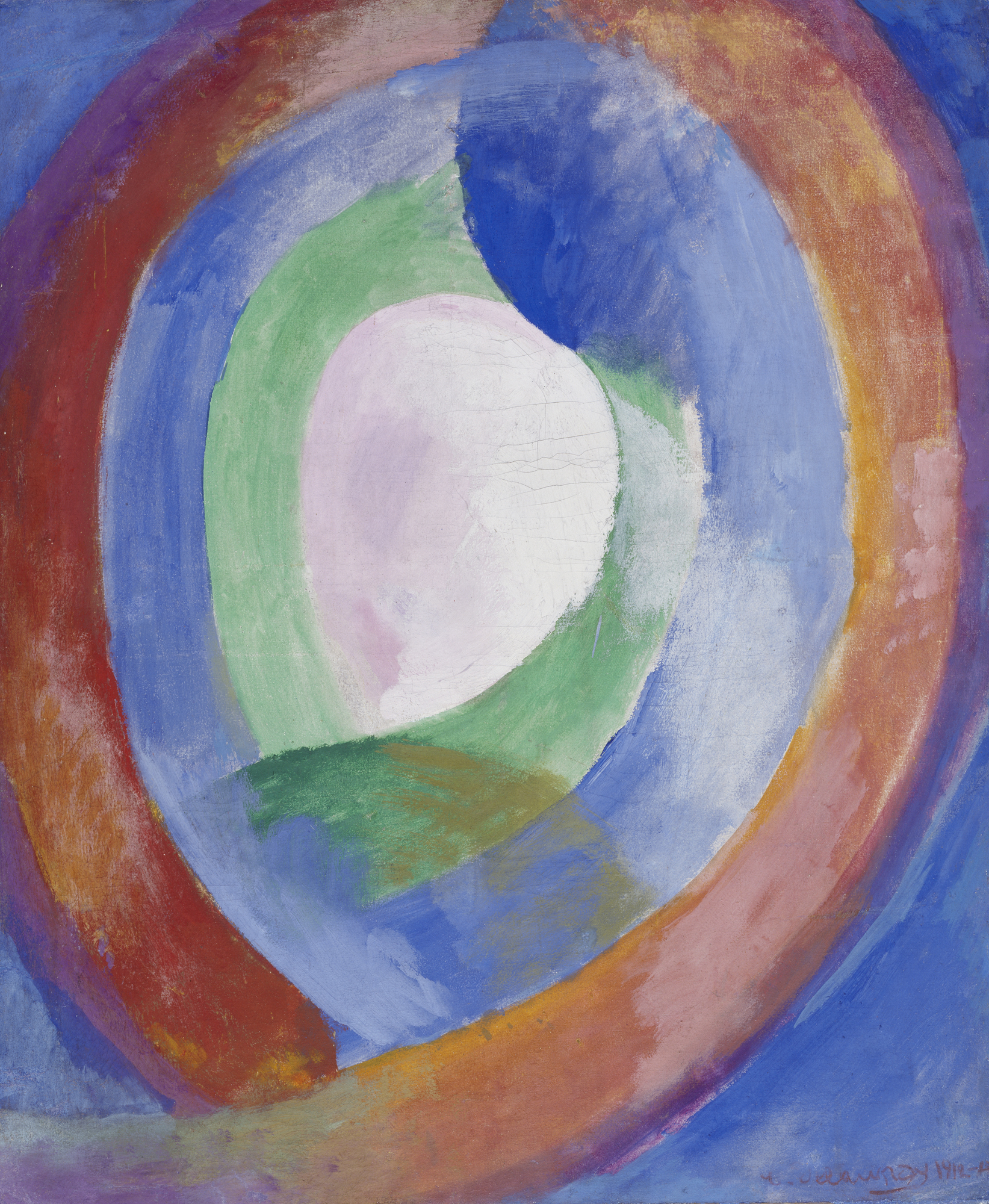
In Formes circulaires, lune no. 1, move outward from the pale central oval through green, blue, pink and orange bands. The rings do not form a uniform target: their widths vary, and some passages cut across them. The picture combines geometric structure with visibly brushed color.
Compare it with Kandinsky’s Painting with Green Center. Kandinsky gives the eye numerous independent lines to follow; Delaunay gathers it into broad, circling color relationships. Both use strong color, but they organize attention differently. Delaunay’s 1913 work is not an example of the later Color Field movement; that distinction matters even when two paintings both emphasize color.
Three later approaches to explore: gesture, color fields and optical effects
The early works above do not cover the whole story. These museum examples introduce major later approaches. Follow the links to view the actual paintings and their collection records.
Gestural Abstract Expressionism: Jackson Pollock
In One: Number 31, 1950 at MoMA, Pollock’s interlaced paint trails spread across the canvas. The museum documents pouring, dribbling and flicking paint onto canvas laid on the floor. Look for overlapping paths rather than a single outlined object. This is a documented process example; an energetic-looking digital image or print would not, by appearance alone, establish the same making process.
Color Field painting: Mark Rothko
Open Rothko’s No. 10, 1950, at MoMA. Broad horizontal areas and softly merging boundaries create a different experience from Pollock’s intricate trails. The museum connects the work’s warm and cool color relationships with Rothko’s interest in an enveloping emotional experience. Color Field emphasizes the expanse and interaction of color; it is more specific than “a colorful abstract painting.”
Op Art: Bridget Riley
See Riley’s Current, 1964, at MoMA. Its patterned lines create an optical experience rather than depicting moving objects. MoMA places the work in the context of The Responsive Eye, the 1965 exhibition of art using pattern and color for optical effects. When comparing an image with Klee’s repeated lines above, ask whether the pattern produces a perceptual effect, rather than treating every repeated motif as Op Art.
And where does hard-edge painting fit? It emphasizes sharply defined divisions between shapes or colors. It often overlaps with geometry, but a curved shape can also have a crisp boundary. Ellsworth Kelly’s Black Ripe, 1955, at Stanford’s Anderson Collection is a useful museum example: a dark organic form has a decisive boundary. Shape and edge are separate things to describe.
At the border: semi-abstract and dreamlike imagery
Surrealism is not another word for abstraction. A dreamlike picture can contain highly recognizable people and objects; an abstract picture can contain none. “Semi-abstract” is a useful descriptive term for imagery that simplifies or transforms a subject while retaining clues to what it is.
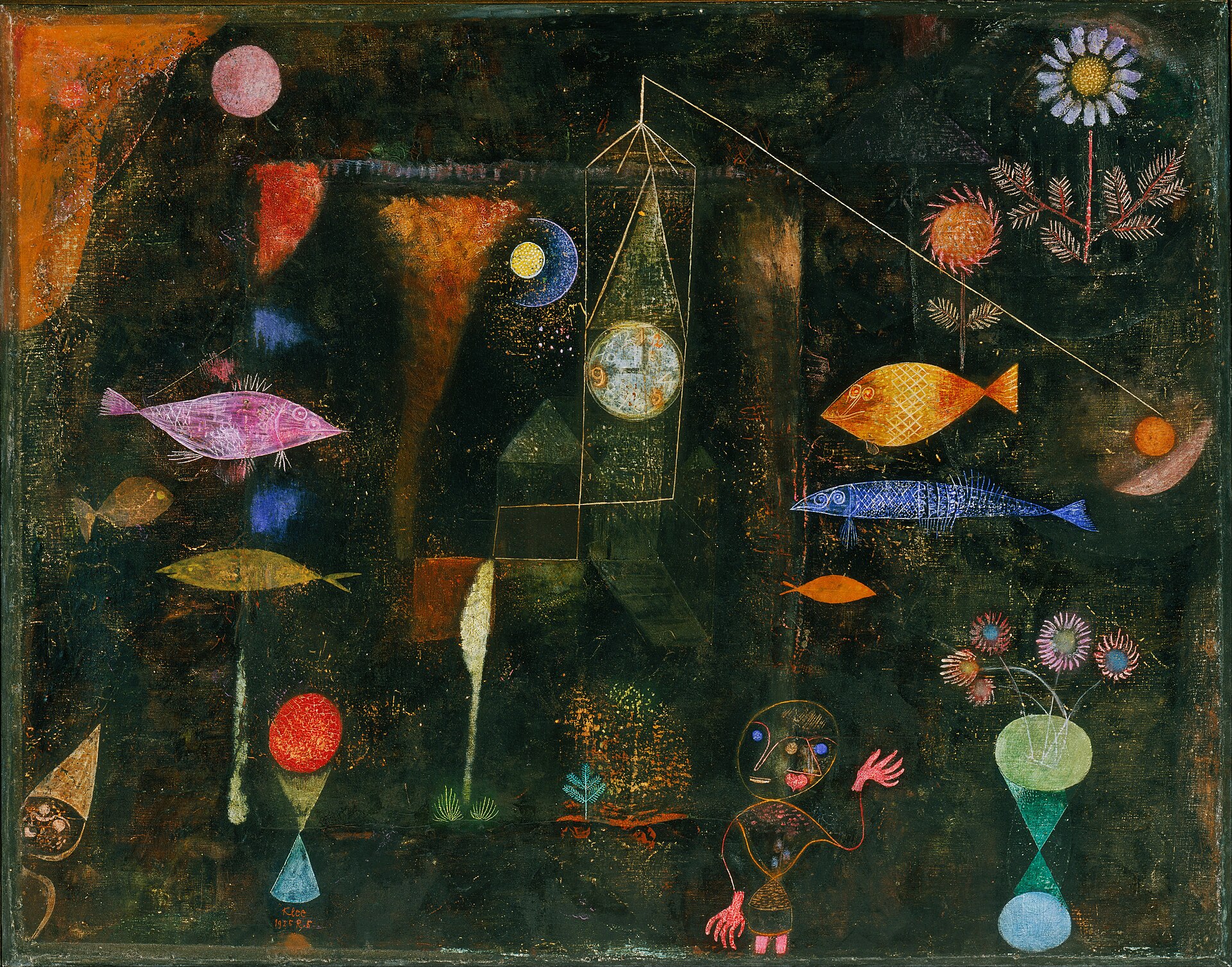
Klee’s Fish Magic makes that boundary visible. Find the pink fish on the left, the orange and blue fish on the right, and the small figure near the bottom. These are recognizable subjects, yet they share a dark, improbable space with flowers, circles and a suspended clock.
The comparison with Klee’s Variations is revealing: one relies on repeated linear structures, while the other assembles recognizable motifs into a fantastical scene. The artist’s name alone does not tell you how abstract an individual work will be. Here, “dreamlike imagery with abstract passages” is more informative than “pure abstraction.”
Use the examples to describe what you like
Suppose you like Dove’s swelling curves but find Mondrian’s grid too regular. Work through three observations:
- Subject: Dove still suggests a moon and sea; Mondrian does not depict a recognizable scene.
- Shape: Dove emphasizes irregular, flowing bands; Mondrian uses straight divisions and angular areas.
- Edge and rhythm: Dove alternates dark, curved boundaries with softer light; Mondrian uses strong, stable divisions.
A useful description is “organic, nature-derived abstract art with flowing forms.” If you instead want those forms without an identifiable landscape, try “biomorphic abstract art.” If the clear boundaries matter most, add “with crisp edges.” Keep the adjectives that match the images; you do not have to choose only one label.
A three-panel set, meanwhile, is a format rather than a type of abstraction. It could contain a geometric design, a gestural composition or a recognizable landscape. For a room, begin with the image qualities you want, then address format and placement. Our guide to choosing artwork without a fixed decorating style develops that next step.
A WhispArt example: semi-abstract forms with a surreal mood
This side of WhispArt sits close to semi-abstract, dreamlike imagery. These two works leave room for recognition without resolving every form into an ordinary scene. “Surreal” here describes their mood, rather than claiming membership in the historical Surrealist movement.
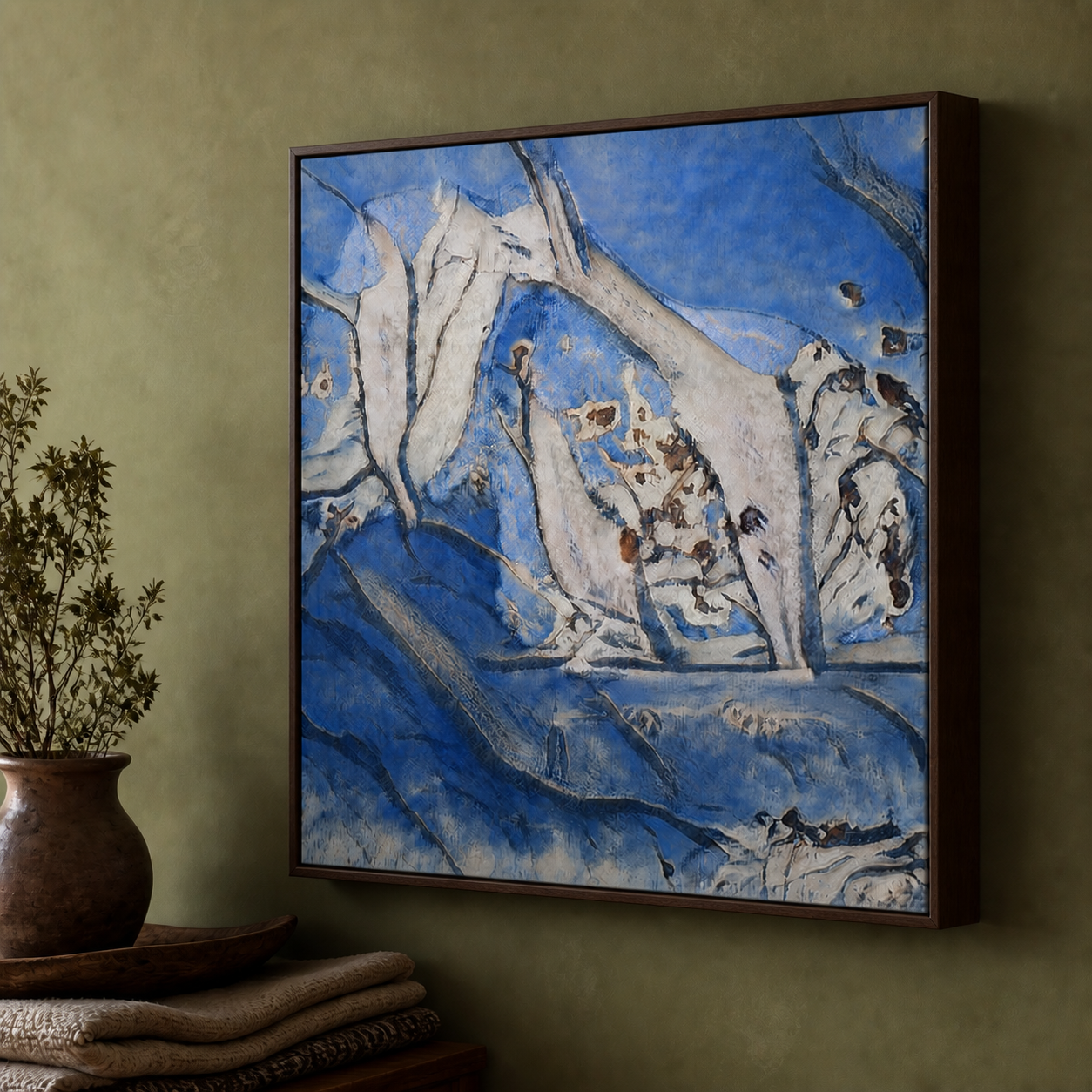
In Tide Without a Name, blue and pale flowing forms invite associations with water or landscape while remaining difficult to pin down. In the room illustration, the irregular composition gives the framed square an internal sense of movement.
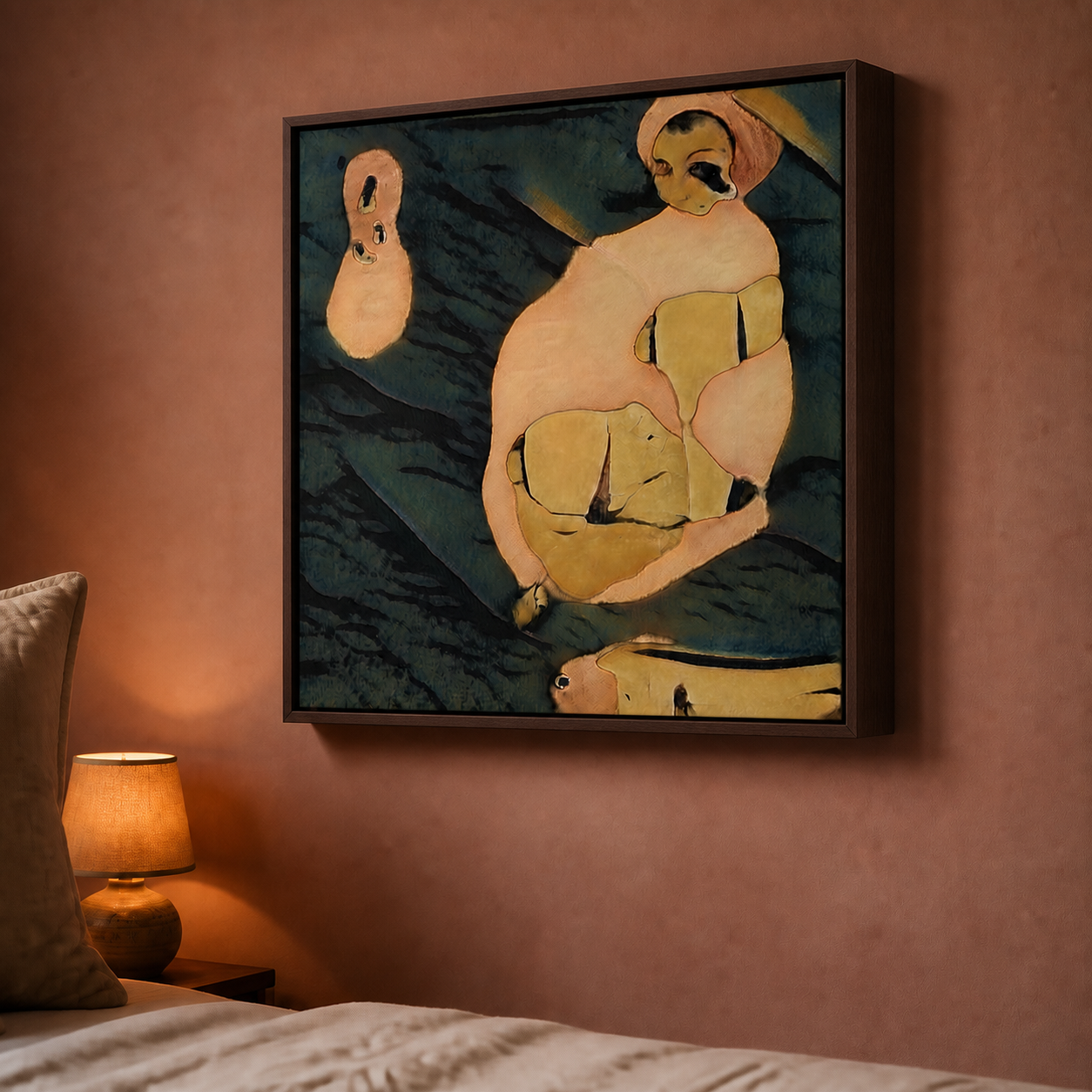
Vessel of Secrets leans further toward recognizable yet ambiguous imagery: peach-colored shapes suggest a figure and vessels against a dark teal field. It offers a useful middle ground for someone who enjoys abstraction but still wants hints of a story.
FAQ
How many types of abstract art are there?
There is no universal count. Lists often mix movements, methods and visual descriptions. Geometric, organic, gestural, Color Field, hard-edge and optical are useful starting points, but they overlap and do not exhaust the history of abstraction.
Was Van Gogh an abstract artist or an Impressionist?
Van Gogh is generally classified as a Post-Impressionist. In The Bedroom, expressive colors and visible strokes transform a recognizable room. That is different from a non-objective work built without depicted objects. He was not part of the later Abstract Expressionist movement.
Is Monet’s Water Lilies abstract art?
The answer depends on the particular painting and what you mean by abstract. The 1906 work shown here depicts an identifiable pond, even though its paint and reflections can look abstract in passages. Monet was an Impressionist; “non-objective” would be an inaccurate description of this specific example.
Which famous abstract artists should a beginner look at?
Start with Mondrian and Malevich for contrasting geometric structures, Kandinsky for active lines and colors, Dove for nature-derived forms, and Delaunay for color rhythm. Then compare Pollock, Rothko and Riley through the linked museum works. Klee is especially useful for seeing how one artist can move between abstract structure and recognizable imagery.
Are geometric and hard-edge abstract art the same?
No. Geometric describes the kinds of shapes; hard-edge describes sharply defined boundaries. They often occur together, but an organic curve can have a crisp edge, and a geometric shape can be visibly brushed or softly bounded.
Is Surrealism a type of abstract art?
The terms overlap in some works but are not interchangeable. Surreal imagery can retain recognizable figures and objects in dreamlike relationships. Abstraction concerns how a work departs from literal representation. Fish Magic shows why a fantastical scene need not be completely non-objective.
Can a print or digital artwork be abstract?
Yes. Abstraction describes the image’s relationship to representation; it does not identify the physical medium. A print may reproduce an abstract painting, and a digital work may use abstract shapes. Check the actual listing for medium and material rather than inferring painted texture from a picture.
Image and source notes
The historical images are reproductions of the named artworks, with public-domain or CC0 image sources linked in their captions. Looking cues are our visual readings; collection records provide artwork identities and historical context. WhispArt’s two supplied room images are styled illustrations, with illustrative frames and settings.
For the next stage of choosing an actual object, see our guide to buying wall art online: size, material and proof.



.png)
,_1927_-_Paul_Klee,_MET_DP-825-001.jpg)
_-_1931.511_-_Art_Institute_of_Chicago.jpg)


