Examples of Negative Space in Art: What the Gaps Do
Blue sky, pink intervals between branches, a pale patterned curtain: the space around a subject has a shape and a job of its own.
Negative space is the area around or between the main forms in an artwork. In the examples below, it appears as sky above a reaper, colored gaps between trees and a pale background around a standing woman. It helps us read the subject’s outline, position and relationship to its surroundings. It can contain color, texture and painted detail.
The Getty’s elements-of-art guide distinguishes the area occupied by primary objects—positive space—from the area around them. That gives us a useful starting point: choose the form you are looking at, then examine what surrounds it.
We would start there before counting how much of a picture looks empty. A broad opening above a figure and a small interval between two branches can both matter, but they do different things. These three real works make those differences visible.
Homer: an open sky above a dense field
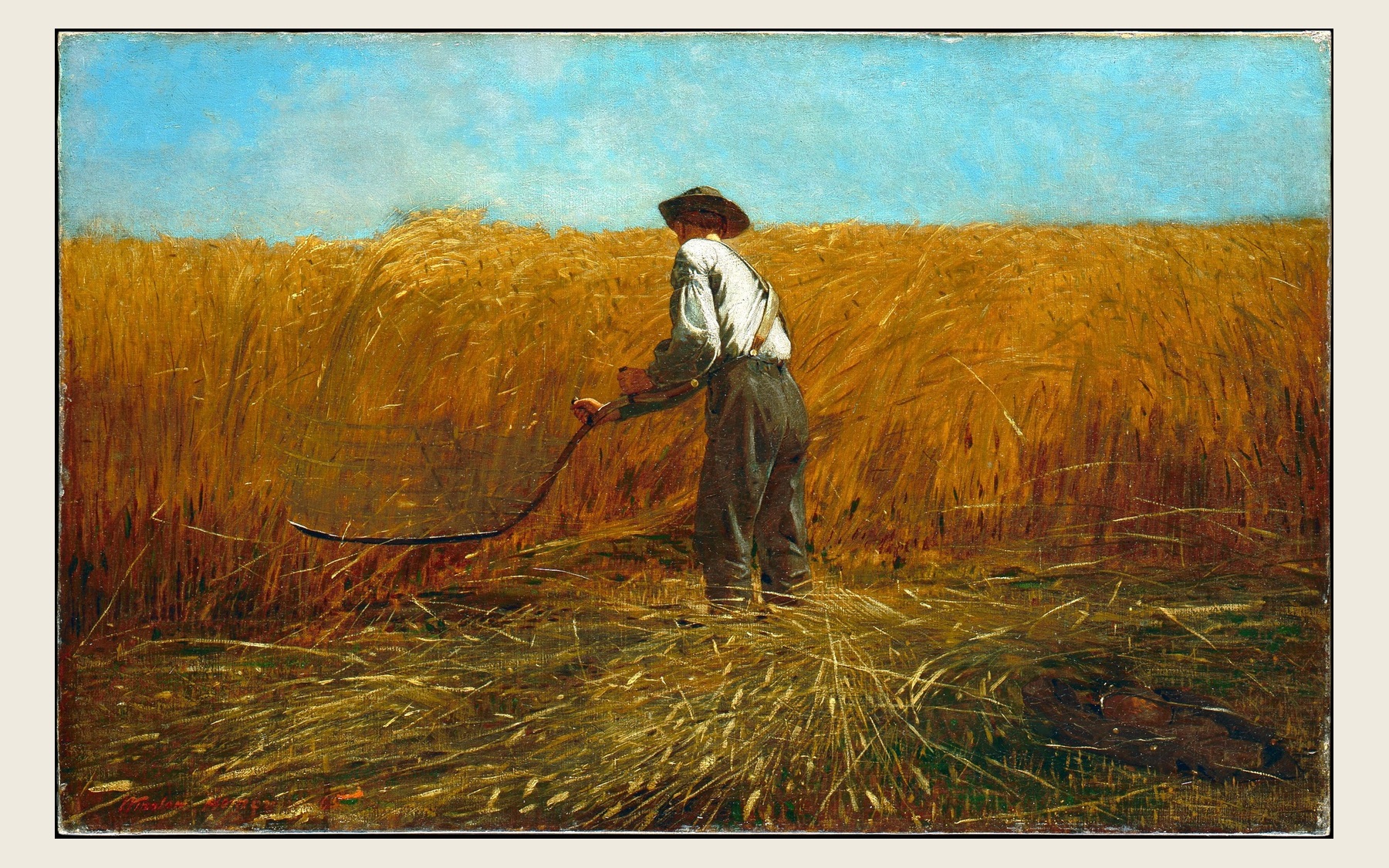
In Winslow Homer’s The Veteran in a New Field, begin with the reaper’s white shirt and dark hat. Above him, a broad blue band opens across the picture; around his lower body, strokes of standing and cut wheat accumulate.
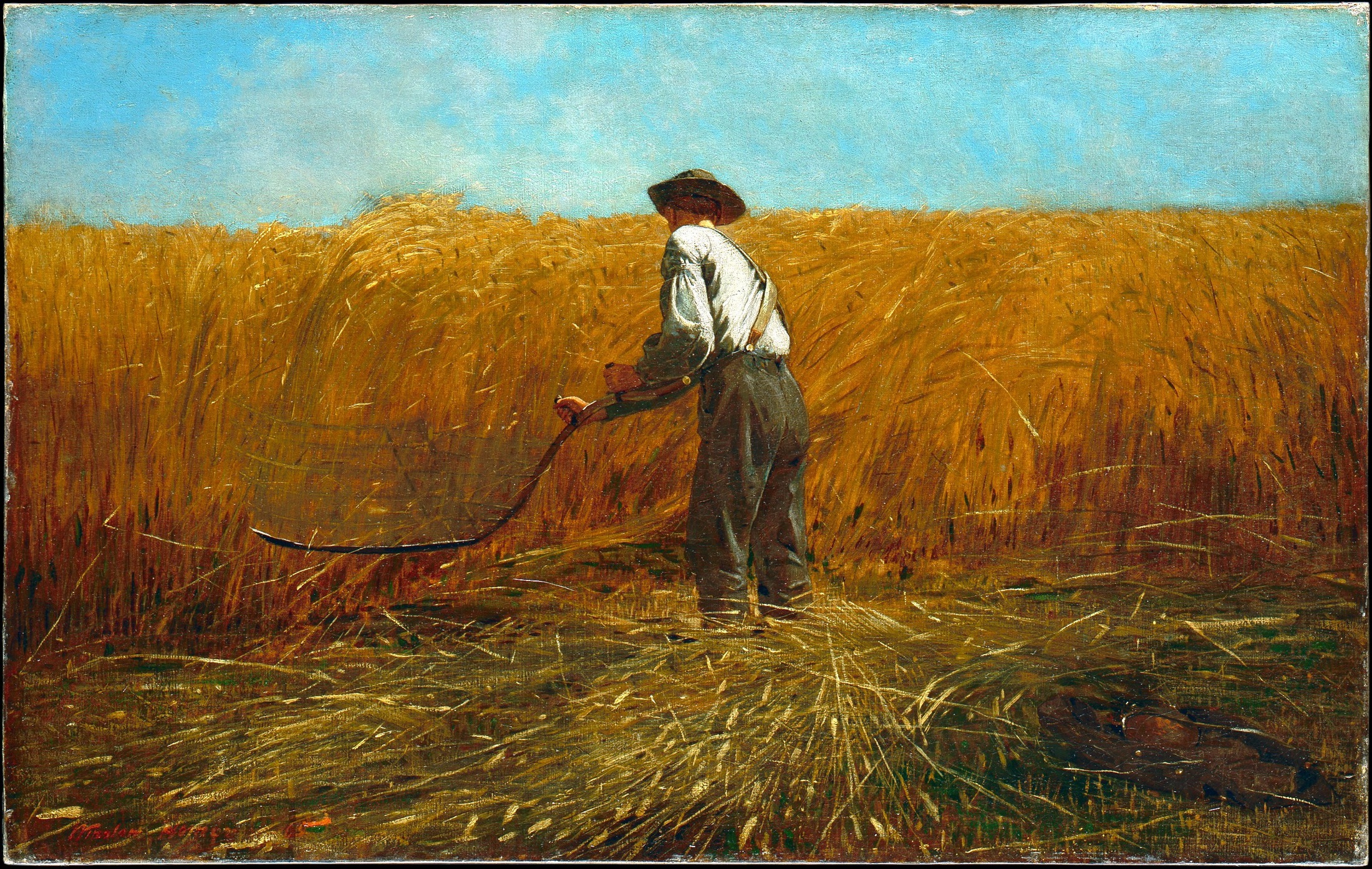
The sky is the clearest surrounding area to follow. Its relatively unbroken color makes the hat’s silhouette easy to find, while the wheat gives the figure a denser setting below. Look at the difference between the space just above his head and the busy marks beside his legs.
We would describe this as open headroom above a figure embedded in a textured field. Calling everything outside the man “empty” would lose what the wheat contributes: it has its own direction, density and weight.
Nor does the open sky settle the painting’s mood. The Met’s record dates it to 1865 and explains its tension between grief and renewal after the Civil War. The veteran’s discarded military belongings and his scythe carry meanings that a simple “space equals calm” reading would miss.
Hiroshige: pink spaces that give branches their rhythm
Utagawa Hiroshige’s Plum Garden at Kamata offers many smaller surrounding shapes. Follow the dark trunks upward, then look at the pink areas between their branching limbs.
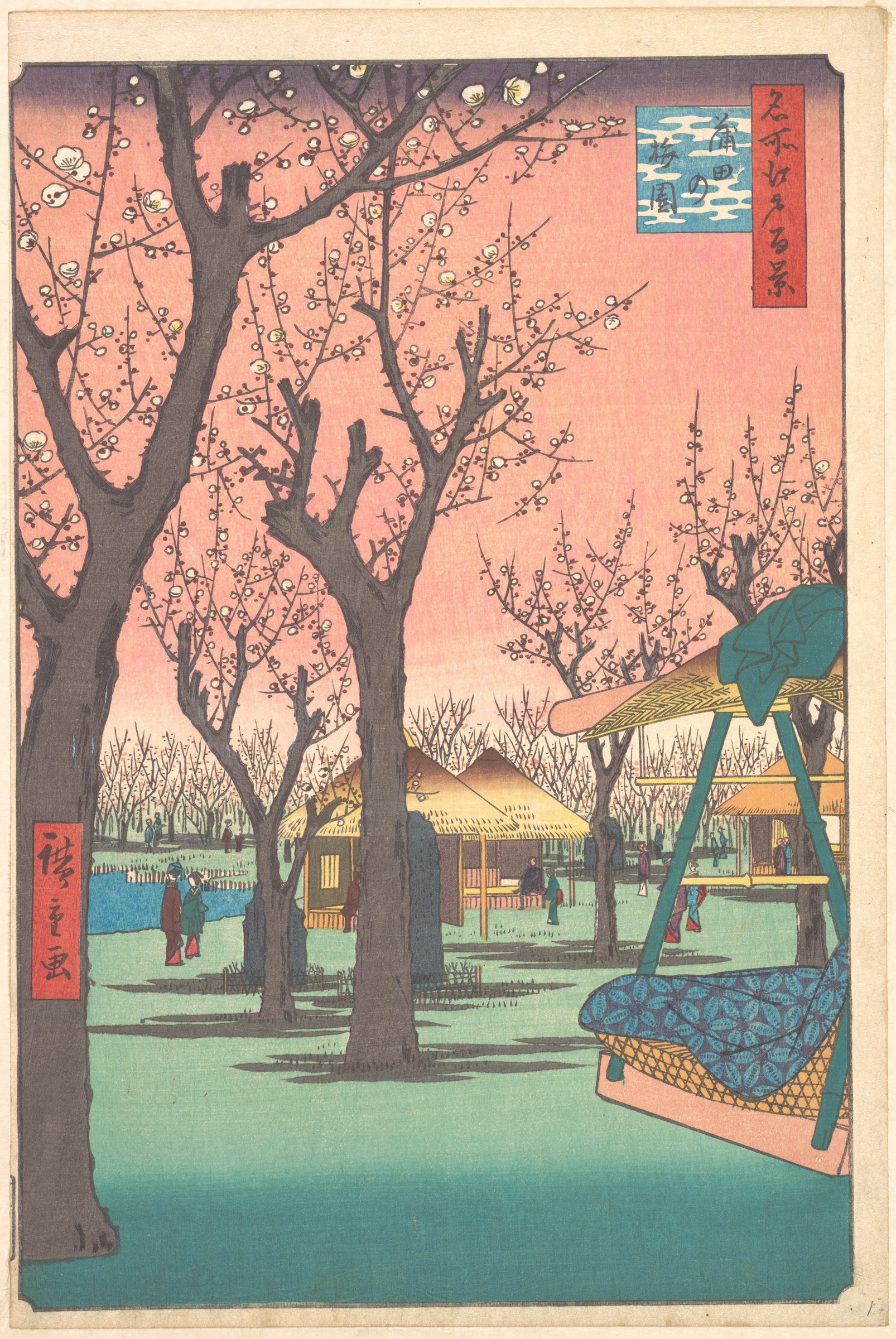
Those intervals differ in width and outline. Some taper into narrow forks; others open into larger patches of sky. Together they help articulate the trees: you can follow where a branch splits because the colored space separates one limb from another.
This is a useful example of negative space having its own shape. The pink is active in our reading even though it is not a tree. Fine twigs and blossoms interrupt it, so the surrounding area also varies in how open or intricate it feels.
The larger green ground below provides another interval around the trunks, small figures and foreground structure. It belongs to the represented garden and carries shadow. Here, attending to space means comparing these relationships rather than treating the background as a single blank region.
The Met identifies this particular work as an 1857 woodblock print in ink and color on paper. Its title is Plum Garden at Kamata; keeping the object identity precise matters when comparing reproductions of Hiroshige’s garden views.
Whistler: a painted background close to the subject’s color
In James McNeill Whistler’s Symphony in White, No. 1: The White Girl, the standing woman wears white against a pale curtain. Her dress occupies positive space in this reading. The curtain around her is the surrounding area, even where the two share similar tones.
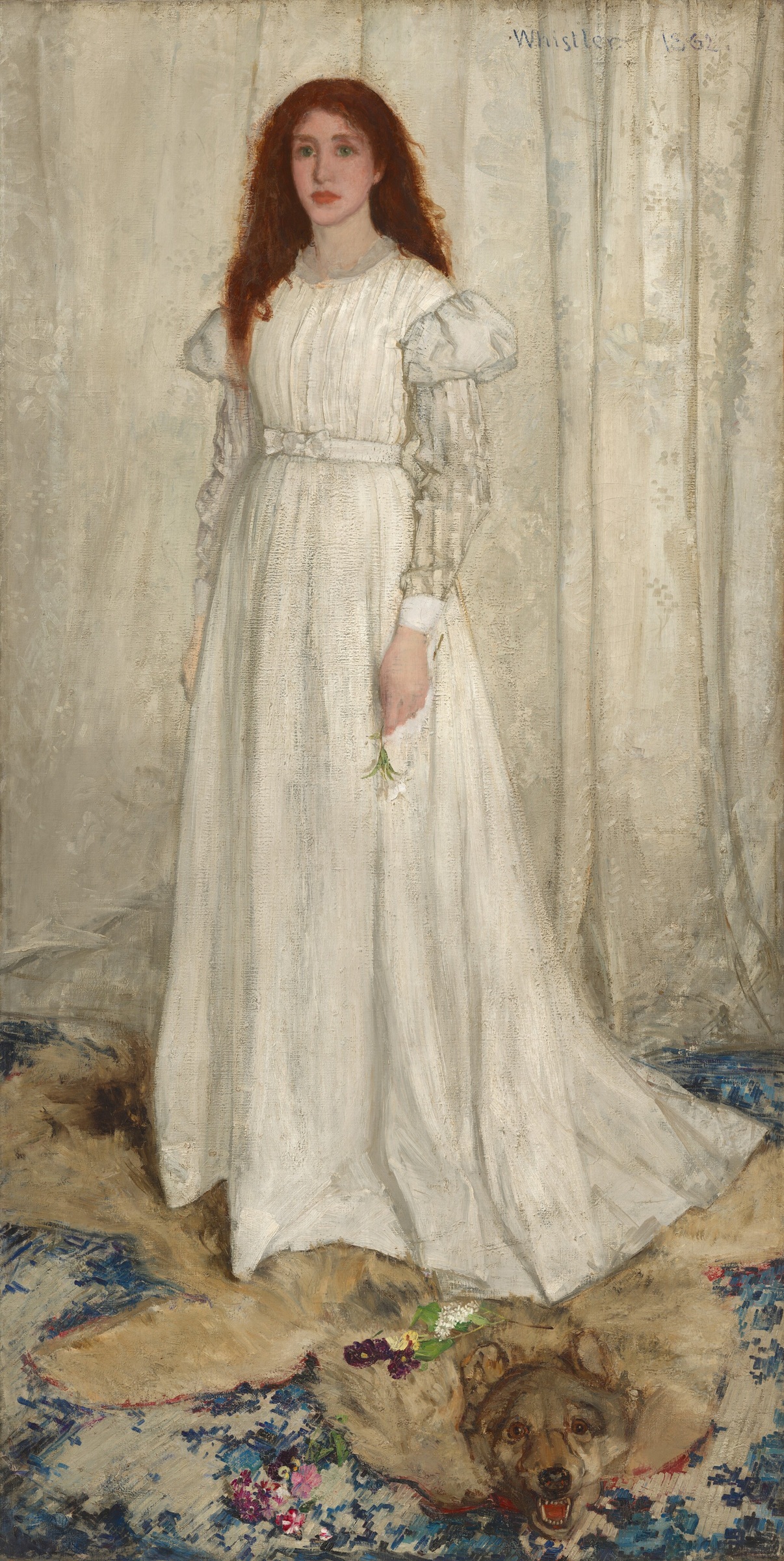
Follow the edge of her sleeve against the curtain, then compare it with her auburn hair against the same background. The hair creates a stronger contrast; parts of the dress require closer attention to slight shifts in tone and contour.
The background is painted and patterned. “Negative” describes its relationship to the figure here; it does not mean that the canvas was left untouched. This example also shows why the amount of white in a picture cannot tell you how much negative space it has.
The National Gallery of Art identifies the model as Joanna Hiffernan and records the painting’s dates as 1861–1863, 1872. Our close reading concerns the visible figure and surround; it does not establish a single intended emotion or replace that documented history.
A completed comparison: which example explains the space you mean?
Imagine a gallery conversation in which someone asks for a reference showing recognizable trees, irregular colored gaps and a branching rhythm. This is an editorial example, not a reported gallery commission.
We would choose Hiroshige for that brief. The pink intervals let us trace several branch divisions and compare narrow forks with wider openings. Homer’s upper sky gives a clearer example of one broad opening above a figure, but does not illustrate the requested branching intervals. Whistler makes a stronger reference for a pale figure whose boundary is close in tone to its background.
The choice changes with the question. For “show me how space above a person changes their placement,” we would start with Homer. For “show me how the subject and surround remain distinct when both are pale,” we would use Whistler. These are references for looking and describing, rather than claims that any historical object is available to buy.
That is a more useful outcome than saying that all three have “good negative space.” You can name the relationship you actually want to discuss: broad upper opening, branching intervals or a subtle figure boundary.
When the question is “is there too much space?”
In a photography critique about a dark self-portrait, visible replies disagreed: some preferred a tighter crop, while others valued the surrounding darkness. That discussion illustrates a particular judgment problem; it does not establish a universal rule or a survey of art buyers.
For the works here, we would ask what a proposed crop removes. Cutting Homer’s sky reduces the opening above the reaper. Cropping into Hiroshige’s branches changes the intervals we have just followed. Tightening Whistler around the woman removes some of the pale surround against which we read her figure. More or less space becomes a concrete change to a particular image.
You can also examine this relationship in nonrepresentational work. Our guide to different types of abstract art offers the broader category context; this article’s task is to describe the forms and spaces within a chosen image.
Questions about negative space in art
Does negative space have to be white?
No. Homer’s blue sky and Hiroshige’s pink intervals both function as surrounding areas in the readings above. Color does not determine whether a form is positive or negative; its relationship to the subject matters.
Is every background negative space?
A background can function as negative space around the main subject, but it may contain other objects that deserve attention as positive forms. Name the subject you are discussing, then identify the particular areas around it. Homer’s wheat, for example, is a detailed part of the scene rather than an empty backdrop.
Is negative space the same as unpainted paper or canvas?
Unmarked paper can serve as negative space, but painted areas can serve that role too. Whistler’s curtain is painted; it functions as the surround when we focus on the standing woman.
How much negative space should an artwork have?
There is no required percentage for these examples. Judge the actual relationship: the opening above a figure, the intervals between branches or the contour against a pale surround. A crop changes that relationship, so its effect needs to be considered in the particular image.
Sources and approach
We used the Getty’s elements-of-art explanation, the Met’s records for Homer and Hiroshige, and the National Gallery’s Whistler record. The interpretations come from looking at the reproduced works; the gallery comparison is hypothetical. Digital images support composition reading, not examination of an original surface.
Cover: Winslow Homer, The Veteran in a New Field. Public domain / CC0. Full painting fitted within a neutral matte; the full reproduction appears above.