Jazz Art Has No Single Style: Read the Image Before the Label
A musician in a picture, a painting built around visual rhythm, and an image merely described as “jazzy” are three different things. Real works make the difference visible.
The short answer
There is no single jazz art style. Some artists depict performers or a club; others let repetition, interruption or changing scale carry something they associate with music. The strongest connection is not necessarily the most literal-looking image. To read one, ask three separate questions: What does the work show? What does its composition do? What evidence connects it to jazz? A saxophone motif answers the first question only partly; a quick, broken line answers the second only by interpretation. Neither alone proves the artist's source.
We use “jazz art” here for visual art with a stated or documented relation to jazz, while allowing a viewer's musical association to remain an association. That distinction matters when you want to understand an artwork rather than buy a mood label.
A three-test way to look
Start with the image, then check the record. The sequence below is our editorial tool, not a claim that music can be translated into a fixed set of shapes.
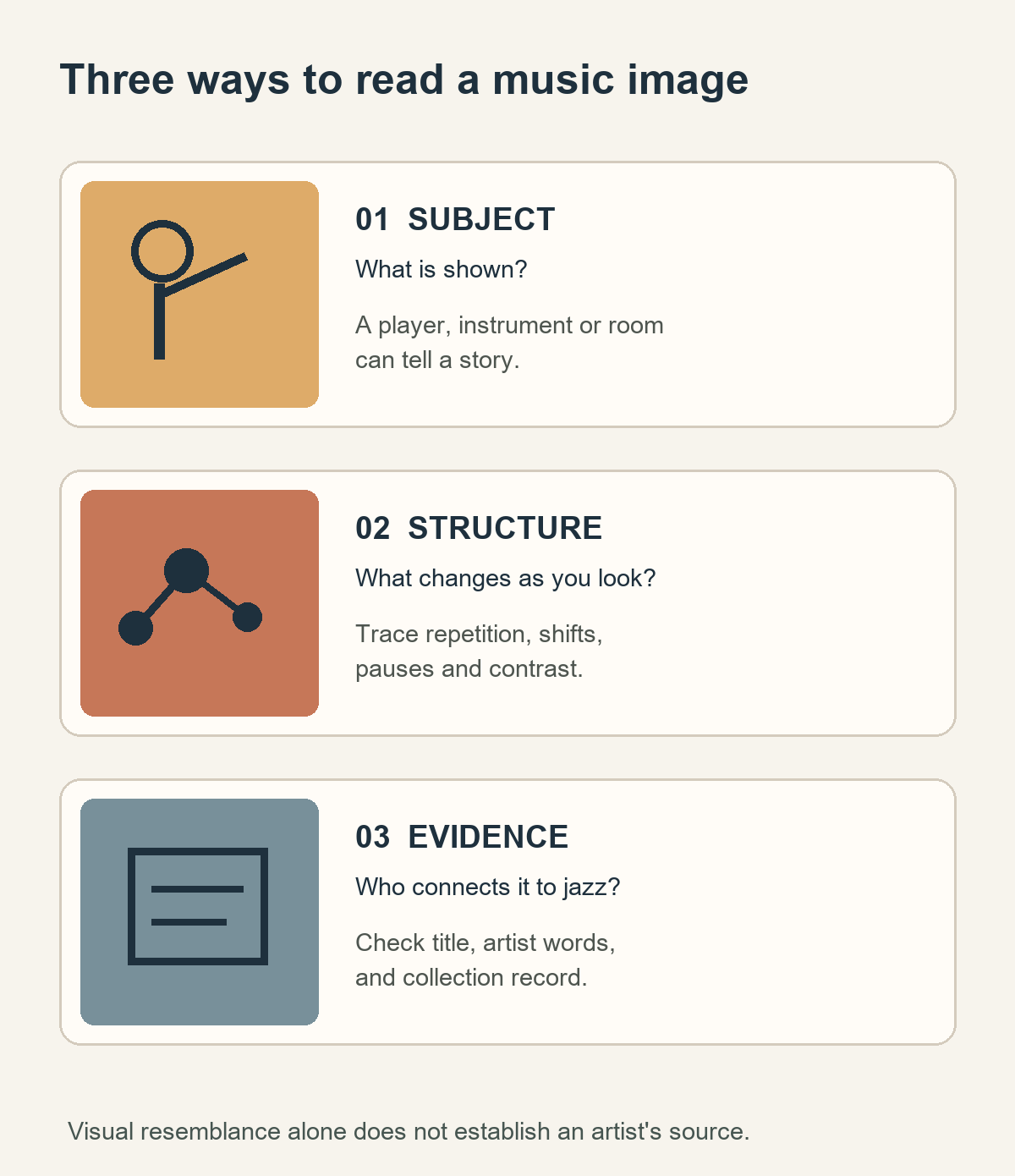
The National Gallery of Art places a performance photograph, Mondrian's rhythmic geometry and Bearden's layered collage in the same jazz-inspired conversation. Their images do not share a single palette, medium or amount of abstraction. The useful commonality is an explainable relationship to music, not a uniform look.
A real work with a visible musician: Albert Gleizes
Albert Gleizes's Composition for “Jazz” (1915) is an instructive first stop because it resists a tidy category. We can identify a player and the round body of an instrument, yet the figure is divided by angled planes. The instrument becomes part of the composition's changing shapes, rather than a realistic scene to inventory. Look from the pale circular form toward the dark vertical and diagonal areas: the eye has to reconstruct the performer as it moves. That visual work is more interesting than simply saying “it has a musician.”
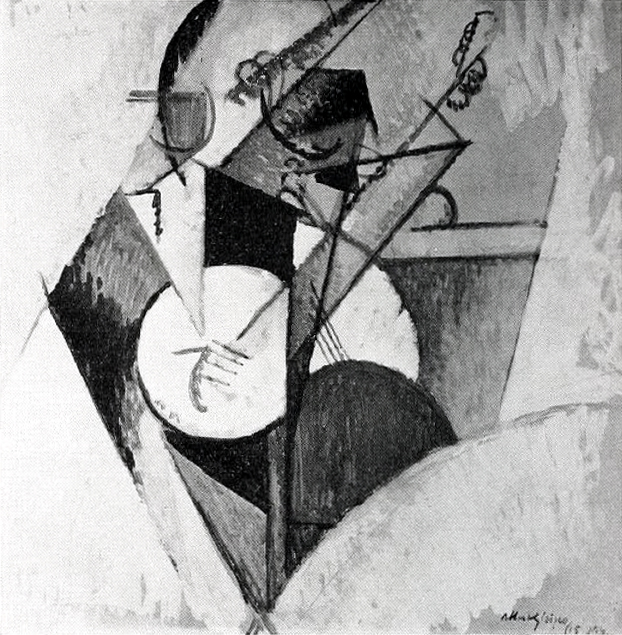
The title and Guggenheim collection identity justify describing a jazz connection. They do not tell us exactly which sound each diagonal represents, or that this 1915 work anticipates every later form of jazz. We would rather leave that uncertainty visible. The style label here is Cubist, while the jazz association is the work's title and subject; those are related facts, not synonyms.
When no musician is pictured, trace the decisions
Open the National Gallery's image of Piet Mondrian's Broadway Boogie-Woogie (1942–43). Its account connects the shifting colored grid to music Mondrian heard after moving to New York. Follow one line in the museum image: color interrupts a path, a small unit recurs, another direction cuts through. Do not invent a one-to-one code between paint and notes. The musical context comes from the museum's documented account, while the path you trace is a visual interpretation. We link to the copyrighted museum image rather than copy it.
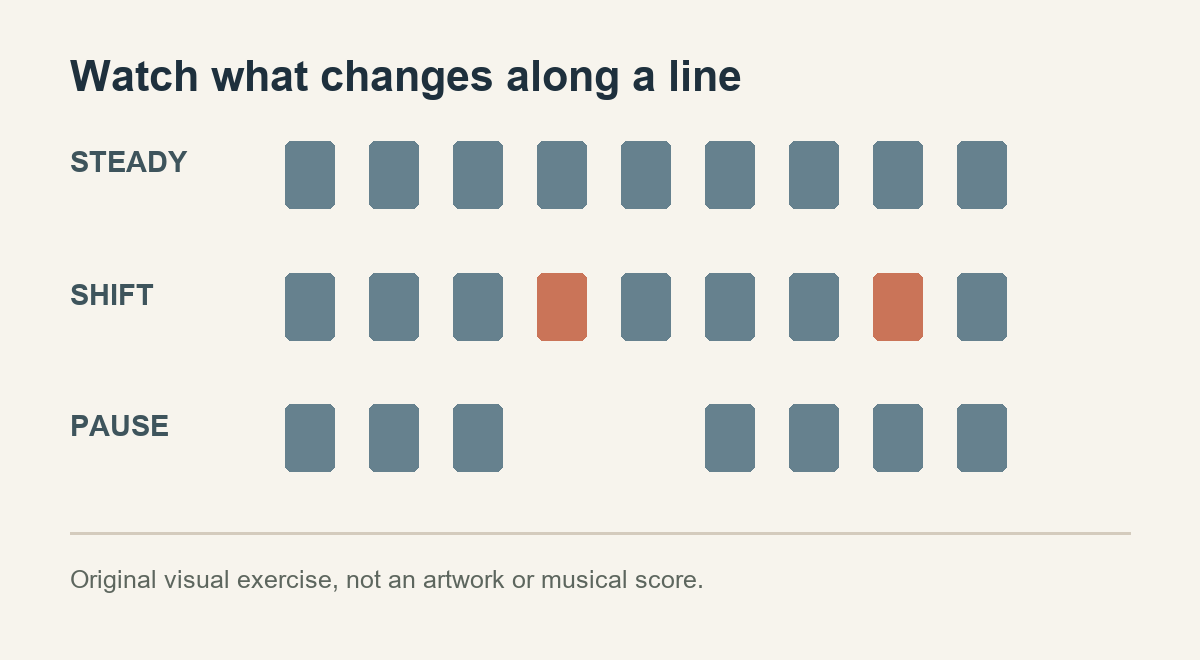
The next graphic is our own simpler exercise. A repeated unit changes color twice, then an empty space interrupts the sequence. It teaches what to look for in a composition; it is not a reduction of Mondrian's painting or a transcription of a track.
Romare Bearden takes a different route. The Gallery explains that his collage Tomorrow I May Be Far Away (1967) borrows its title from a blues song and uses changes in scale, pattern and perspective to build a layered sense of memory and movement. “Jazz-influenced” does not require us to erase the blues source or claim the collage literally illustrates a performance. The artist's cultural and musical context is part of the account. A retail tag such as “abstract jazz” is thinner evidence than this.
One discussion of favorite jazz-inspired art moves from Mondrian to Bearden to album sleeves and concert prints. In another artist's drawing discussion, people ask what was playing and describe different pictures as sounding different. Those are useful questions and individual reactions, not proof that a shape has a universal musical meaning. Our view is that a work becomes more legible when the artist or institution can say what musical relation it actually has.
A musical picture is not automatically a jazz picture
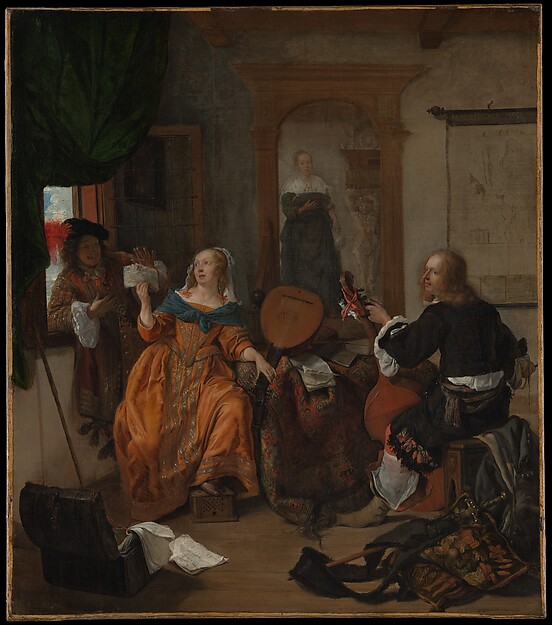
Gabriël Metsu's A Musical Party (1659) makes the simplest boundary visible. The lute, viol and songbook belong to a scene of music-making, but the Metropolitan Museum of Art dates it more than two centuries before jazz emerged. The picture has musical subject matter; it is not jazz art. Its careful depiction of people also reminds us that “music art” is not a single visual treatment.
A closer-looking boundary is Paul Klee's Bad Band (1920). The holding museum identifies a musical subject but does not document a specific jazz source, so we link to its record rather than reproduce the copyrighted image or assign the music by appearance. A portrait may be stylized without being wholly abstract; a fully abstract work may have a documented music source without showing an instrument. A discussion of an Ornette Coleman portrait even disagrees about whether the image is abstract, surreal or “looks like jazz.” We treat those as reactions and ask for the artist's account before making a stronger label. If the separate question is how abstract movements differ, our guide to real abstract paintings handles that taxonomy.
For a jazz-club wall, choose the relationship before the motif
A club owner has a practical version of the same question. Suppose a small stage-side wall needs one artwork visible from the nearest tables. We would ask whether it should honor a particular musician, convey the motion of performance, or simply make the room warmer. Those are different briefs. A named, credited performance photograph may fit the first; a contemporary artist's documented response to local musicians could fit the second; a warm but generic pattern can do the third without needing a historical “jazz art” claim.
If the shortlist is an uncredited retro saxophone image versus a work with identified maker, source and display rights, we would carry the latter forward provided it still reads from the seats and the rights cover the intended use. First check authorship and permission. Then test the actual framed footprint and contrast in the club's evening light from the table and approach. If the source work is unavailable or too quiet at that distance, commission an original with a clear brief or find another documented work; do not lift a museum image from a web page. This is an editorial selection method for a fictional wall, not a completed installation or a product recommendation.
We would also keep the artist's identity in the description. Jazz is not just a font, a sax silhouette or a retro filter. A convincing art choice can explain its subject or source without pretending every fast mark is a musical quotation.
FAQ
Is jazz art a single painting style?
No. It may be representational, photographic, collaged or abstract. Ask how the work depicts or responds to music, and what source supports that connection.
Does a painting need a saxophone or musician to count as jazz-inspired?
No. The National Gallery documents Mondrian's musical context for Broadway Boogie-Woogie, although the painting is a geometric composition. A visible instrument can be helpful subject matter, but it does not by itself identify the music being played.
Is every abstract painting with rhythm jazz art?
No. Repetition, interruption and movement are visual qualities; they are not proof of a particular artist's musical source. Check the title, artist's words or a credible collection record before stating the connection as fact.
Is a musician portrait abstract or surreal?
It depends on the individual work. A distorted but recognizable figure can remain representational, while abstraction can reduce or remove recognizable imagery. Describe what is visible first; use a style label when the artist or artwork supports it.
Can I print a museum's online jazz artwork for a club?
Not from the image's age or web availability alone. Check the specific work, reproduction and commercial display rights. The two historical images reproduced here have public-domain file records; that status does not transfer to the linked Mondrian or Bearden images, or to every museum photograph.
Sources and image note
Art examples and context: National Gallery of Art, “Seven Artists Inspired by Jazz”; Gagosian Quarterly, “Painting Jazz”; Guggenheim object record for Gleizes; Met record for Metsu; and Barnes record for Klee. The reproduced Gleizes image has a public-domain Commons file record; the Metsu image is Met Open Access. Klee is linked only because the holding museum marks it in copyright. The cover and two teaching diagrams are original WhispArt editorial graphics, not historical artworks, products or a photographed club. Reddit links identify questions and differing reactions; they are not a survey.