Movement in Art: Action, Rhythm, and the Still Life That Leads Your Eye
Running children make movement easy to recognize. A table of fruit asks a subtler question: can a picture feel active when nothing in its scene is moving?
Homer: the bodies tell us that an action is happening
In Winslow Homer’s Snap the Whip, start with the children’s feet. Some are planted, others lifted; knees bend in different directions. Their joined hands stretch the group across the field, while the children at the left have lost the chain.
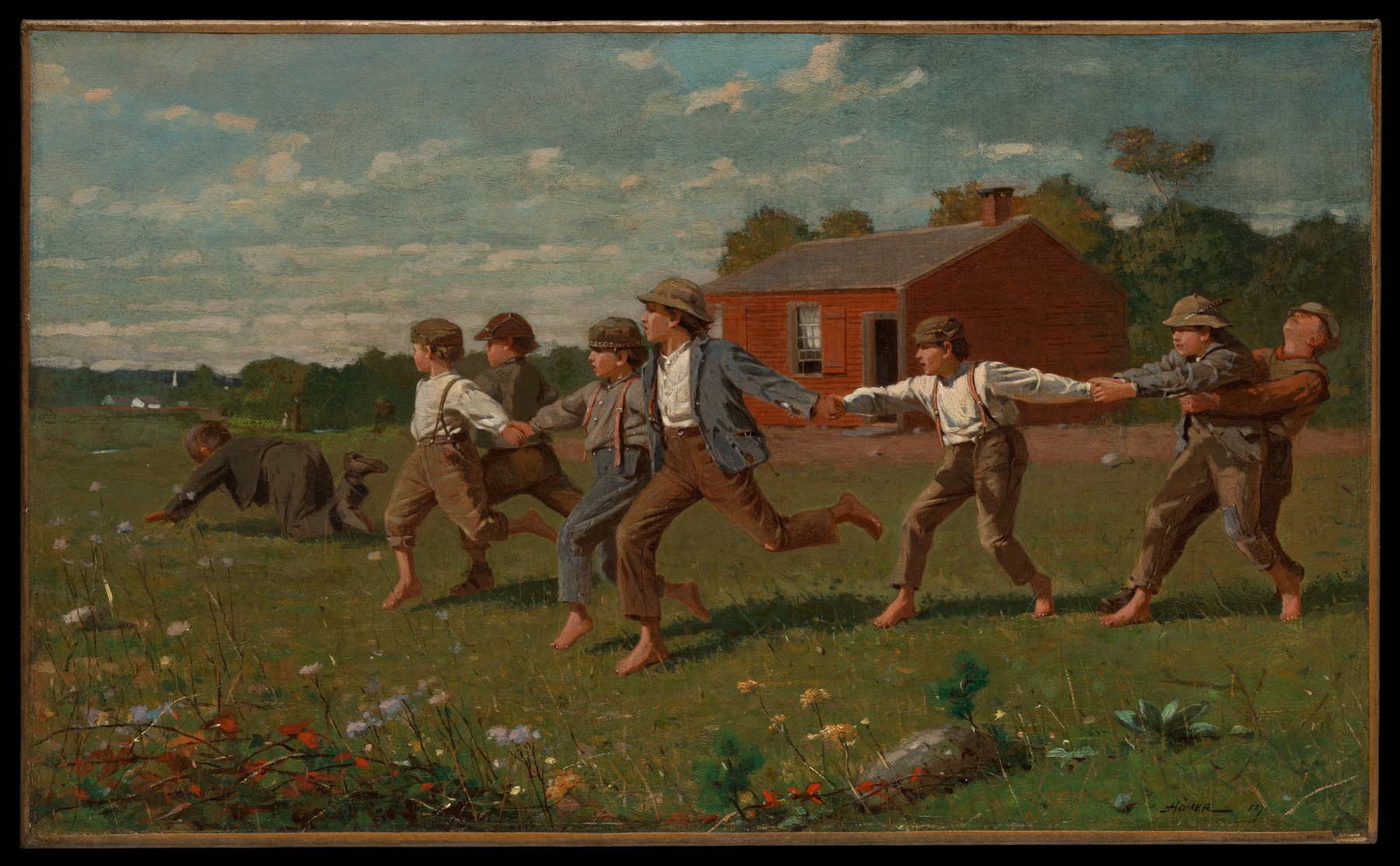
The linked arms suggest pulling; the unequal footing suggests a game that cannot remain in this exact position. This is depicted action: we infer motion from bodies and their relationships. We are not seeing consecutive frames of a film, and the painting does not give us a measured speed.
There is also a route across the composition. Following one hand to the next connects several figures. That route and the children’s action reinforce each other, but they are not the same claim. “The children are running” describes what happens in the scene. “The joined hands connect the figures across the picture” describes how its parts relate.
For a workshop discussion about recognizing action, we would choose this painting first. The answer can point to something concrete: lifted feet, leaning bodies and the pull between hands. It does not depend on declaring every diagonal inherently energetic.
Van Gogh: repeated marks make a landscape feel active
Now look at Vincent van Gogh’s Two Poplars in the Alpilles near Saint-Rémy. Two tall trees rise through the center. Their short, curling marks differ from the longer blue and pale strokes traveling across the sky.
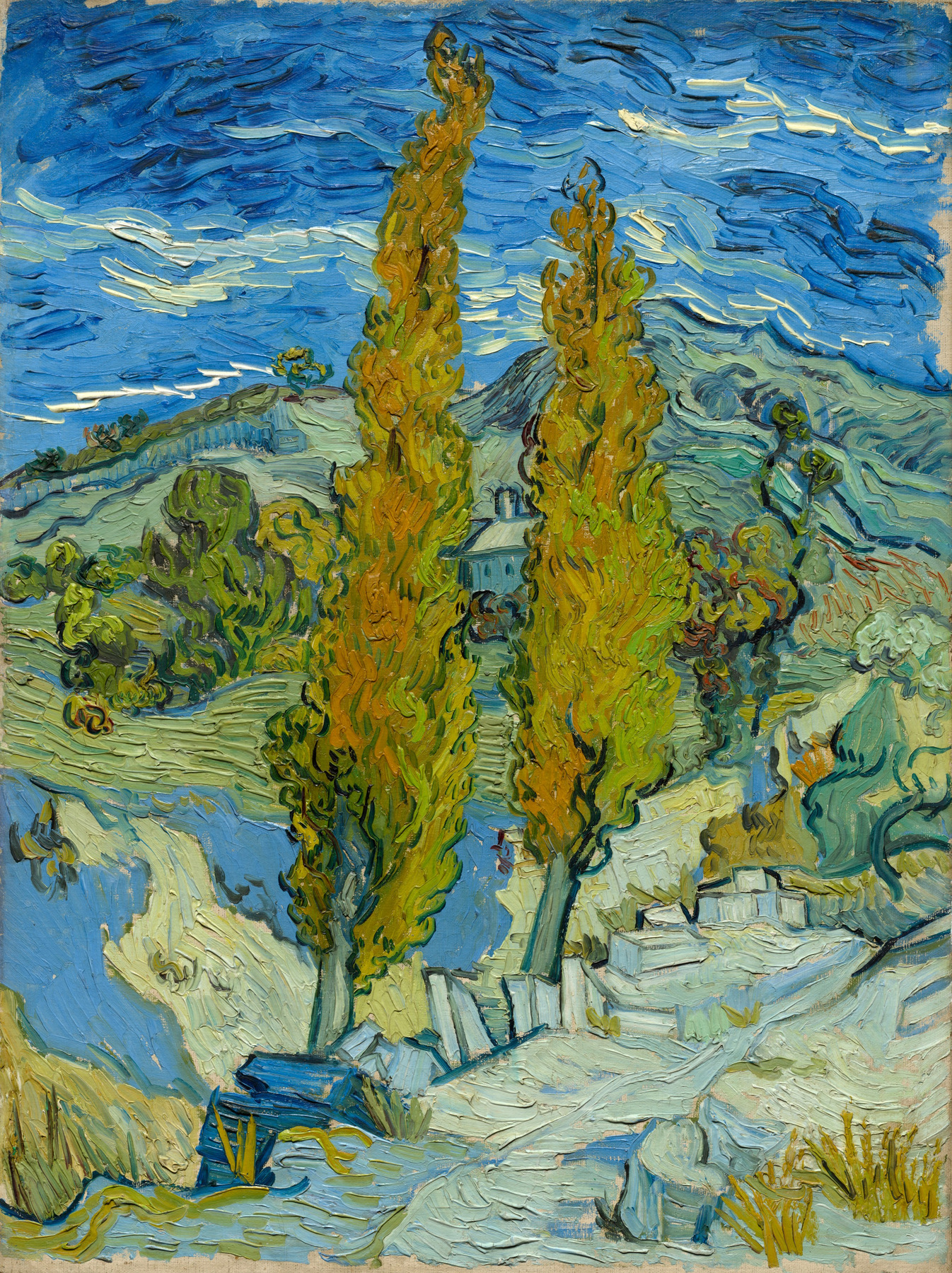
I read an upward pull in the narrow trees and a sideways flow in the sky. Repeated strokes create a rhythm; changes in their direction keep that rhythm from becoming a row of identical marks. The pale ground and curving hills extend the comparison into the lower half of the painting.
This gives us a more careful description than “the trees are blowing in the wind.” The marks are visible; a particular wind speed or weather event is not established by them. We can describe the painting’s directional activity without turning that reading into a report of what physically happened in the landscape.
Rhythm concerns repetition and variation; movement concerns the action or direction we perceive. Rhythm can contribute to movement, as it does in this reading, but repeating a shape does not automatically depict something traveling. For the separate vocabulary of contours, edges and implied paths, see our guide to line in art.
Cézanne: the objects stay still while the arrangement invites looking
Paul Cézanne’s Still Life with Apples and Peaches provides the useful counterexample. No fruit is shown falling or rolling. No hand enters to pick anything up. Yet the arrangement offers relationships we can follow.
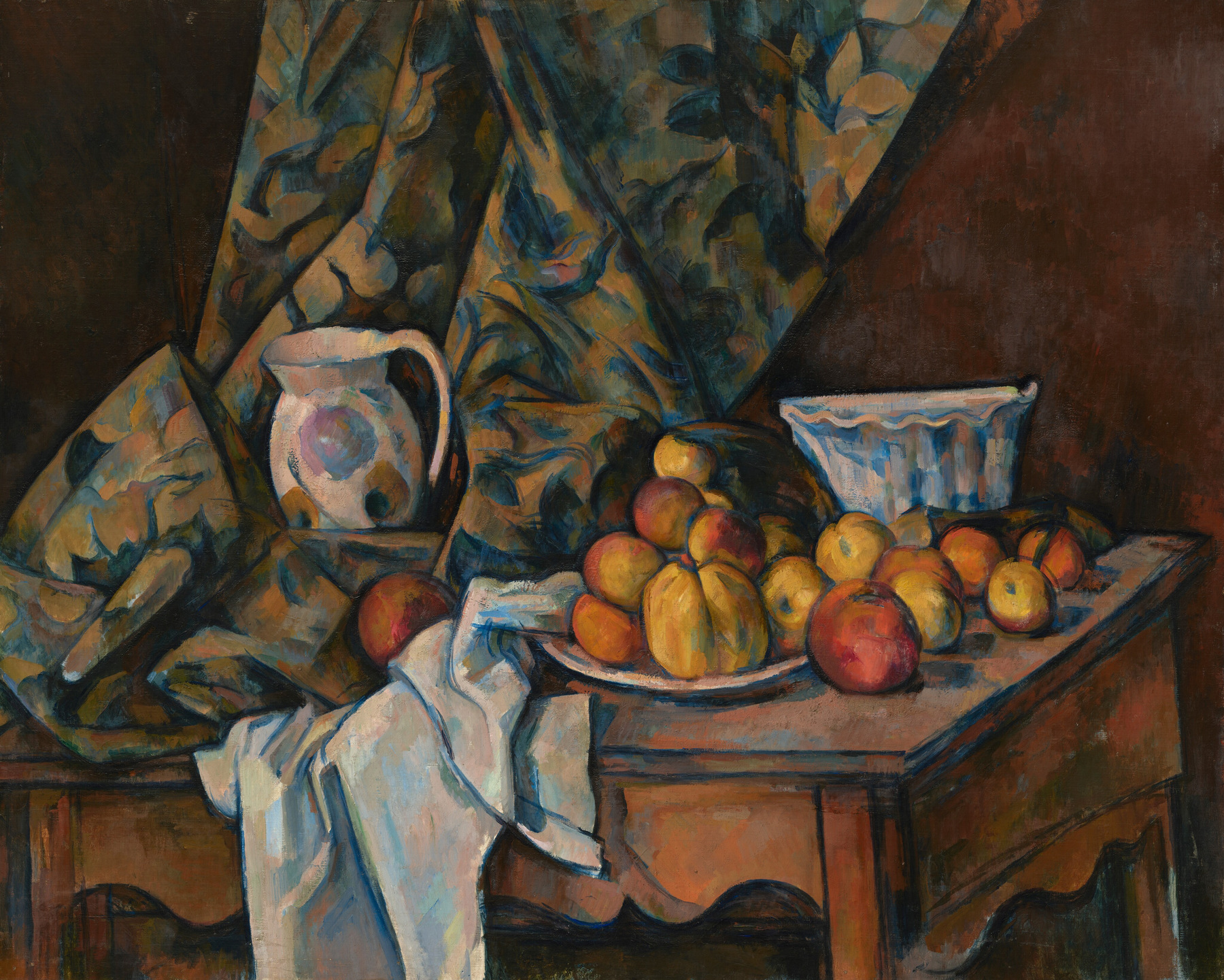
Begin with the white cloth hanging over the front edge. Its folds meet the pale rim of the plate; the clustered yellow and red fruit then lead toward the pale bowl farther back at the right. The jug at the left offers another light shape to return to. Those are located relationships in the image, not an instruction that every viewer must follow that order.
The contrast with Homer is decisive. Homer gives us bodily evidence of action. Cézanne gives us stationary objects whose light areas, repeated rounded forms and overlaps can connect our attention. The second picture can have visual movement without depicting moving fruit.
If you noticed the jug first, your reading has not failed. A suggested viewing path is an interpretation of available cues, not an eye-tracking result. We would use this still life when the question is “How can a picture lead attention without showing action?” For “How can posture suggest an event?”, we would return to Homer.
Choose the example that answers your question
The three paintings give us three useful descriptions: Homer depicts action through posture and connection; van Gogh creates directional rhythm through marks; Cézanne offers a path among still objects. They are examples of overlapping effects, not three boxes that all art must fit into.
When comparing works for a discussion or your own collection, we would replace “this one has more movement” with the specific quality you enjoy. Perhaps you want the sense of an event unfolding. Perhaps you prefer a quiet subject with small relationships to discover. The Cézanne example shows why choosing stillness does not mean choosing an empty or uninteresting picture.
For the broader question of how scale, balance and grouping hold an image together, our composition guide develops those relationships. Here, the completed distinction is simpler: what seems to move within the depicted world, and what invites your attention to move across the picture?
FAQ
Is movement the same as an art movement?
No. Movement as a visual principle concerns perceived action or direction within a work. An art movement names a historical grouping of artists, approaches or ideas. A painting can belong to an art movement and also have visual movement.
Can a still life show movement?
Yes. In the Cézanne shown above, light cloth, a plate, rounded fruit and pale vessels offer a possible route through the arrangement. That is different from claiming that the fruit is physically moving.
Do diagonal lines always create movement?
No single line direction settles the reading. In Homer, posture, footing and joined hands work together. A diagonal edge can also belong to a stationary table or building. Describe its relationship to the rest of the picture.
Does more movement make an artwork better?
No. A lively event, a restless rhythm and a deliberately steady arrangement offer different experiences. The useful comparison is whether the visible relationships serve the kind of looking you enjoy, rather than whether the picture reaches a maximum level of activity.
Sources and image notes
The linked Met, Cleveland Museum of Art and National Gallery of Art records identify the paintings, dates, media and open-access images. The Virtual Instructor’s movement lesson discusses rhythm, lines and implied action. Our readings of the three paintings are editorial interpretations, not measured viewer behavior or claims about the artists’ private intentions.
Public discussions about breaking down composition and a landscape feeling static helped identify questions; they do not establish buyer preferences or the results of a Whispart workshop. Cover: the complete Met image of Snap the Whip proportionally fitted within a neutral graphic surround. The full painting also appears above. Museum reproduction does not imply endorsement.