Pixel Art: How Small Shapes Build a Whole World
A tiny tree, a key and a finished village reveal how much a small image can say. Look at the actual shapes before settling for the word “retro.”
Pixel art is digital art made with deliberate control of pixels and the shapes they form. Its appeal often lies in how clearly a few small marks can suggest an object, a surface or a whole place. An image containing visible squares does not, by itself, tell us how those marks were made.
We like pixel art most when that economy feels expressive: the little opening that makes a key recognizable, or a few green marks that give a tree variation. To see those decisions, we will look at actual artwork by Kenney, whose Tiny Town pack is released under CC0. These are authored game assets, shown as art examples rather than a recommendation for a particular arcade interior.
What makes the pixels part of the drawing?
A digital photograph also consists of pixels. Reduce it far enough and its smooth edges turn into blocks. Pixel art involves choosing how those small units should describe the image. Lospec’s introduction puts deliberate pixel control at the center of the medium.
That does not require clicking every pixel separately. In Cure’s PixelJoint tutorial, fill and line tools can belong to a controlled pixel-art process. There is also no universal maximum canvas size or color count. The useful viewing question is what a contour, a connected color shape or a small contrasting mark contributes.
This distinction explains why an enlargement can help us look without proving how an unknown image was made. Here we have the creator’s original files, so the shapes remain traceable. A screenshot of uncertain origin would leave the process uncertain too.
A tree: outline first, little marks second
Start at the pointed top of the tree below and follow the dark, stepped edge downward. Then look inside that outline: small darker green marks interrupt a broad light green shape. The original tile is only 16×16 pixels; the displayed enlargement repeats each source pixel in a larger square.
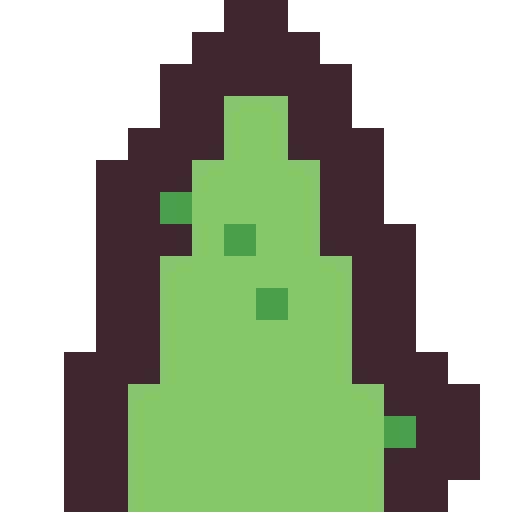
The dark boundary gives the foliage a distinct shape. Its edges widen and narrow in steps rather than tracing a smooth curve. Inside, the light green forms most of the foliage. A few darker marks sit at different heights, including small squares within that larger shape. We read them as variation within the foliage, without needing a separately drawn leaf at every position.
Our eye receives “tree” before it receives “individual leaves.” The pointed silhouette and green mass do enough together. The connected areas of one color are often called clusters in pixel-art teaching. In this particular tile, those broad areas keep the object simple while giving it more character than a uniform green triangle.
This is a completed reading of one small object. A detailed tree, a soft silhouette or an abstract image may make different decisions; the example does not set a rule for every pixel artist.
A key: the empty space carries information
Now follow the key from its open head to the shaft and the small teeth. Notice how much of its identity comes from the gaps and the outside shape, rather than elaborate surface detail.

The opening in the head separates it from a solid disk. The narrow shaft connects that head to the teeth at the other end. Light and dark gray marks suggest a face and an edge, but they remain subordinate to the overall shape.
For us, this key is a particularly satisfying example of selection: it preserves the features needed for recognition and spends very little on decoration. That is an observation about these visible marks, not a claim that the creator followed a documented sequence of drawing steps.
The enlargement adds no new drawn detail. Every original pixel becomes a 32×32 block in the educational PNG. A browser may display that file at another size, but its underlying image still contains the same original choices.
How the little pieces become a place
In Kenney’s supplied town scene, look first for the roofs, then the pale paths and the trees that flank them. Move between those groups before concentrating on an individual figure.
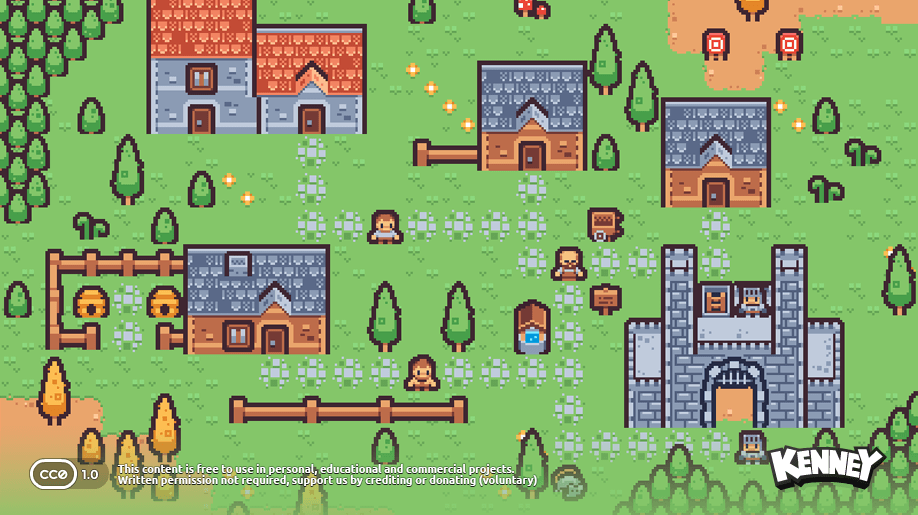
Orange and blue roofs give related buildings distinct appearances. Repeated trees describe edges and patches of vegetation. The paths connect the houses, well and castle; the small figures make those buildings feel large enough to enter. The castle’s towers and dark opening distinguish it from the domestic doorways elsewhere.
We find the scene inviting because these relationships are easy to follow. It gives our eye a route through the little world while leaving much of its imagined life unspecified. That response depends on the assembled picture, not just the number of pixels in a single tile.
The sample is the author’s 918×515 presentation image, including its footer, drawn from a pack of 16×16 tiles. It is not itself a 16×16 canvas. Nor does a game scene define the entire medium: pixel art can depict portraits, landscapes or nonrepresentational forms. To explore the latter through another medium, see our visual guide to types of abstract art.
Texture is an option, not an entrance requirement
Dithering alternates colors in a pattern to suggest a blend or texture. It is one pixel-art technique, explained in Cure’s tutorial; it is not compulsory. The clean areas in the tree and key already perform their jobs without a checkerboard transition.
A Reddit discussion asking whether to add dithering makes the choice concrete. Such questions are useful prompts for looking, rather than a vote that settles the medium. We would ask whether the added pattern clarifies a surface or makes a tiny object harder to read.
In these examples, we prefer the uncomplicated shapes. In a larger image of weathered stone, cloth or changing light, a patterned transition could be part of what makes the picture absorbing. The image’s aim changes the judgment.
FAQ
Is every low-resolution image pixel art?
Low resolution alone does not establish deliberate pixel drawing. A reduced photograph can look blocky through automatic resizing. For an unfamiliar image, use the creator’s source or process description before making that claim.
Does pixel art have to use a 16×16 canvas?
No. That is the native size of these particular Tiny Town tiles. Pixel art can use other dimensions and palettes; one asset pack does not define the medium’s limits.
Do pixel artists have to place every pixel by hand?
No. Controlled fill and line tools can be part of the process. The definition concerns intentional pixel-level decisions, rather than a rule about one permitted tool.
Must pixel art include dithering?
No. Dithering can suggest texture or a color transition. These tree and key examples remain readable with broad color areas. Adding a pattern should serve the particular image.
Does a consistent grid prove an image was made without AI?
No. A consistent grid is a visual property, not reliable proof of authorship or process. These examples are traceable to Kenney’s released files; unknown images require their own source information.
Sources & image notes
Technique context: Lospec and Cure’s PixelJoint tutorial. Artwork: Kenney, Tiny Town, CC0. Tree and key images are exact integer enlargements of the supplied tiles; the town presentation is unchanged. Our observations concern these digital reproductions, not a tested wall print or installation.
Cover photograph: Element5 Digital / Pexels, cropped, used under the Pexels License. It provides arcade context and does not depict a WhispArt project.