Unique Wall Art Ideas for an Apartment That Feels Like Yours
When the furniture is all new, a distinctive image and one object you actually kept can give the room a point of view. Start with ideas, then test a pairing instead of buying another matching set.
Six ways to make wall art distinctive
Unique wall art does not have to be a costly one-of-one painting. It can be an image with a specific connection to you, an unusual material, a work found outside the usual matching-decor aisle, or a familiar format with an unexpected subject. The best idea is the one you want to keep looking at after the room is finished.
On smaller screens, scroll the table sideways to read every column.
| Idea | When it works | Check before choosing |
|---|---|---|
| Your own photograph, printed well | A place or person matters to you more than a trend | Can the file print cleanly at the intended size? |
| Local artist or secondhand work | You enjoy finding an object with its own visual character | Inspect condition, maker information when available, and total framing cost |
| Textile, relief or sculptural wall piece | You want texture and shadow rather than another flat image | Weight, cleaning and whether the wall can safely support it |
| Contemporary surreal or figurative art | A face, strange scene or visual tension holds your attention | Live with the image briefly before making it the room’s focal point |
| Limited print or editioned work | You prefer a particular artist’s image but do not need the original object | What “limited” means for the actual edition and what you receive |
| One framed fragment of your own life | A ticket, drawing or small paper item carries a real story | Whether the original should be preserved separately and a copy displayed |
These routes are options, not a hierarchy. A mass-produced image can still be meaningful if you chose it for a reason; an original can feel impersonal if you bought it only to fill a blank. An inspected wall-art ideas guide already lists style directions such as vintage signage and surreal imagery. The harder question for a newly furnished apartment is what any choice says when placed beside the few things its resident brought along.
Why new furniture can still look like a display room
Imagine someone who moved to a new city with only a small box of possessions. The sofa, oak side table and shelves are all new and serviceable. On the shelf sits one well-read book that made the move. The book may be ordinary, but it is actually theirs; a generic vase bought to match the sofa cannot supply that same fact. This is a hypothetical room, not a customer installation.
In a direct public discussion about a “furniture catalog” living room, commenters focus on generic art and staged tabletop objects, while suggesting books, photos and objects accumulated through living. Another “less like a hotel” discussion raises books, hobbies and art alongside the usual rugs and plants. Those comments do not prove a universal design rule. They do point to a useful test: which visible object could only have been chosen by this resident?

Do not replace a good sofa to answer that question. Give the wall one piece worth looking at and let one genuinely kept object live close enough to be noticed. The art need not depict the book or share its color. The relationship can be a deliberate contrast.
Test two artworks in the same room
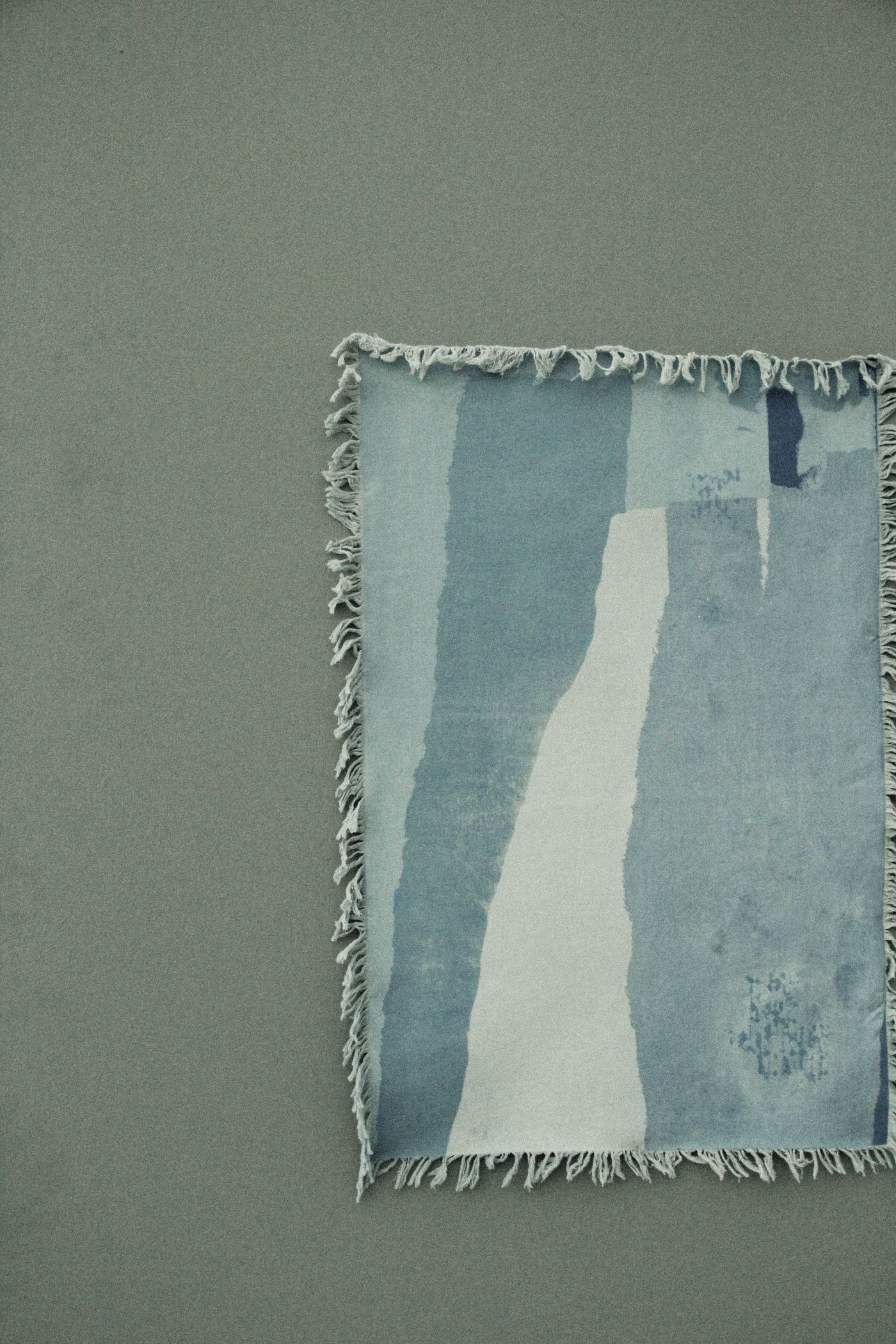
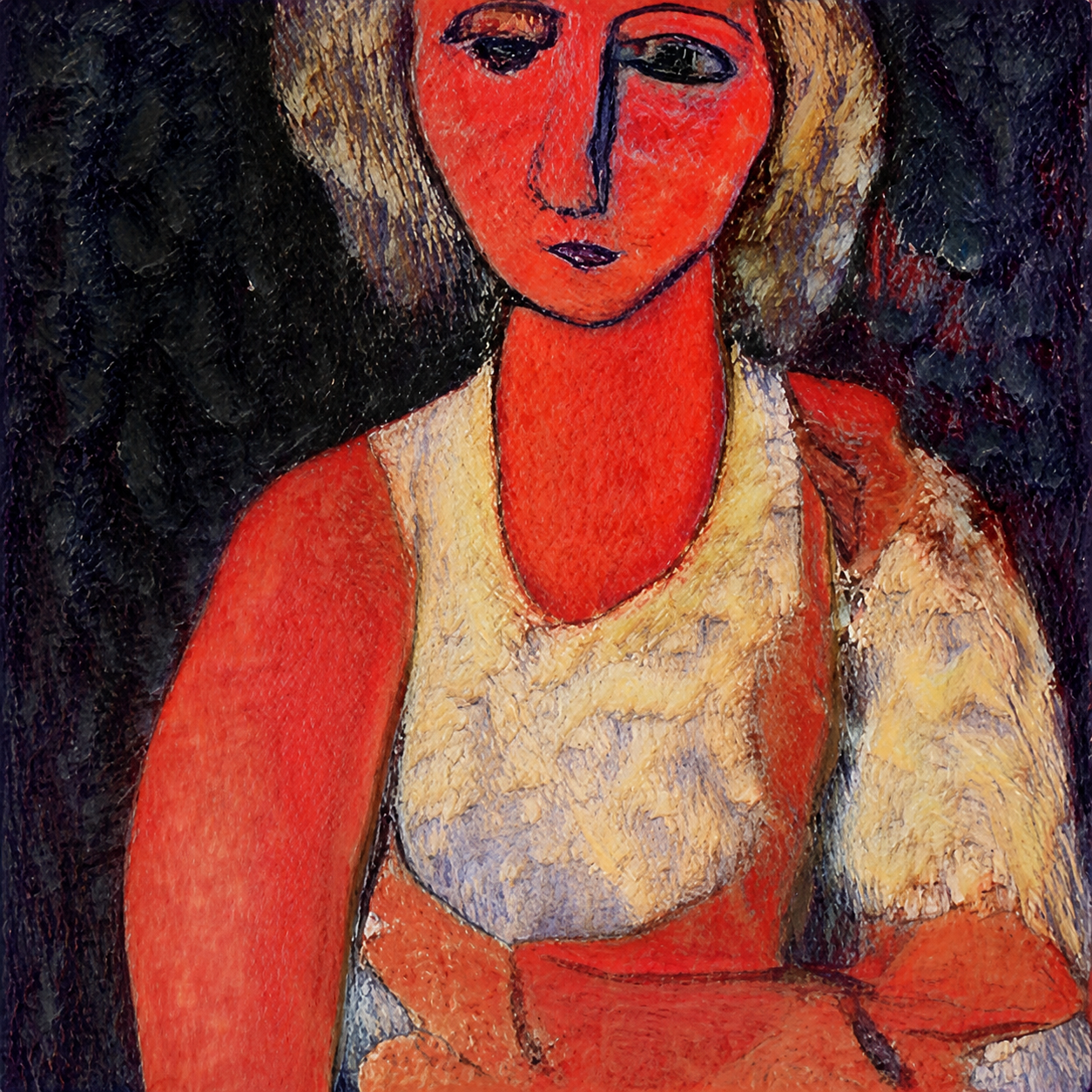
Keep the new furniture and worn book fixed in the thought experiment. Candidate A is the blue abstract textile photographed above. Candidate B is WhispArt’s Second Mirror, a vivid red figurative work. These are different physical objects, so compare the image you want and the display conditions each needs. The choice is not “quiet is bad, bold is good.”
On smaller screens, scroll the table sideways to read every column.
| Candidate | What the room gains | Choose it if... |
|---|---|---|
| Blue abstract textile | A quieter blue field plus physical texture; the book remains a personal cue | You prefer a calmer image and want textile texture on the wall |
| Second Mirror | A recognizable, slightly uncanny portrait and strong red presence; the book can sit nearby without matching | The image holds your attention and you welcome a room with more visual tension |
Picture each candidate on the same wall above the new sofa, with the same kept book nearby. The photographs identify the works, not a measured or exact room simulation.
For this hypothetical resident, assume the unusual portrait is the image they keep returning to. Choose Second Mirror. Its visual strength is the tradeoff: if faces feel intrusive or tactile material matters more, choose the textile. A personally meaningful photograph is another valid route. There is no obligation to choose the boldest image merely to avoid a showroom look.
Here is the supplied Second Mirror image without a generated room. Compare its actual color and details with the textile example before making a decision.
Then change the object beside the art
Keep the selected artwork, sofa and table in mind. First imagine a newly bought decorative vase beside the art. Then replace only the vase with the resident’s worn book. The vase is not wrong; it simply tells us little about the person who lives there. The book carries a specific history even if a visitor never learns its title. This is a controlled editorial question, not a before-and-after customer photo.
For the stated resident, place the actual book near the art and stop there for now. It gives the room one point of contrast and one point of personal continuity. Do not manufacture a backstory for a new object or scatter keepsakes across every surface. If the book is valuable or vulnerable to light, display something else the resident truly uses and keep the book safely stored.
A discussion about affordable, unusual wall art also reveals a practical constraint: large originals can feel out of reach, and people consider local consignment, prints, textiles and making something themselves. One work and one kept object can be a smaller first decision than filling the whole wall. If you already own art and chiefly need placement or rental-safe hanging guidance, our apartment wall decor guide handles that separate task.
If you host new colleagues, let curiosity be a bonus
A move for work can make a new living room do double duty: it is your everyday room and a place to welcome people you barely know. That does not make a guest's reaction the test for the art. In a discussion specifically about conversation-starting wall art, several people pushed back on selecting for visitors rather than the person who sees it daily; others liked work tied to travel, local places or a real interest. Those are individual comments, not evidence that every guest will ask about art.
Return to the two candidates above. Suppose the resident loves the red portrait but a new colleague finds faces unsettling. Keep the portrait if living with it still feels right; a visitor can simply talk about something else. Suppose instead the resident is indifferent to the portrait and bought it only to elicit a reaction. Choose the blue textile or a photograph of a place that actually matters to them. A small, honest answer to “where did you find that?” is easier than inventing a story about a dramatic image you do not like.
Artwork also cannot compensate for a room where guests cannot sit comfortably. In a hosting-focused decorating thread, commenters spent far more time on seating, clutter and room access than on the art. For this hypothetical apartment, make the seating usable first, keep the chosen image, and leave room for conversation that has nothing to do with the wall. If colleagues never mention it, the art has not failed: the resident still gets to live with an image they chose.
FAQ
Does unique wall art have to be an original painting?
No. A personal photograph, artist print, vintage find, textile or sculptural piece can be distinctive through its image, source or relationship to you. Verify any “limited edition” claim on the actual listing.
Can a print make a new apartment feel personal?
Yes, if you chose the image because it matters to you and gave it an intentional place. Price or rarity alone does not create that connection.
What if I moved with almost no keepsakes?
Start with one real item you kept or use, such as a book, photograph or small object. Do not buy a fake “personal” accessory just to complete a styling formula.
What if I dislike a bold portrait?
Choose the quieter textile, a photograph or a different artist’s work. The test is which image you want to see repeatedly, not which one makes the loudest first impression.
How many objects should go beside the art?
There is no required number. In the example, one well-used book is enough to test the relationship before buying more decor.
Should I choose art mainly to start conversations with guests?
Choose a work you want to see regularly. A local find or image linked to a real interest may invite a question, but guest approval is a poor substitute for your own lasting interest.
What if a visitor dislikes the unusual artwork I love?
You can keep it. You do not need to defend the room to every visitor, and the conversation can move elsewhere. If the work itself feels wrong to you after living with it, reconsider the image for your own sake.
Sources and image notes
The public discussions linked above supplied questions about cost, sameness and personal objects; they are not a representative survey. The room and resident are hypothetical editorial examples. Cover: real photograph by RDNE Stock project / Pexels. The other two sourced photographs are credited in their captions; all three are used under the Pexels License. Second Mirror is shown from its supplied original image; no material, size, stock or customer-installation claim is inferred.