Zen Art: What the Term Means Before You Choose It for a Spa
A circle, a searching face and a gold-ground plum tree show why the history of a work matters as much as its appearance.
Start with the work, then choose the words
Zen art has a historical relationship with Zen Buddhism; “calming wall art” describes an intended visual effect. The two can overlap, but they are not interchangeable. For a spa lounge, first decide whether you want a documented connection to that tradition or simply a picture with a quiet composition. Then choose an image—and a description—that fits the brief.
A black circle alone cannot establish who made it, what its inscription says or why it was painted. A richly colored work, meanwhile, may have a documented place in a Zen temple. Three museum examples make that distinction easier to see before we put it into a practical selection.
What does Zen art mean?
The Met’s history of Zen Buddhism traces its Chinese Chan background and the importance of monasteries in the development of Japanese ink painting. Subjects included teachers and religious figures, but also plants, birds, literary figures and landscapes. This is a history of people, practices and settings, rather than one decorating formula.
The Smithsonian’s Mind Over Matter exhibition similarly placed painting, calligraphy and objects within Zen’s cultural history. Spare compositions are part of the story; they are not a reliable test for identifying every work.
When browsing, keep three descriptions separate: a historical work with a documented Zen connection; a contemporary work whose maker explains a Zen influence; and decor described as “zen” because it looks peaceful. Each can be considered on its own terms. The last label does not supply the first kind of history.
A circle with a particular inscription
Art historian Yukio Lippit places Nantenbo in the continuing tradition of Zen monk-painters in his MFAH essay on Zenga. Look at the writing alongside the circle in Nakahara Nantenbo’s Enso, dated 1922. The circle varies from dense black to dry, streaked ink. Its broad band is only part of the composition: the calligraphy and red seals also occupy the sheet.

The museum’s translation presents a challenge to catch the moon. That gives us something specific to say about this work. It does not mean every ink circle carries the same message, or that an anonymous circle found online is by Nantenbo.
For a reproduction intended to introduce this example, keep the writing with the circle. Cropping it into a stand-alone symbol removes information that helps explain the image. Use the record’s orientation rather than rotating it to fit an empty space.
A figure with presence, not a neutral symbol
Hakuin Ekaku’s Portrait of Bodhidharma offers a different encounter: a large face, emphatic eyes and dark strokes describing the robe. The Met identifies Hakuin as a monk whose painting served his teaching, and Bodhidharma as the figure traditionally credited with bringing Zen teachings to China. That is a more useful identification than calling the image a generic Buddha portrait.

The portrait’s concentrated expression might be exactly what someone wants to spend time with. It may also feel more forceful than the image imagined in a “soft and quiet” decor brief. Historical relevance and the visual character you want are separate decisions; neither answers the other automatically.
Gold and branching movement in a Zen temple
Kano Sansetsu’s Old Plum, made in 1646, stretches across four sliding-door panels. Follow the dark trunk as it bends through the gold field. There is open space, but also color, blossom, textured bark and strong movement.

The Met’s record places these panels at Tenshō’in, within Kyoto’s Myōshinji Zen temple complex. Curator Aaron Rio’s account discusses their architectural setting. The connection rests on that documented history, not on whether the picture resembles today’s neutral spa interiors.
For a design conversation, “gold-ground plum-tree panels made for a Zen temple setting” is more informative than a vague promise of serenity. It identifies both what you can see and the context you can support.
A completed choice for a spa lounge
Consider a hypothetical resort lounge whose operator wants a circle composition with a documented Zen connection and a short explanatory label. This is an editorial example, not a client project or a claim about what all spa guests prefer.
| Candidate | What supports the description? | Decision for this brief |
|---|---|---|
| Nantenbo’s Enso | A named work, date, collection record and interpreted inscription | Choose a reproduction of the complete image |
| Sansetsu’s Old Plum | A documented Zen temple setting | Relevant history, but a branching, gold-ground composition rather than the requested circle |
| An anonymous circle sold as “Zen calm” | A retail description; maker and context are unspecified | Do not use it to make a historical attribution |
Choose Nantenbo’s Enso for this brief. Keep the complete image and place the source information alongside it. A finished short label could read:
Reproduction of Nakahara Nantenbo’s Enso (1922). The inscription challenges the viewer to catch the moon. Original in the Birmingham Museum of Art, 2008.32.
Retain the museum’s image credit with the reproduction or its accompanying information. The tradeoff is that the writing and seals remain visible; this is a particular artwork, with more to read than a cropped circle motif.
Now change the brief: the operator wants a quiet contemporary picture and no historical or religious story. A contemporary abstract work can be the better choice, described by its actual maker, title, medium and visual character. There is no need to attach “Zen” to it. If the artist explicitly describes a Zen influence, attribute that explanation to the artist rather than inventing an older lineage.
For the different task of deciding what art should do across reception, circulation and lounge areas, see our hospitality design concepts guide. The choice here concerns the identity and description of one image.
When the image arrives without its history
These uncertainties appear in real discussions: a reader looking for Zen art wanted larger, clearer examples than a book supplied; another, given a calligraphic work, did not know its language or orientation. Those are individual questions, not a survey of spa operators.
If an inscription is part of an unknown work, keep its identity unresolved until a reliable record or qualified reading supports it. You can describe visible features without inventing a translation. Similarly, religious imagery can matter to viewers beyond its decorative appearance; a few forum responses cannot establish one universal view about its use.
FAQ
Is Zen art always minimalist?
No. The three works shown here include calligraphy with a circle, a forceful figure and richly colored temple panels. A spare appearance can be a visual quality, but it cannot establish an artwork’s historical context.
Is every painted circle an ensō?
A circle-shaped mark is not enough to identify the maker, tradition or meaning of a particular work. Nantenbo’s example has a museum record and an inscription. For an unidentified contemporary circle, begin with the artist’s own title and explanation.
Is Bodhidharma the Buddha?
The portrait shown here depicts Bodhidharma, traditionally associated with the transmission of Zen to China. Use the museum’s specific subject identification rather than treating every Buddhist figure as interchangeable.
Can a spa use contemporary abstract art instead?
Yes, that can meet a visual brief without making a historical claim. Credit the actual work and describe the qualities relevant to the room. If a Zen influence is part of the artist’s explanation, present it as that artist’s stated influence.
Does choosing Zen art guarantee a calming effect?
No such guarantee follows from the label. A viewer’s response to a bold portrait may differ from their response to a circle or a tree. The choice demonstrated here matches a stated image-and-context brief; it does not establish a therapeutic benefit.
Sources and image notes
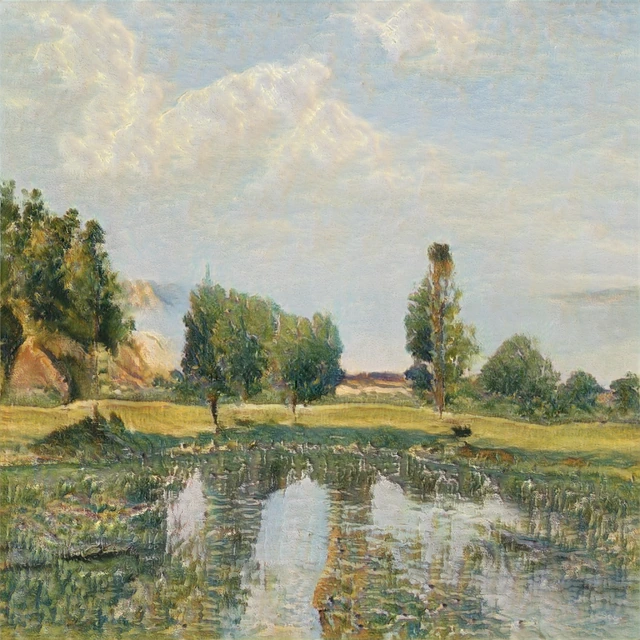
The linked Met, Smithsonian and Birmingham Museum of Art sources provide the historical and object-specific information. The museum images show real works, not generated substitutes. Met images are supplied under its Open Access policy; the Birmingham image uses the Open Content terms on its object page. Cover: detail of Unkoku Tōgan’s Landscape of the Four Seasons, late 16th–early 17th century, right screen. The Metropolitan Museum of Art, 2015.300.73.1, .2; public domain, CC0. This landscape introduces the visual setting; its appearance alone does not establish a Zen attribution.
The lounge brief, shortlist and sample label are WhispArt’s editorial application of those records. They do not represent a museum endorsement or a photographed spa installation.