Buying Art from a Gallery for the First Time: What to Say and Ask
You do not need an art-history vocabulary to start. You need a work you want to understand, a realistic total budget, and a few clear questions.
When buying art from a gallery for the first time, say what has caught your attention and give your total spending limit. Ask whether the exact work is available, what physical object the price covers, and the full amount including any frame, delivery and tax. Decide after you have those answers in writing.
Perhaps you have just settled into your first apartment that feels worth furnishing for the longer term. The sofa may change; you want the picture to stay. A gallery visit can help you see a work at its real scale and ask about it directly. It does not oblige you to buy that day.
The examples below follow an imaginary buyer with a $600 total budget. The dialogue and prices are illustrative, not records of a real sale or current gallery offers.
Before you go, make the first question specific
Check the gallery’s opening hours and whether visits require an appointment. If you are travelling to see one particular piece, confirm it is there and available before making the trip. An artwork shown on a website or in an exhibition is not a promise that it can be bought and collected immediately.
Bring the title or a screenshot of the work that interests you, a photograph of your wall, and the usable wall dimensions. You can ask about the art even if you have not settled the room. The measurements become useful when you discuss the actual outside-frame size, rather than estimating from a small online image.
A short inquiry could read:
“Hello, I’m interested in [artist and title]. Is this work available, and can I see it at the gallery? I’m buying for my apartment and my total budget is $600, including framing and delivery. Could you tell me the medium, dimensions and current price?”
If you like an artist but cannot see their work in the current exhibition, ask whether the gallery handles that artist and has other available work. Keep the inquiry with the gallery that introduced you to the piece. Artwork Archive’s buying-etiquette guide explains why those gallery relationships matter.
Start the conversation in ordinary language
“I keep coming back to this one” is a useful opening. You can describe the color, a face, a strange landscape, or simply the fact that you want to look again. There is no need to identify a movement before asking about the work.
Buyer: “I’m looking for my first piece for home. I like this image, but I’m still working out what I enjoy. Could you tell me about it?”
Gallery: “What drew you to it?”
Buyer: “The blue and gold, and the way the face seems to change when I look longer. I’d like to know how this particular work was made.”
Notice the shift from general praise to a question about the object. A conversation about the artist can deepen your interest, but you still need to know what you would take home.
Ask permission before photographing a work. If photography is allowed, photograph its information label too, so the artist, title and dimensions stay attached to the right image. This is among the practical visit suggestions in LePrince Fine Art’s gallery-buying guide. If photographs are not permitted, ask for a listing or an emailed image instead.

Ask four questions before discussing payment
- “Is this exact work available?” Confirm the artist and title. If it is sold, reserved or not for sale, ask about a specific alternative rather than assuming another version is identical.
- “What exactly am I buying?” Ask about medium, support, dimensions, whether it is a unique work or an edition, and whether the shown frame is included. For an edition, ask which numbered example is offered and what the documentation records.
- “What is the full amount to get it home?” Request separate amounts for the work, any frame, delivery and applicable tax. If a cost cannot yet be quoted, the total is still incomplete.
- “When and how can I receive it?” Ask about exhibition release dates, packing, collection or delivery, and who to contact if the work arrives damaged. Read the actual seller’s terms before paying.
These are concrete questions, not a challenge to the gallery’s expertise. Carré d’artistes’ gallery guide also emphasizes object details, total costs, documentation and delivery. The terms in your transaction still come from your seller’s written offer.
When a reply remains vague, narrow the follow-up: “Does the quoted $520 include the frame shown here?” is easier to answer than “Is everything included?”
Work through the whole quote: a $600 example
The imaginary buyer prefers work A. Its $520 label looks affordable, but the buyer wants it framed and delivered. The gallery then offers work B, already framed, as another option.
All figures in this table are hypothetical quoted amounts in US dollars. The tax amounts are supplied scenario inputs, not tax rates or advice for a particular location.
| Quoted item | Work A | Work B |
|---|---|---|
| Artwork | $520 | $450 |
| Frame | $110 | Included |
| Delivery | $40 | $35 |
| Quoted tax | $45 | $36 |
| Total | $715 | $521 |
| Against $600 limit | $115 over | $79 remaining |
Decline A at this total. Consider B at $521 only if you also want B as an artwork. It fits the budget, leaving $79, but a lower total does not settle your preference.
“Thank you for breaking that down. My limit is $600 altogether, so $715 does not work for me. Could I take another look at the framed piece at $521? I want to make sure I like that work in its own right.”
Suppose the buyer looks again and still likes only A. The completed decision is to leave without buying. There is no need to turn B into a purchase simply because it is affordable. If B is independently appealing, the buyer can proceed after confirming the exact work and the written terms.
Another legitimate revision is to ask for a quote with collection instead of delivery, if collecting is practical. Recalculate the actual revised total; do not silently remove costs from the gallery’s offer or assume you can take an unprotected work home safely.
If the price is fixed, make your next step clear
You can ask whether there is flexibility, but a discount is not an entitlement. If the gallery says its prices are fixed, accept that answer and move to a choice you control: another work, more time, or no purchase.
“Understood. I’m keeping to my total budget, so I’ll leave this one for now. If you have another work by this artist within that amount, I’d be glad to see the details.”
If you need time, ask whether the work can be held and for how long. Clarify whether the hold requires a payment and what happens to it if you decline. Do not assume a hold, a payment plan or a return option exists. Any of those arrangements needs the seller’s specific agreement.
A polite exit can be simple: “Thank you. I’m still deciding, and I don’t want to rush this. May I take the work’s details?” You have completed a useful visit if you leave knowing what you like, what it costs and what remains unresolved.
Before paying, keep the agreement attached to the work
Ask for the final written invoice or order confirmation to identify the artist, title, object or edition details, agreed frame, itemized total and collection or delivery arrangement. Save the seller’s applicable terms, any condition notes and the correspondence about changes to the quote. If a certificate is supplied, keep it with those records.
Match the paperwork to the actual work you selected. A long artist biography cannot resolve a different size on the invoice. If something does not match, ask the gallery to correct or explain it before you proceed.
For an email-only purchase, add the image and specification checks in our guide to buying wall art online. If your uncertainty concerns originals, editions and other formats, start with what to look for in original art under $1,000.
Practice describing an image before naming its style
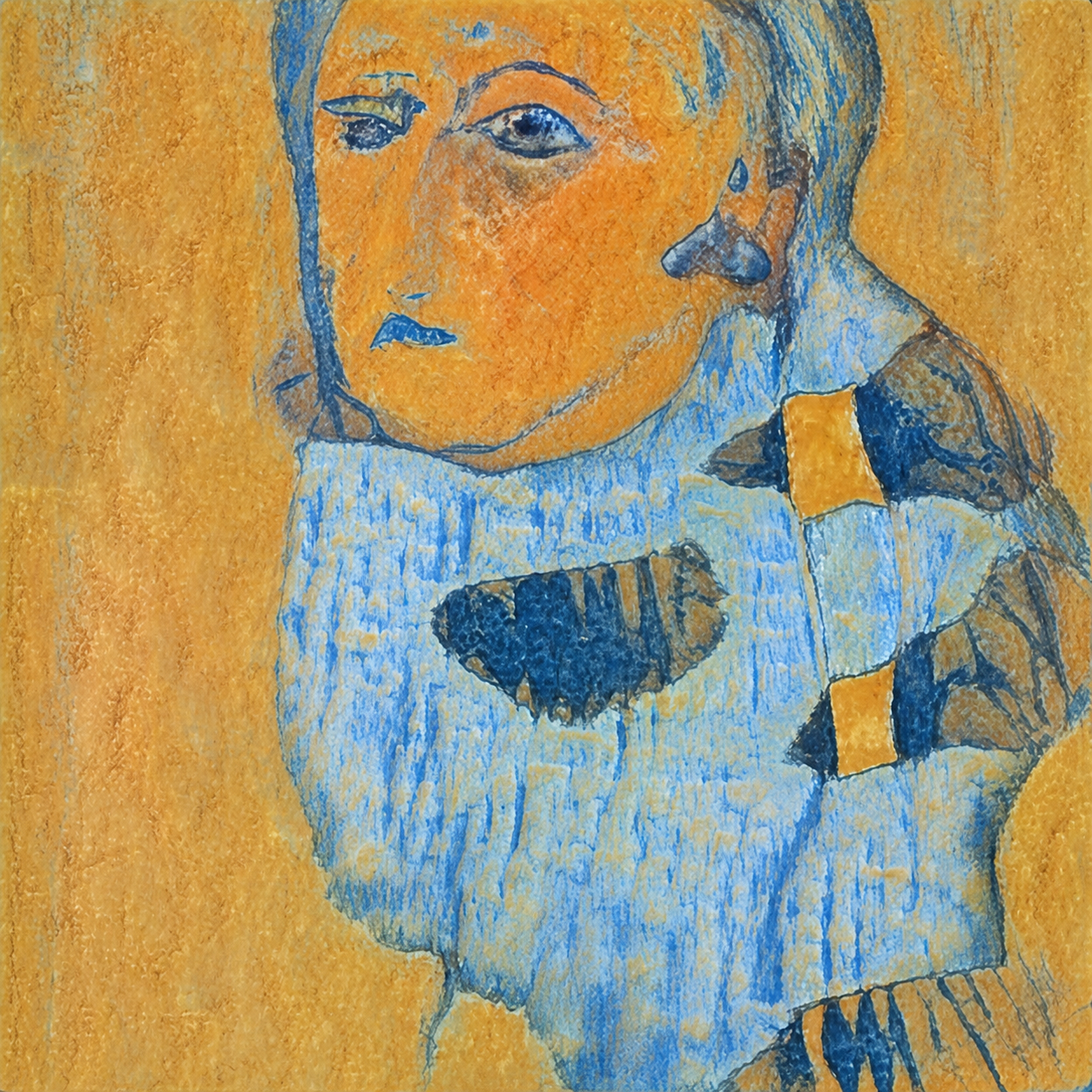
With this WhispArt image, “a blue-and-gold portrait with overlapping viewpoints” is already a useful description. The recognizable face and impossible combination of views give it a surreal quality, while the broken planes introduce abstraction. That is a reading of the visible image, not a claim that a historical artist or movement made it.
This is a useful way to discuss our more surreal, partly abstract imagery—or any unfamiliar picture. Start with what you notice. Then ask the seller how the actual object was made. Painted-looking marks in a digital image cannot answer that material question for you.
FAQ
Can I visit a gallery without buying anything?
You can inquire and look without committing to a purchase. Check that gallery’s opening and appointment arrangements first. If asked about your plans, say you are exploring and learning what you like.
Is everything displayed in an art gallery for sale?
Do not assume it is. Ask whether the exact work is available and whether it can be released immediately or must remain until an exhibition ends. A website image alone does not confirm either point.
Is it rude to ask the price?
No. A clear price question helps establish whether a work is a realistic option. Ask for the full amount, including the particular frame, delivery and applicable tax, so you are comparing complete offers.
Can I negotiate when buying art from a gallery?
You can ask whether the seller offers any flexibility. Practices vary, and the gallery may have fixed prices. Accept the answer; consider another suitable work or leave if the complete quote exceeds your limit.
What if I cannot collect the artwork myself?
Ask the gallery for a delivery quote to your actual destination, expected timing, packing arrangements and the process for reporting damage. For an international shipment, clarify which charges are included and which remain your responsibility before accepting the total.
What should I leave with if I decide not to buy?
Keep the artist and title, the confirmed object details, the complete quote if available, and the gallery contact. Note the unanswered question or budget gap. That gives your next inquiry a clear starting point without requiring a purchase today.