Original Art Under $1,000: What Should You Actually Look For?
A four-figure ceiling does not reduce art buying to a hunt for bargains. It makes the decision more specific: what kind of object can this budget realistically buy, what evidence should a seller provide, and will the work still hold your attention after the excitement of finding it has passed?
What an under-$1,000 budget changes
The budget is not a quality verdict. It is a filter on scale, medium, career stage, and sales channel. In this range, the most convincing purchase may be a smaller painting, a work on paper, a study, a piece by an emerging artist, or a carefully produced one-of-one work from an independent studio. A large canvas by an established name is a different market, so comparing every candidate with that fantasy only makes useful options look inadequate.
This is also where the word original needs attention. It may mean a unique physical work, but a listing can use similar language for an edition, a print, or a reproduced image. None of those categories is automatically inferior. The important thing is that the category is stated plainly. You should know whether you are buying the only physical version, one item in a numbered edition, or a reproduction before price, scarcity, and documentation enter the conversation.
Treat the price as the beginning of a practical inquiry. Ask what is included, whether framing is part of the object, how the work is identified, and what happens if its condition on arrival differs from the listing. A modest budget rewards precision because there is less room for prestige to stand in for evidence.
What the budget can buy, and what to inspect
These are not price rules. They are useful patterns for comparing unlike offers without pretending they are the same object.
On smaller screens, scroll the table sideways to see all four columns.
| What you may encounter | Where value can appear | What to verify | Common tradeoff |
|---|---|---|---|
| Small original painting | Direct handling, surface, and a singular composition | Dimensions, medium, support, signature or identifying record, condition | Less visual scale than the room image may suggest |
| Work on paper | Immediate mark-making and access to strong artists at a lower object cost | Paper type, fixative if relevant, glazing, matting, and framing needs | Framing can materially change the final cost |
| Study or early work | A focused idea or process visible without the price of a major work | How the seller describes the work and whether it is finished for sale | May be quieter or less resolved than a larger piece |
| Limited edition | A defined edition and often stronger production than an open print | Edition size, number, printer or producer, paper or substrate, and replacement policy | It is not unique even when the edition is small |
| One-of-one contemporary studio work | Individual identity, physical production, and direct studio context | How uniqueness is defined, material details, archive record, photographs, fulfillment terms | The studio may have a shorter public track record |
Six signals worth more than a grand description
You do not need specialist vocabulary to inspect an offer. You need observable answers.
- A precise objectThe listing identifies the medium, support, dimensions, orientation, date, and whether the frame is included. Words such as original or collectible should not replace those basics.
- Useful photographsLook for a straight-on view, a scale view, details of surface and edges, and consistent color across images. A room mockup can help with proportion, but it should not be the only evidence.
- Traceable authorshipThe artist or studio is named, contactable, and able to describe its role. A biography need not be impressive; it needs to be coherent and connected to the work being sold.
- Proportionate documentationAt minimum, keep a receipt and a record that identifies the work. Provenance is ownership history, while a certificate is one possible document within a larger record rather than a magic guarantee.
- Visible transaction termsShipping method, insurance, duties where relevant, return window, and damage procedure are available before checkout. Ambiguity here can turn a good object into a poor purchase.
- A reason to look againThe work has more than instant impact. Its balance, tension, color, rhythm, or emotional temperature gives you something to notice on a second and tenth viewing.
Do not buy the room mockup
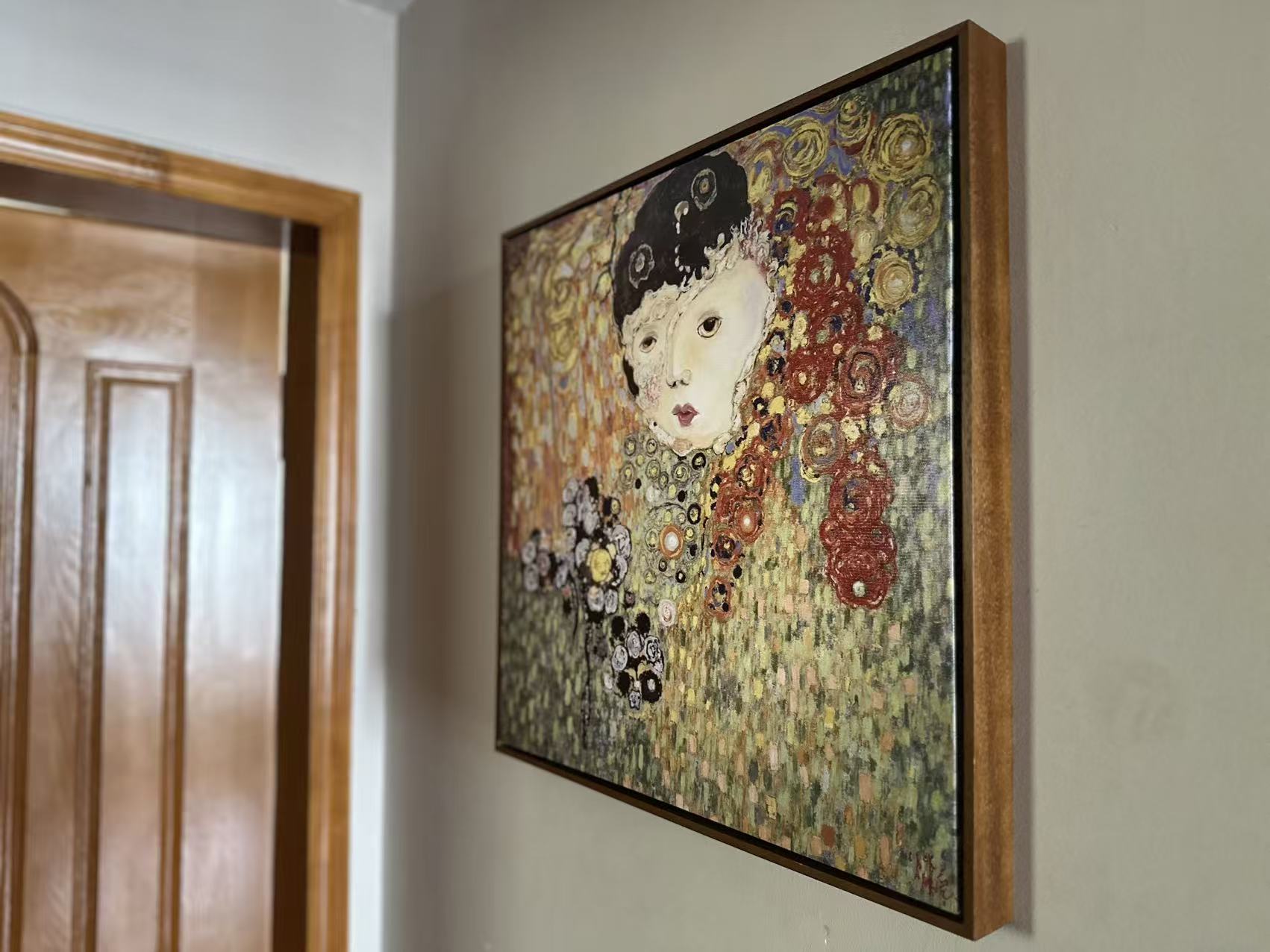
Online presentation quietly changes how art feels. A wide-angle interior can make a small work look commanding. Warm grading can soften colors. A close crop can hide the frame, edges, or proportion of the whole object. These choices are not always deceptive, but they are reasons to separate the artwork from the scene built around it.
Start with the actual dimensions and mark them on your wall with low-tack tape or paper. Step back from the distance at which you normally enter the room. Notice not only whether the rectangle fills the wall, but whether there is enough space around it for the composition to breathe. Then compare the listing images on more than one screen if color is central to the purchase.
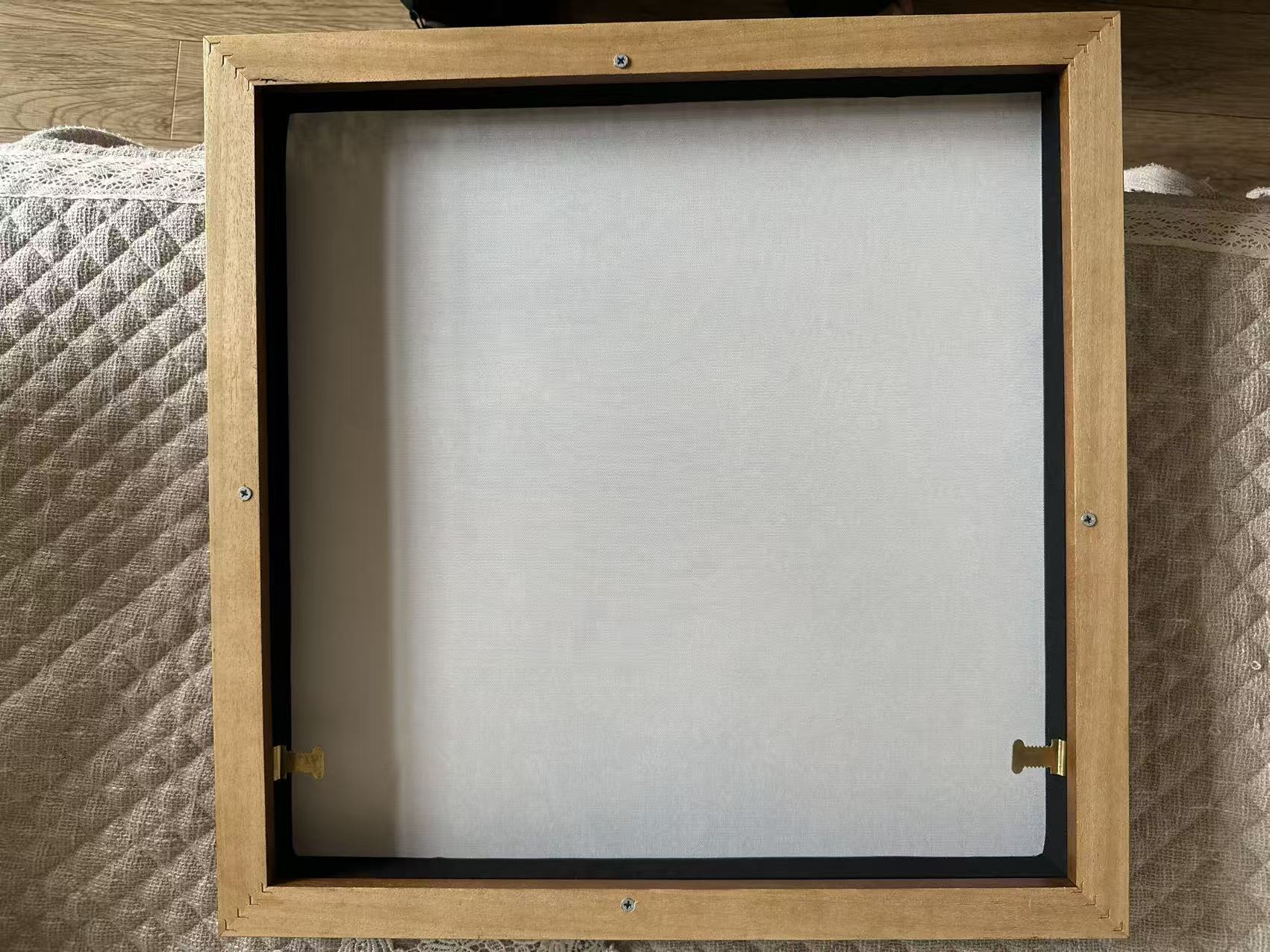
Ask for a neutral, straight-on photograph if one is missing. For textured work, a side-lit detail can reveal relief and brushwork that a frontal image flattens. For framed work, request a corner or profile view so the depth, join, and relationship between image and frame are visible. The seller's willingness to provide ordinary visual evidence is itself useful information.
A seven-minute check before you pay
Use the same sequence for a gallery, marketplace, social account, or independent studio. Stop when an answer creates more uncertainty than it resolves.
- Name the objectWrite down exactly what it is: unique work, edition, or reproduction; medium; support; dimensions; and framed or unframed condition.
- Check the image setConfirm that at least one image is neutral and straight, one shows scale, and one reveals material or surface. Ask for the missing view rather than guessing.
- Read the sellerLook for a consistent identity, contact route, transaction history or credible studio context, and language that distinguishes facts from aspirations.
- Ask three questionsWhat exactly will I receive? What documentation comes with it? What happens if it arrives damaged or looks materially different from the listing?
- Calculate the landed costAdd framing if absent, shipping, insurance, tax or duties, and any installation needs. Compare total cost, not the headline price.
- Test the roomMap the dimensions on the intended wall and view the outline from normal seating and entry points.
- Wait one nightReturn to the work without the countdown, sale badge, or discovery rush. If your interest survives, you are evaluating the piece rather than the moment.
The most useful first purchase is not the one that proves you understand the art market. It is the one that teaches you what you want to keep seeing.
An editorial principle drawn from recurring first-buyer questions
Value in a home is not the same as resale value
A purchase can be serious without being an investment. The work may change the character of a room, mark a period in your life, reward attention, and support a practice you want to exist. Those are real forms of value, but they do not predict a future buyer or a higher price.
This distinction matters most when a seller uses scarcity as the entire argument. One-of-one status or a small edition can describe supply, but scarcity does not make a weak image compelling, repair poor production, or establish a resale market. Judge the work first, then decide whether its form of scarcity is documented clearly enough to matter to you.
If resale is essential to the purchase, an under-$1,000 online search is not a shortcut to certainty. You would need a different level of market evidence, transaction history, condition analysis, and professional advice. For a first piece, a more honest standard is whether the object, price, and seller can all withstand ordinary questions.
How an independent studio can earn trust
A small studio does not need to imitate a major gallery. It needs to make the work inspectable. Whispart approaches that responsibility through one-of-one framed canvas works, human selection, individual identity, and physical production rather than open-edition decor. The relevant test is not the size of the institution but whether the specific object and the process around it are described with enough clarity for a buyer to judge.
That is also why the technology behind an image should not become a substitute for the image itself. If you are considering machine-learned work, the earlier guide to AI art value explains how selection, material form, accountability, and repeated viewing can matter more than the label attached to the tool.
Questions first-time buyers still ask
Is $1,000 enough to buy real original art?
Yes, but the realistic field often includes smaller paintings, works on paper, studies, emerging artists, and independent studios. The useful question is not whether the price is high enough to make the work real, but whether the category, materials, authorship, and transaction are clear.
Does a certificate of authenticity prove a work is genuine?
A certificate can be useful, but it should be read alongside the seller's identity, receipt, object details, ownership history where relevant, and consistency of the overall record. A document is strongest when it connects a traceable party to a precisely identified work.
Should I buy framed or unframed art?
Compare the total object and total cost. Unframed work offers flexibility, but suitable framing can add expense and delay. A framed work is easier to assess as a finished object if the listing shows the frame clearly and gives its material and depth.
What if the colors look different when the art arrives?
Minor variation between screens and physical materials is normal. Reduce uncertainty by asking for neutral photographs, viewing images on more than one screen, reading the return policy, and confirming how a material difference from the listing is handled.
Is original art under $1,000 a good investment?
Do not assume so. Buy because the work, object, and price make sense to you now. Financial resale requires evidence that a normal product page cannot establish, and no thoughtful seller should promise it casually.