How to Decorate Around a TV on a Large Wall Without Filling Every Gap
The television can stay. So can the console you already own. The useful choice is whether personal art should sit beside the screen or make the screen part of a larger display.
To decorate around a TV on a large wall, decide first whether to separate the screen from the art or include it in one gallery. A side grouping leaves the TV visually distinct; a surrounding gallery makes the dark rectangle part of a collected wall. You do not have to cover every blank area to make either choice feel intentional.
Other treatments solve other problems. If exposed equipment and everyday objects dominate the view, sort out suitable storage and cable management before buying pictures. A darker background, paneling or built-ins can change the whole setting, but those are different levels of commitment. HGTV’s TV-wall examples include both art and these broader treatments; Decorilla’s guide also covers galleries, backgrounds and console styling.
Here we will keep things attainable: an already-furnished rental, the same working TV and console, no new joinery, and one picture the resident already likes. The wall still feels impersonal. The question is where the picture belongs in relation to the screen—not what their lifelong decorating style should be.
Same room, two legitimate arrangements
A · Keep personal art as a separate group
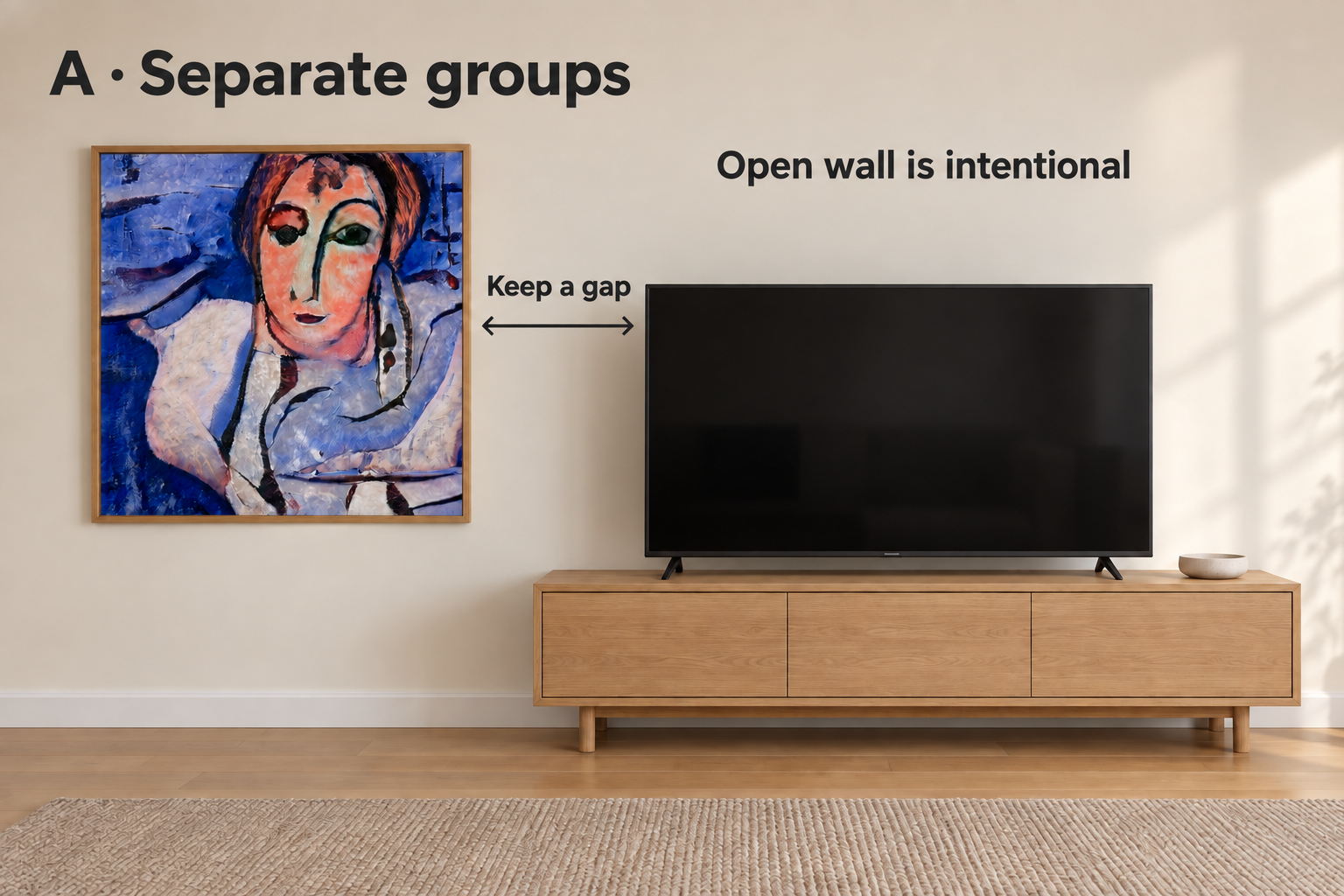
The portrait gives the resident something personal to look at without wrapping pictures around the screen. Its square shape and color distinguish it from the wide black rectangle. The gap keeps those two objects readable as separate groups; the empty upper wall lets that simple relationship remain visible.
This is the choice for our example resident, whose brief is: “I want a picture I enjoy beside the TV, but I do not want a frame surround.” Choose A. Keep the portrait, keep the gap and leave the space above the TV open. Buying smaller filler pictures would work against that stated goal.
B · Make the TV part of a collected wall
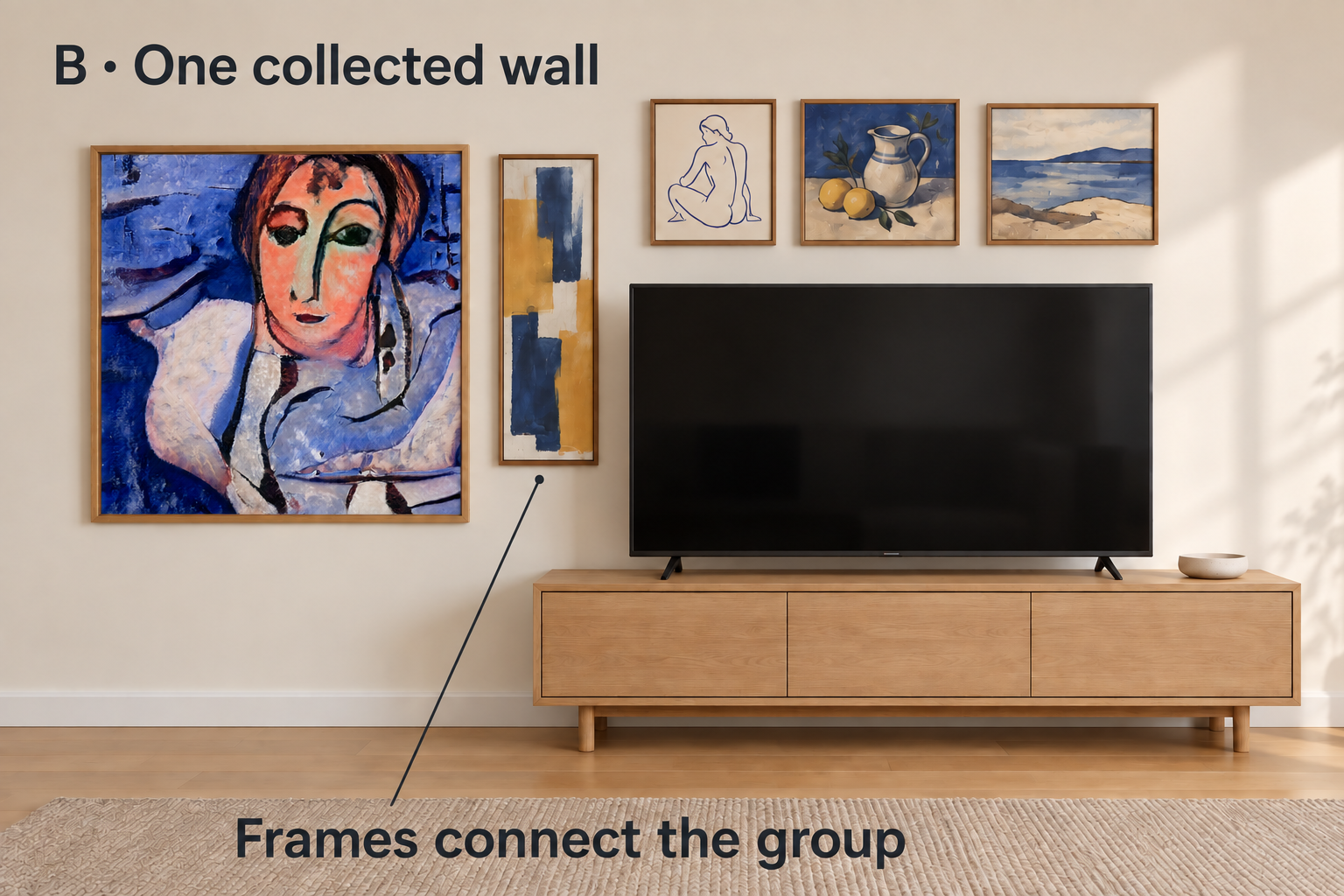
Here the extra frames bridge the gap and carry the display over the TV. The screen becomes one rectangle among several, rather than an object kept apart from the art. The portrait does not have to disappear for the wall to become more collected.
If the resident instead says, “I want the wall to feel like a collection, including the screen when it is off,” choose B. That is a genuine change of goal, not a mistake to correct with minimalism. It also means more objects to select and mount, and more relationships to check while watching.
Both illustrations show the TV off. They demonstrate composition, not whether either arrangement will feel comfortable during a film in your room. The picture sizes are illustrative; obtain actual outer frame measurements rather than treating the scene as a scaled product mock-up.
Choose the relationship, not the most decorated photo
A useful test is to describe the wall without saying “balanced.” In A, there is art beside a screen. In B, there is a display that includes a screen. Which description sounds like the room you want to live in?
A small r/interiordecorating discussion makes the difference in preference unusually clear. The original poster asks for attainable TV-wall ideas. One owner likes having art around their television; another participant sees the arrangement as cluttered. Other replies favor a simpler stand or a darker background. These are individual preferences, not evidence that one layout is universally calming or distracting.
You need not settle the argument for everyone. For our resident’s original goal, A completes the decision with one personal picture and open wall. For a resident who already enjoys several collected works, B can complete it without pretending the TV is absent.
Nor does B require buying a fixed number of frames. Use pictures you actually want, at sizes the real wall accommodates. If you only like one, a sparse arrangement is a finished option—not an incomplete gallery waiting for purchases.
Transfer the choice to your wall, with the TV on and off
Do not move the television merely to make an inspiration photo fit. Start from the actual seat, screen position and furniture you use. Keep controls, sockets, access and the equipment manufacturer’s clearances unobstructed; decoration should not determine a mounting or electrical decision.
- Confirm what can be installed. Check your tenancy conditions and the actual wall, frame weight and mounting instructions. Removable adhesive is not automatically permitted, suitable or damage-free. If there is no approved suitable method, stop before hanging.
- Lay out the real frame envelopes. Use confirmed outer measurements, not print size alone. A paper mock-up can help only when its temporary attachment method is acceptable for that surface. Otherwise, make a measured drawing or arrange the templates on the floor first.
- Look from the sofa with the screen off. For A, can you read the picture as its own group? For B, do the smaller frames connect the collection, or is one stranded with no apparent relationship? Adjust the item causing the problem; do not add one automatically.
- Watch with the screen on under your normal lighting. Notice whether a bright reflection, a picture edge or an object near the screen repeatedly pulls your attention in a way you dislike. If it does, try removing or repositioning that item within the approved layout. If it does not, do not dismantle a gallery just because someone else prefers bare walls.
The completed result for our example remains A: the existing TV and console, one liked portrait on the same wall, a clear separating gap, and no extra row above the screen. Proceed only when the real mounting conditions and viewing check support it. If the available space cannot support that separation, consider the integrated arrangement or leave this wall alone; there is no need to force the picture into it.
If you cannot hang anything, the wall can wait
Do not replace a refused wall fixing with unverified adhesive strips. You can keep the wall bare and personalize a suitable existing surface with a stable freestanding picture or object, following its instructions and keeping it away from screen edges, ventilation, controls and places where it could fall. Do not casually lean a large framed work behind or above the TV.
If the console has no safe spare area, choose another suitable surface or postpone the purchase. The goal is a home that feels more yours, not a television wall completed at any cost. Our apartment wall-decor guide considers other positions when one location is not suitable.
If you are buying rather than placing an existing picture, separate the composition choice from the purchase. Confirm the framed object’s actual size, total cost and seller terms using the online-art buying guide. A convincing room image does not provide those facts.
Sources and image note
Research checked September 9, 2026. HGTV and Decorilla provide existing TV-wall approaches; the linked Reddit thread supplies a small set of contrasting personal accounts. The two-room comparison and resident’s decision are editorial illustrations, not a customer installation or an attention study.
The cover and comparison rooms are AI-generated. The main blue-and-peach portrait uses an original from WhispArt’s product-image library; added gallery pictures are fictional teaching examples. Rooms, relative scale and frames are illustrative and do not establish the supplied size, materials or frame of a sale item.