Hallway Artwork Ideas for Corridors With Lots of Doors
A long corridor is not always one long wall. Choose an arrangement that works with the breaks between doors, then decide which spaces deserve a picture.
For a hallway with many doors, start with a sequence of individual artworks in the broader wall sections. Leave narrow strips empty. Choose an end-wall focal piece only where there is a clear wall at the end, and reserve a gallery grouping for a surface large enough to read as one group.
These are three different hallway artwork ideas, each answering a different wall condition. A sequence gives you several separate encounters along a passage. A focal piece gives the view a destination. A gallery concentrates several pictures in one place. None needs to occupy every available gap.
The same distinction can help in a home hallway or a small hotel. This guide uses an invented independent-hotel corridor to complete one arrangement decision. It does not assume that a residential layout supplies the installation requirements for a commercial property.
Read the wall between the doors
Stand at each end of the passage and look along it. Then look at the individual stretches between door casings. We will call those stretches wall bays. A wide bay might hold a complete picture comfortably; a sliver beside a door may be better left as a pause.
Mark the actual interruptions on a photograph or sketch: doors and their swing, room numbers, controls, signs, access panels and changes in wall depth. Distinguish a broad blank surface from several small blank patches whose combined width looks promising only on paper.
General hallway advice already covers measuring, door swings and sightlines; Giant Sculptures’ hallway guide includes those checks. The decision here is what to do once you can see the interruptions: give each selected bay a job instead of treating the entire wall as an unfinished gallery.
Do not calculate an art width from the full length of a door-filled wall. Measure the usable bay and the proposed outside frame. The remaining space must work with the nearby door, fixtures and actual viewing position. This is a reason to compare full-size outlines in the room, not a universal percentage to apply to every corridor.
Two arrangements for the same door-heavy passage
Compare the two illustrated arrangements below. In A, the blue-and-ochre pictures make an appealing family, but the smaller companions extend the display toward several door edges. In B, three larger pictures occupy selected bays and the smaller companions are removed.
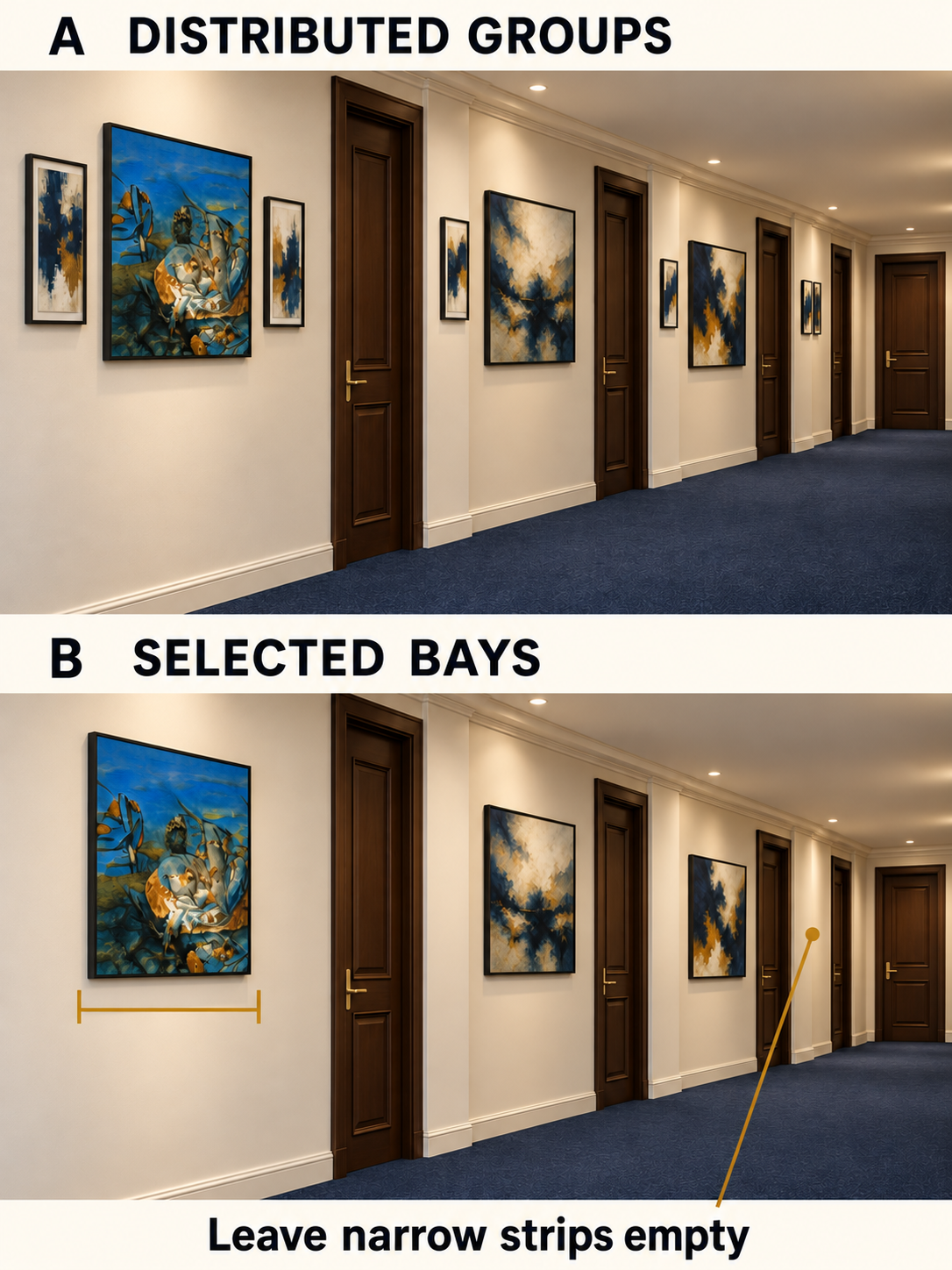
For this passage, choose B. Its three retained works can each be read within a wall section. The empty strips allow the door breaks to remain part of the composition. You give up the chance to display more pictures, but you gain a simpler relationship between each picture and its own wall.
A is not inherently wrong. Its related images could make a satisfying collection on a broad, uninterrupted surface, or as deliberately separate small groups in sufficiently wide bays. Here, the narrower sections and repeated doors make the extra pictures compete for the remaining fragments. That is the reason to edit the arrangement—not an assumption that more pictures always look worse.
Look at the first bay in B. The picture is positioned in relation to that bay; it does not need to be the same distance from the next picture as every other pair. Doors occupy part of the interval. Keep the relationship within each bay consistent before trying to make the distance between every artwork identical.
A completed plan for the illustrated hotel corridor
Imagine the hotel team has identified three usable broad bays on this wall, two smaller residual strips near the far doors, and a door at the end of the view. For this example, assume the team has already confirmed that the broad bays can accept framed art without obstructing required signs, controls or door operation. Those are scenario inputs, not findings about a real property.
The wall assignment is now specific:
- First broad bay: keep one larger work as the opening picture. Remove its smaller companions.
- Second broad bay: keep one related work. Treat the intervening door as a break between pictures, not a gap that needs filling.
- Third broad bay: keep the third larger work to continue the sequence.
- The two residual strips: leave them empty. Do not add miniature pictures solely because they fit.
- End of the corridor: add no focal artwork; the available surface is a door.
The chosen sequence uses a shared palette and similar frame treatment. That helps the three pictures relate across the interruptions, while their differing images keep each encounter distinct. Matching frames alone cannot explain why particular images belong together; use the separate guide to choosing pictures for a curated group when the image selection itself remains unresolved.
Before ordering, place removable full-size paper outlines in the three chosen bays, using each proposed outside-frame size. Check from both approaches and alongside the doors in normal operation. If a frame feels squeezed by a casing or a required fixture, revise that bay alone: reduce the proposed framed size, select a different work, or leave the bay empty. You do not need to shrink every artwork just to preserve a count of three.
The outcome to record is “three selected bays; two strips and the end door left clear,” with the actual frame outlines attached. After this visual decision, the hotel team still confirms the mounting method and applicable building requirements with the responsible installer or facilities lead. For sourcing options, continue with the small-hotel artwork buying guide.
When an end-wall piece or gallery makes more sense
A clear wall at the end: choose a focal piece
Change the example so the passage ends at a broad blank wall, visible from the approach. One artwork there may provide enough of a destination. Try that placement before buying a full sequence for the side walls. If the terminal surface contains a door or required information, it is not a blank feature wall just because it sits straight ahead.
A widened landing: gather the collection there
If the corridor opens into a landing with an uninterrupted wall and an appropriate place to pause, move the small-picture grouping to that wall. Keep the passage itself more selective. This lets the collection be seen together rather than repeatedly divided by doorways. If there is no suitable place to pause, do not invent a gallery stop simply to use the extra pictures.
A genuinely continuous side wall: consider the gallery
A wall without frequent door breaks can support a larger group. Lay out the complete group as one composition, with a defined outer boundary. That is a different starting condition from the illustrated corridor. The useful question is not “Are gallery walls good for hallways?” but “Where can this particular group be seen as a group?”
FAQ
How many pictures should go in a long hallway?
Count useful wall locations before counting pictures. The example has three suitable bays, so it keeps three works. A longer passage could still need fewer if most of its wall is doors, controls or narrow strips. Test the proposed arrangement at full framed size instead of assigning one picture to every stretch of wall.
Should hallway artwork be the same size?
Similar framed sizes can support a sequence where the bays are similar. Unequal bays may call for different sizes or for leaving one empty. Check how each picture sits within its own wall section; forcing identical frames into unequal spaces can undermine the arrangement.
Can you hang art on both sides of a corridor?
Yes, where both walls offer suitable locations. Start by viewing the two sides together from each approach. Add a second side because it contributes a useful picture or sequence, not automatically to mirror the first. Check the full framed depth and location with the people responsible for the passage before installation.
What if there is no blank wall at the end?
Use selected side-wall bays or a suitable landing. An end-wall focal piece is an option, not a requirement. In the illustrated corridor, the end door is deliberately left without artwork.
Can a gallery wall work in a hallway with doors?
It can work on a wide bay or an uninterrupted part of the wall. Keep the group together within that surface. If several doors repeatedly split the grouping, compare smaller independent groups or single works before extending the gallery into every remaining strip.