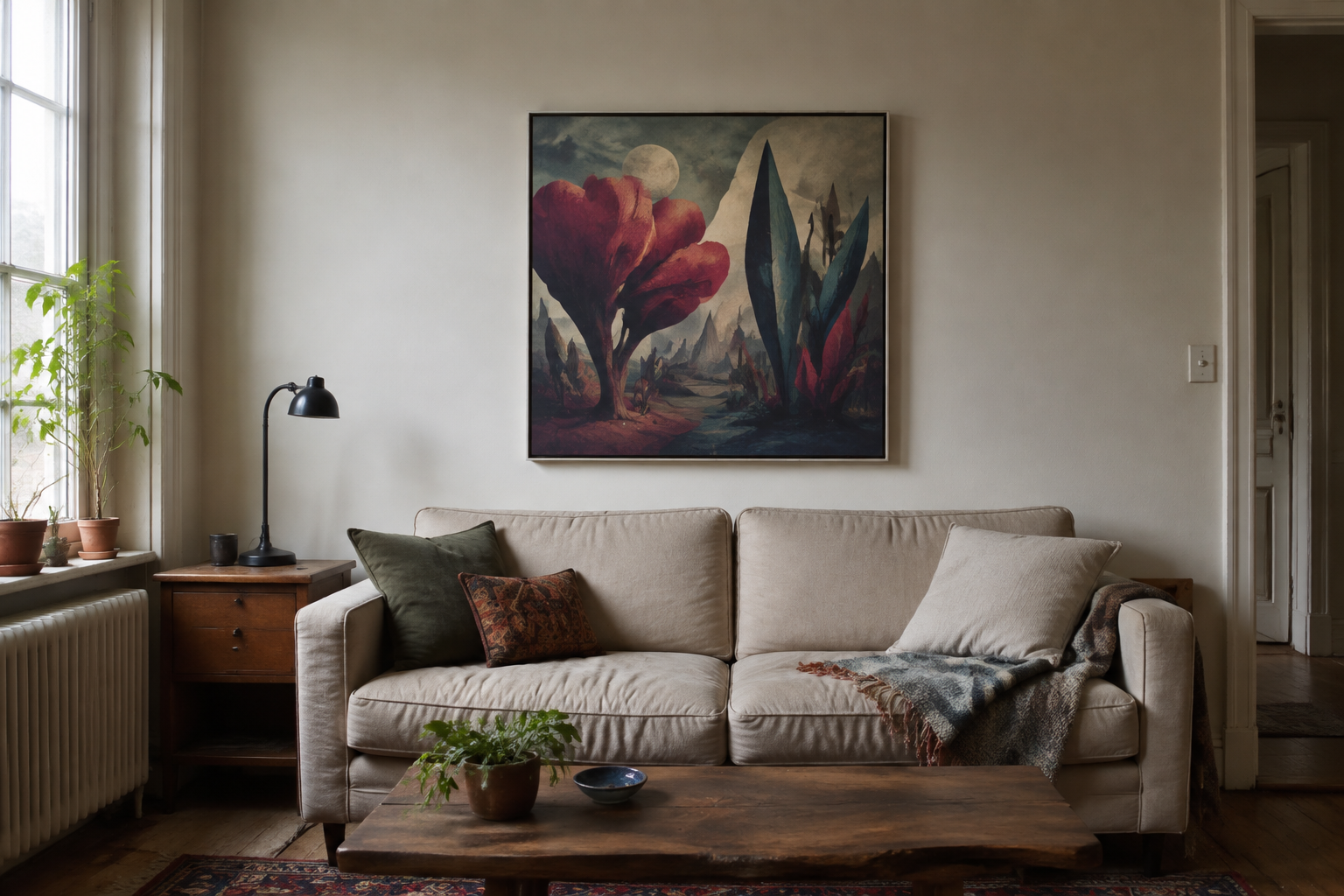
What Is a Statement Piece in Interior Design? Choose One That Earns Its Place
A room can be furnished and still feel anonymous. If your sofa and table already do their jobs, the next purchase does not have to become a whole-room makeover.
A statement is about its role, not its price
A bright painting can make a statement, but so can a quiet, unusually shaped wooden chair. What matters is how the object reads among the things around it. C&E Furniture + Design describes this through context, balance and visual hierarchy, rather than boldness alone. C&E’s guide to statement pieces.
A focal point is where attention settles; a statement piece is an object that can help create it. A window or fireplace can already organize the room without being a new purchase. If the room has a strong architectural feature, you do not need to compete with it just to follow a decorating term.
The statement can also be personal before it is fashionable. In one HomeDecorating discussion, visible comments name inherited furniture, a handmade table and a photograph of family dogs. These are individual examples, not a survey; the original post has been deleted. They are a useful reminder to look at possessions before opening a shopping tab. The discussion and remaining comments.
Ask yourself: what do I want to notice when I come home, and why would I want to keep noticing it? “It makes the place look expensive” gives you less to work with than “I like this strange image every time I look at it.”
Choose the category before the object
If the budget can stretch to only one meaningful purchase, address the room you actually live in. A striking chair that nobody needs is not automatically a better choice than a modest lamp that makes evenings comfortable.
| What is missing? | Start by considering | Do not buy yet if… |
|---|---|---|
| Comfortable seating you use every day | A distinctive chair or sofa that is also comfortable | Its shape interests you, but you cannot confirm comfort or fit |
| Useful light where you read or relax | A lamp with the right practical light and an interesting form | You are choosing by the shade alone, without checking position, power or the light it provides |
| A place for things that currently have no home | Storage furniture you enjoy looking at | It does not hold the things causing the problem |
| Personal character, while the essentials already work | Art, a textile or a meaningful object on display | You are only trying to cover an empty surface |
| A clear focus, despite owning several things you love | Rearranging or re-presenting one existing piece | You have not tried removing nearby visual competition |
Art is a sensible candidate when the room works but feels impersonal. It is not a substitute for a usable seat, adequate light or necessary storage. Equally, there is no need to replace a serviceable secondhand sofa simply because the artwork you like feels more individual than the sofa.
If you choose art, make the next decision specific: a familiar subject or an unfamiliar one; a quiet presence or an image you keep returning to. For the later checks on the physical object and seller, use the wall-art buying guide.
Budget for the finished decision
The relevant cost is what it takes to use the object in your home, not just the number beside the product photograph.
Complete cost = item + tax + delivery + necessary setup or installation + any changes the purchase depends on.
Consider this hypothetical $400 budget. The amounts below are illustrative, not market prices or Whispart product quotations.
| Cost to include | Framed-art option | Chair option |
|---|---|---|
| Item | $250 | $300 |
| Tax allowance | $20 | $24 |
| Delivery | $30 | $60 |
| Suitable installation or setup allowance | $20 | $0 |
| Extra change the buyer decides is essential | $0 | $36 for a new cushion |
| Complete cost | $320 | $420 |
| Money left from $400 | $80 | $20 over budget |
The art option is within this example’s cap. That does not make it the correct purchase if the room urgently needs a chair. The chair may become viable by dropping the optional cushion: $384, leaving $16. Or the buyer can keep looking or postpone both options. Replace every allowance with an actual quote before paying.
Notice the last row of spending. If one purchase seems to demand a new rug, a different side table and replacement curtains, those are part of the decision too. Put them on paper. You may discover that you like the photographed room more than the object itself.
Keep essential household spending outside this decorating budget. A statement piece is optional, and leaving some of the allowance unspent is a valid outcome.
A worked choice: art or another chair?
Assume the room already has usable seating and reading light. The owner likes unfamiliar botanical imagery and wants the room to feel more personal. Use the same hypothetical $400 cap and costs above: framed art is $320; the chair is $384 if the optional cushion is removed. Both can fit the cap. These are teaching inputs, not products for sale or observations about a customer.
Choose the art for this brief. It addresses the missing personal character while the sofa keeps doing its job. Reject the extra chair for now because another seat is not needed. The choice leaves $80 in the example's budget. If the room instead lacks a comfortable usable seat, the chair becomes the priority after its comfort, dimensions and complete cost are confirmed.
Next, compare how the selected art reads with different supporting accents. The illustration shows the same invented picture and serviceable furniture in two arrangements; it does not depict either item at a verified price.
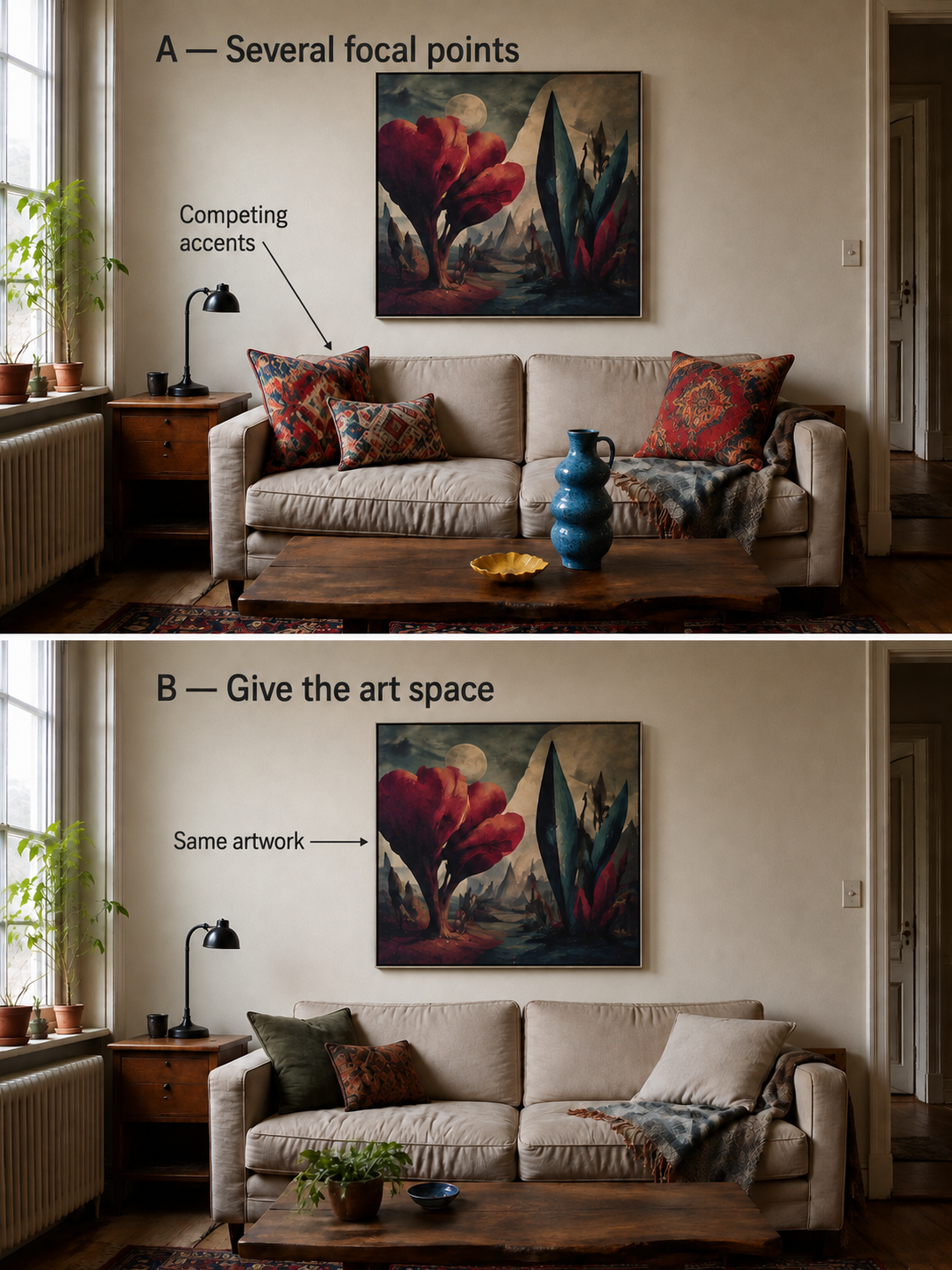
The completed styling choice is B: keep the sofa, keep the chosen art as the priority, and defer additional decorative purchases. You give up some decorative intensity. If you enjoy a deliberately layered room, A may suit you better; one priority purchase is a budget strategy, not a universal rule about taste.
The image illustrates a relationship, not an exact color, frame size or fixing method. For the separate task of choosing a real display position, use the apartment wall-decor placement guide.
Audition the idea before buying
This is a practical selection exercise, not a product test or a guarantee against regret.
Name the thing you would keep. Choose an existing object, or one candidate you can describe without naming its price. Write what appeals to you: the subject, a memory, an unusual shape or how it will be used.
Choose its actual place. Record the available dimensions and the item’s finished dimensions. For furniture, include depth, door movement, delivery access and the space you use around it. For wall art, include the frame, not just the image size.
Try less around it. Temporarily move small decorative objects that compete for attention. Do not remove useful furniture just to imitate a product photograph. If you already own the candidate, try a different position before shopping for a replacement.
Check the ordinary views. Look from the doorway and your usual seat, in daylight and with the evening lights you normally use. Ask whether the object still interests you and whether the room still works. A phone photo can help compare arrangements, but it cannot verify exact color or material finish.
Check the exit. Confirm the seller’s actual return conditions, return costs and any custom-order exclusions. If you cannot return it, resolve more uncertainty before ordering, rather than assuming you can reverse the decision later.
For anything mounted or wired, verify the exact installation requirements and who will carry out the work. In a rental, permission is a separate question from whether a fixing product can support an object. Do not improvise installation to make a shortlisted piece fit the plan.
Let the supporting pieces stay ordinary
Simply Home Decorating recommends personal meaning and restraint around a statement piece. That is helpful guidance, not a requirement to empty the room or discard your other belongings. Its statement-piece guide.
For a limited budget, “one priority purchase” is a spending strategy, not a law that a room may contain only one interesting thing. You can keep a patterned throw, family photographs and a favorite lamp. What you are avoiding is buying a second object solely to rescue the first.
If your chosen piece feels disconnected, first reconsider its position and the things immediately around it. If it still only works when you imagine replacing everything else, return to the shortlist. The object may be good and still be wrong for this room.
Make the decision in one sentence
Completed example: “Choose the $320 framed-art option because personal character is the missing need; test it on the wall above the existing sofa; keep $80 of the $400 cap. Confirm actual outer dimensions, mounting and return terms before paying.” If a necessary extra cost exceeds that remaining allowance, revise or pause the purchase.
Complete this sentence before checking out:
“I am choosing ___ because it adds ___, it fits in ___, and its complete cost is ___.”
You are ready to proceed when the reason is personal or practical, the location is usable, and the complete cost fits the money you have actually set aside. If any part remains vague, wait. If an object you already own passes those checks, you may be finished without buying anything.
Questions that often remain
Does a statement piece have to be large or colorful?
No. An unusual shape, texture, subject or personal association can give an object presence. Whether it stands out depends on its surroundings; size and bright color are options, not entry requirements.
Can inexpensive or secondhand furniture be the statement piece?
Yes. Its price does not determine its role. Check condition, usability and complete cost just as you would for a new item. A low purchase price stops being helpful if making it usable exceeds your budget.
Should I buy the statement piece first when furnishing an empty apartment?
It can inform later choices, but do not prioritize it over essentials you need immediately. If your space and routine are still uncertain, start with those needs and avoid committing to an object that depends on an untested layout.
What if my partner or housemate dislikes it?
For a shared room, agree on the intended place and spending limit before purchase. Show the exact candidate, not just a general style. If the disagreement remains, choose a private area or postpone the shared-room purchase.