Limited Edition Prints: Is an Artist’s Proof Worth More to You?
The number tells you where a print belongs in a stated edition. It does not, by itself, tell you how different the picture is—or whether an AP premium buys something you want.
A limited edition print belongs to a declared, capped edition. An artist’s proof, usually marked AP or A/P, may be an artist-reserved impression of the same completed image. The designation alone does not establish better printing, a changed composition or an early working version. Before paying more, read the edition terms and identify the difference the seller is offering.
For a first home, we would begin with the picture we want to live with. A smaller proof allocation might interest a collector, but it is a different attraction from a visible change in the work. Below, one hypothetical US buyer compares those attractions within a $500 total budget.
Read the fraction with the edition statement
A mark such as 12/100 identifies one impression in a numbered set of 100. It does not automatically include artist’s proofs, printer’s proofs or another size of the image. Artwork Archive’s guide compares 1/100 with 64/100 as theoretically equivalent impressions, rather than treating the lower number as an automatic quality or value advantage. We would also require separate documentation for a claim that a particular impression was pulled first; its number alone does not establish that history.
Consider a fictional publisher’s statement: “100 numbered impressions, 10 artist’s proofs and 5 printer’s proofs; completed image measuring 16 × 20 inches, on the specified cotton paper.” Those declared allocations add up to 115 completed impressions in that edition family: 100 + 10 + 5. They do not establish a worldwide count of every version of the image.
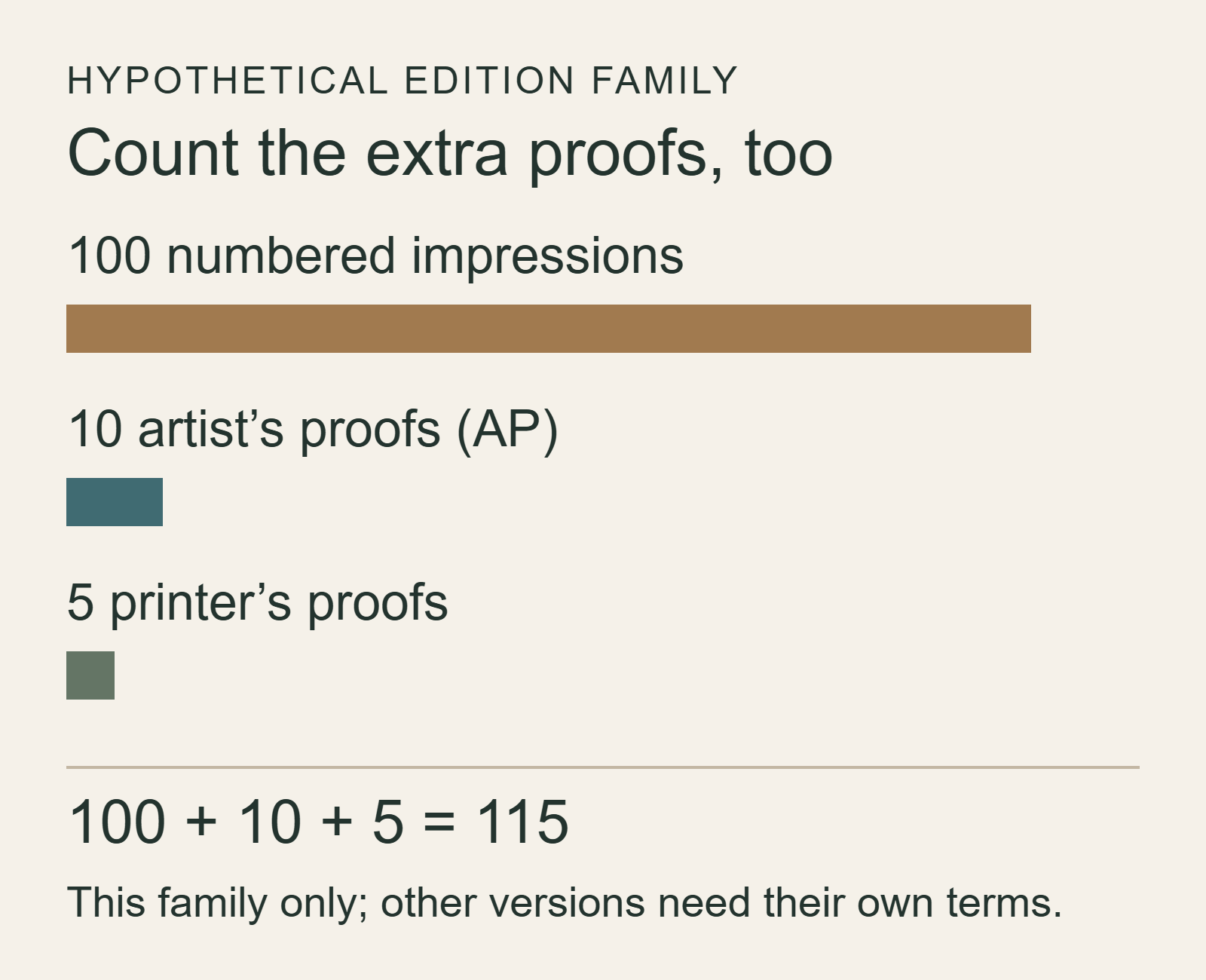
If another paper or size is offered, its terms need to be read too. Photographer Matt Payne’s discussion of edition practices examines this scope problem. We would ask what the cap applies to, rather than silently turn “100 in this version” into “only 100 copies of this picture exist.”
“Proof” can describe different things
Christie’s print guide distinguishes artist’s proofs from trial and other working proofs. An AP can be identical to the completed numbered edition. A trial or working proof may document a change in color, composition or the printing process. Those are specific differences to establish from the work and its record.
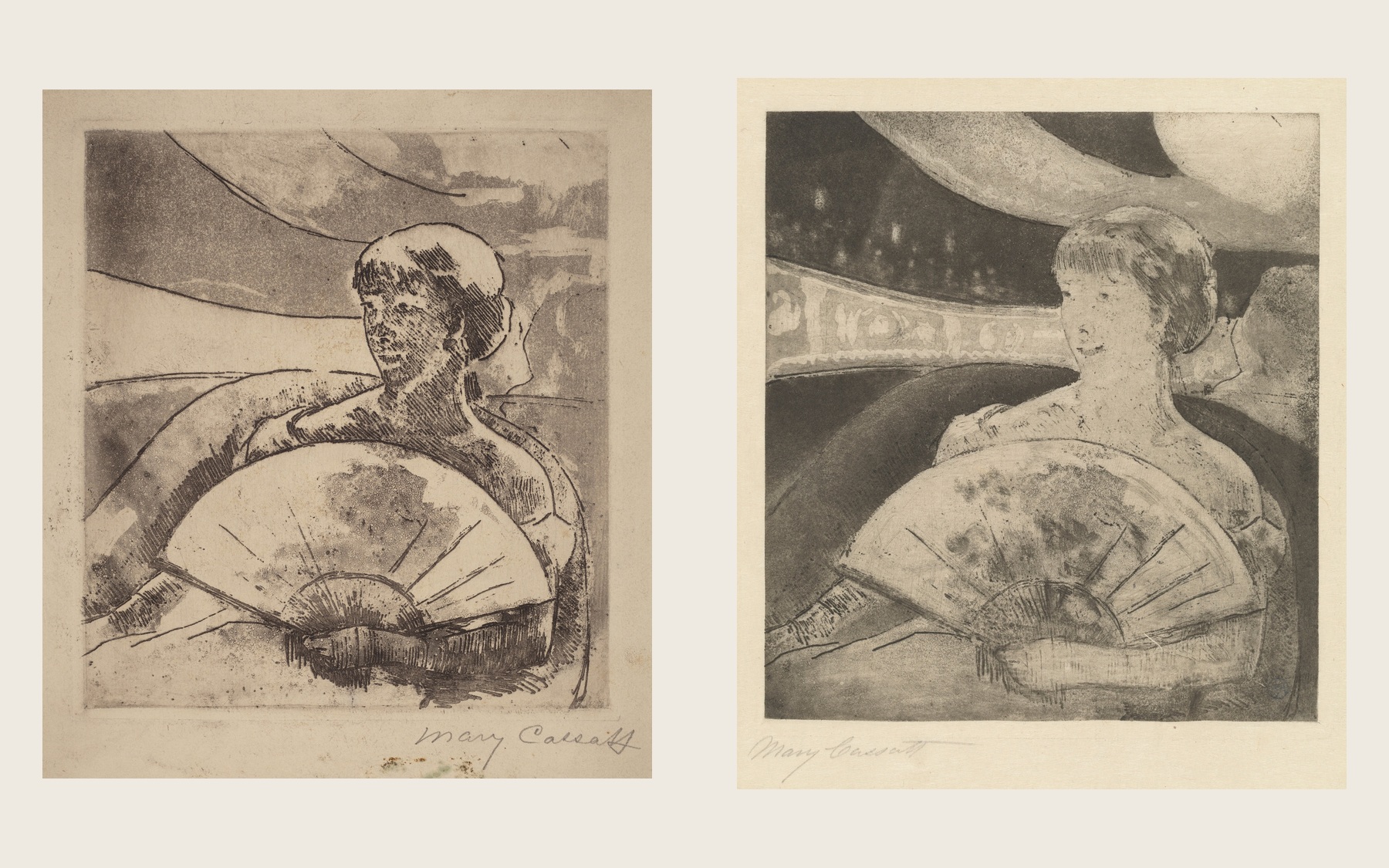
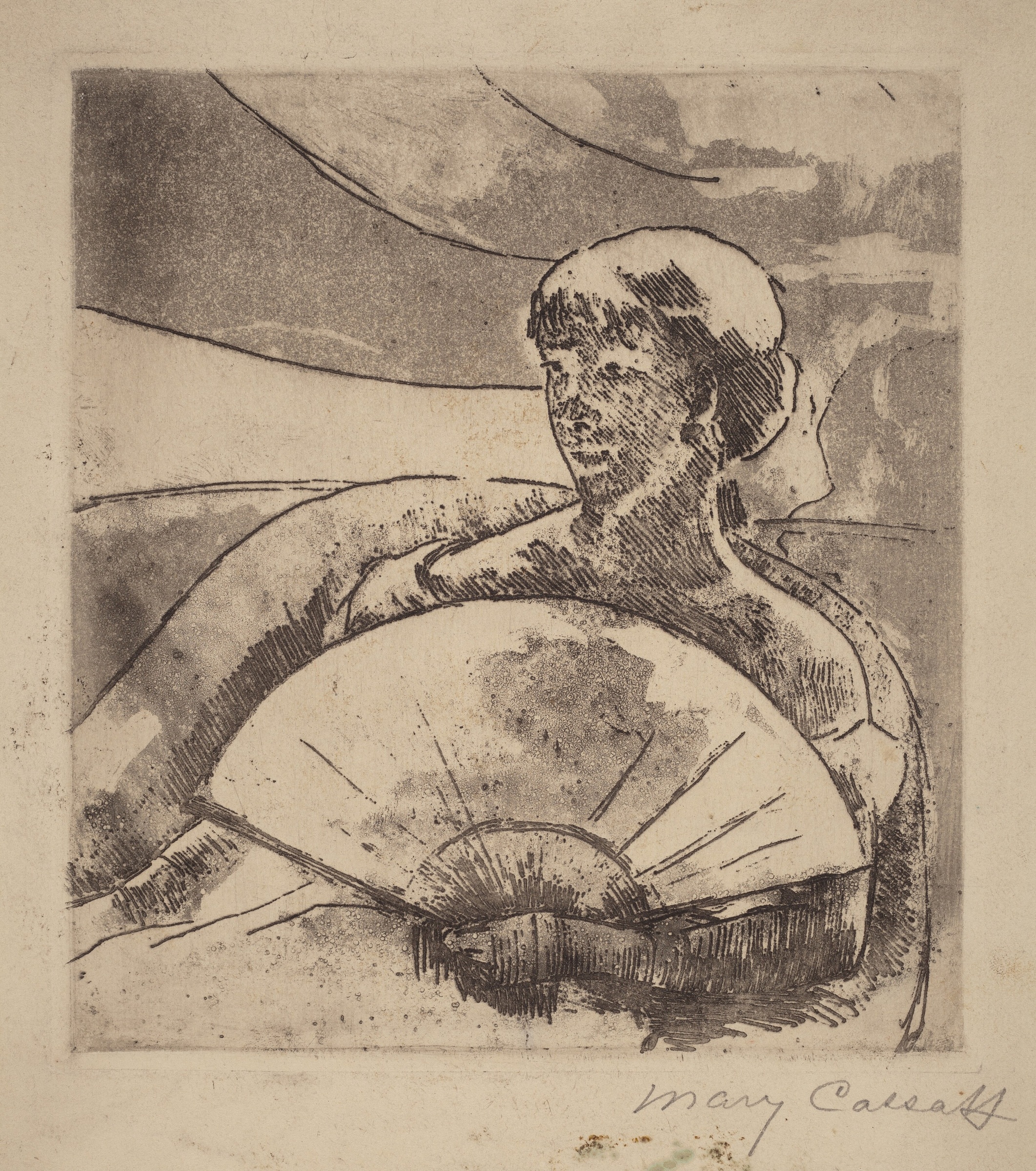
Mary Cassatt’s In the Opera Box (No. 3) makes a documented state change visible. In the second state below, dark marks cover much of the face and shoulder while the theater box is comparatively light.
In the fourth state, the face becomes lighter against a darker surrounding box. Compare the face first, then the bands behind it. The contrast relationship has changed.
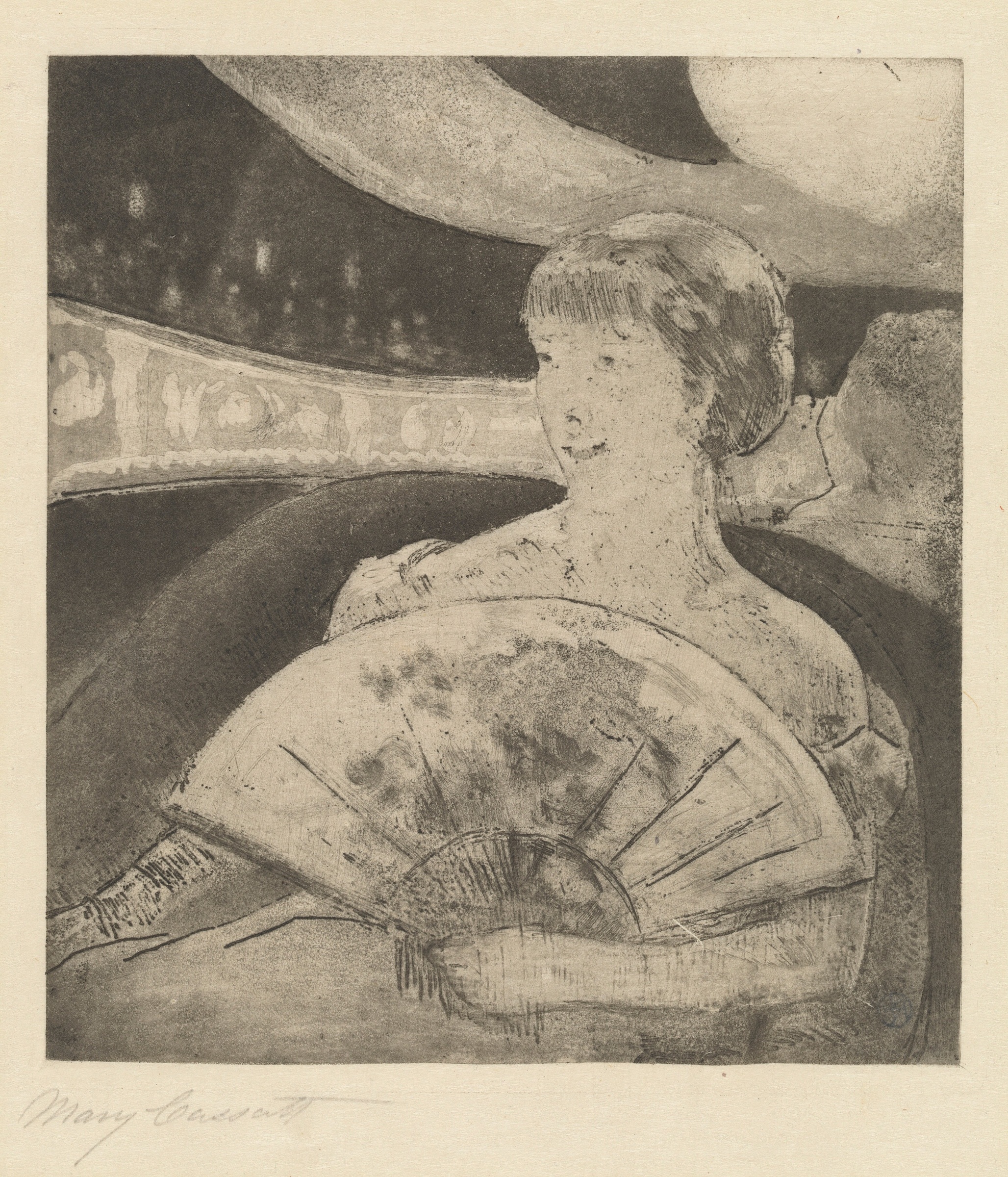
The NGA’s account of Cassatt’s printmaking describes this move from working proof toward the final print. The museum catalogues these impressions as ii/iv and iv/iv: the second and fourth of four states. Those are not copy numbers such as 2/4 and 4/4. The impressions are also on different papers.
This pair illustrates a changed printing state, not an ordinary numbered print beside an AP. We would not infer a comparable visible change from AP lettering on a contemporary listing. A buyer’s discussion asking whether edition numbers matter shows why the distinction is useful; the replies contain differing assertions, so the terminology here comes from institutional and specialist records.
A $500 choice: ordinary numbered print or AP?
Imagine a buyer furnishing a first condo. They want a particular completed image and have $500 altogether. Two hypothetical offers have the same 16 × 20-inch image, paper, printing process, signature and condition. The written terms declare the 100 numbered impressions, 10 APs and 5 printer’s proofs described above. The seller confirms that the AP has no hand additions or change to the image.
All amounts below are invented US-dollar inputs, not current seller quotations. The $40 tax reserve is a fixed scenario assumption, not a tax rate; an actual destination-specific quote must replace it before payment.
Compare the totals below. If the table is wider than your screen, scroll sideways to see both offers.
| Cost | Numbered print | AP |
|---|---|---|
| $260 | $340 | |
| Assumed frame | $140 | $140 |
| Assumed shipping | $25 | $25 |
| Assumed tax reserve | $40 | $40 |
| Total | $465 | $545 |
| Against $500 limit | $35 remaining | $45 over |
We would choose the numbered print at $465 for this buyer. The buyer gets the completed image they want, with the stated paper, signature and condition, within the assumed total. The extra $80 buys the AP allocation rather than a documented visual or material difference, and the $545 total exceeds the limit.
The tradeoff is giving up that artist-reserved designation. Someone who specifically values that connection could make a different preference judgment, but the designation alone would still not prove superior quality or future resale performance. A print does not become less meaningful to live with because another impression belongs to a smaller allocation.
If the real framing or tax quote pushes the ordinary offer above $500 too, this completed choice changes to no purchase at the present total. The reserve is not permission to ignore an actual charge.
What would make us reconsider?
Suppose a third, separate hypothetical offer appears at $290. Its record and close photographs establish an intentional hand-added red line, and the buyer prefers that alteration. Keeping the same $205 ancillary-cost assumptions gives $290 + $205 = $495. We would consider that version because the documented difference is wanted and the total fits.
This is now a different comparison: the image has an intentional addition, so it is no longer the identical-image AP offer above. An AP mark would not supply the evidence for that addition. The seller’s specific description and photographs would.
If the seller cannot explain the edition scope, proof allocation or supposed difference, we would pause either purchase. Ask: “For this exact size and paper, what numbered edition and additional proofs were issued, and does this AP differ from the completed numbered print?” Keep the answer attached to the offered impression. A vague scarcity claim cannot fill the missing record.
For the separate question of printing process and paper quality, see art print versus poster. For a certificate or invoice that does not match the offered object, our art-documentation guide explains what the paperwork can establish.
FAQ
Does 1/100 prove that it was the first print made?
The numerator identifies an impression within the numbered set. We would not treat that mark alone as proof of when this impression was pulled. Ask for separate documentation if a first-pulled claim is part of the offer.
Are artist’s proofs always better than numbered prints?
No. An AP can reproduce the same completed image on the same paper. Compare the actual condition, materials and documented differences. The designation identifies an allocation; it does not automatically establish better quality.
Does an edition of 100 mean only 100 copies of the image exist?
Only if the declared scope and other allocations establish that. Extra proofs and separate sizes or materials may sit outside the numbered set. In the fictional example, 100 numbered impressions plus 15 proofs means 115 completed impressions in that declared family.
Is an AP the same as a trial proof?
No. A trial or working proof can document the development of an image; an AP may belong to its completed form. Cassatt’s two states show a documented visual change, not an AP premium.
Can a limited edition be a reproduction of a painting?
Yes. “Limited edition” describes the declared edition, not by itself how the image was created. Ask separately whether the object is an original printmaking work or a reproduction, and what process and materials produced this impression.
Should I buy when the edition terms remain unclear?
We would wait for the terms of the exact offered impression. Unclear proof counts or version scope should not become an assumed scarcity claim. If the seller cannot resolve the question, leaving without buying is a complete decision.
Sources and image credits
Christie’s and Artwork Archive support the terminology; NGA supplies the Cassatt state records and printmaking account. The Cassatt images are designated public-domain reproductions, courtesy National Gallery of Art, Washington. Our offer comparison and preference decisions are hypothetical editorial examples, not transactions, investment forecasts or WhispArt limited-edition products.
Cover: Mary Cassatt, In the Opera Box (No. 3), two catalogue states. Public domain / CC0. Complete artwork image(s) proportionally fitted within a neutral matte. The responsive hero may show a detail; the full reproductions appear in the article.